
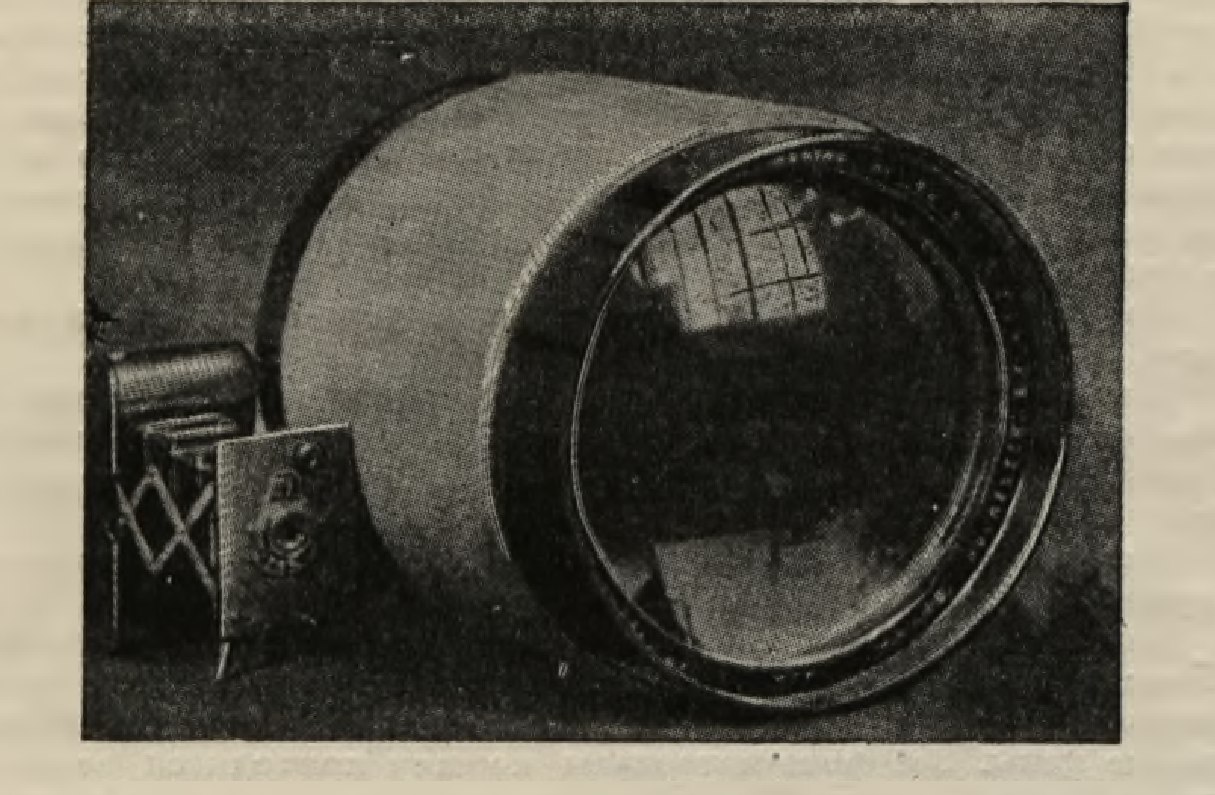
The biggest lens
It was built in America for military aerial photography from a great height. Of its size one may judge from the comparison with the roll-film camera of 4.5×6 cm standing beside it. This lens weighs 17 kilograms, its diameter is 23 centimetres, the focal length equals 90 centimetres.
Toward the merger of the German photo-industry
(From our Berlin correspondent.)
In No. 6 of Sovetskoe Foto we gave detailed data on the merger of a number of large photo-factories into the big new concern “Zeiss-Ikon” in Dresden. In addition to this we can report the following. The well-known firm “Agfa” at present supplies photographic material of every kind, since some time ago it took upon itself the making of the photographic papers of the firm Bayer (in Leverkusen) and the manufacture of the photographic cameras of the firm Ritschel in Munich. The photo-papers and cameras are issued also under the mark “Agfa.” It is interesting to note that such mergers of homogeneous factories are growing ever wider in German industry. In regard to the photographic industry one should mention one more merger, made by the firm “Mimosa,” which expands its activity from year to year and now belongs to the largest factories in the photographic industry. To the concern “Mimosa” already belong the firms: “Mimosa,” “N. P. G.,” “Trapp & Munch” and “Verax.” The joint-stock society “Mimosa” now issues, besides photo-papers, also films, plates and photo-chemicals; the papers of the marks “N. P. G.” and “Trapp & Munch” are well known in Russia. The firm “Verax” made plates in 12 various sorts, photo-chemicals of every kind, and the well-known “Verax” light-filters, glasses for dark photo-laboratories and supplementary lenses. The joint-stock capital of the firm “Mimosa” reaches 2 million German marks. “Agfa” belongs, as is known, to the commercial merger of the dye industry, whose general capital reaches 1 milliard German marks. — Z., Berlin.
The “Pravda” worker-correspondents and photo-reportage
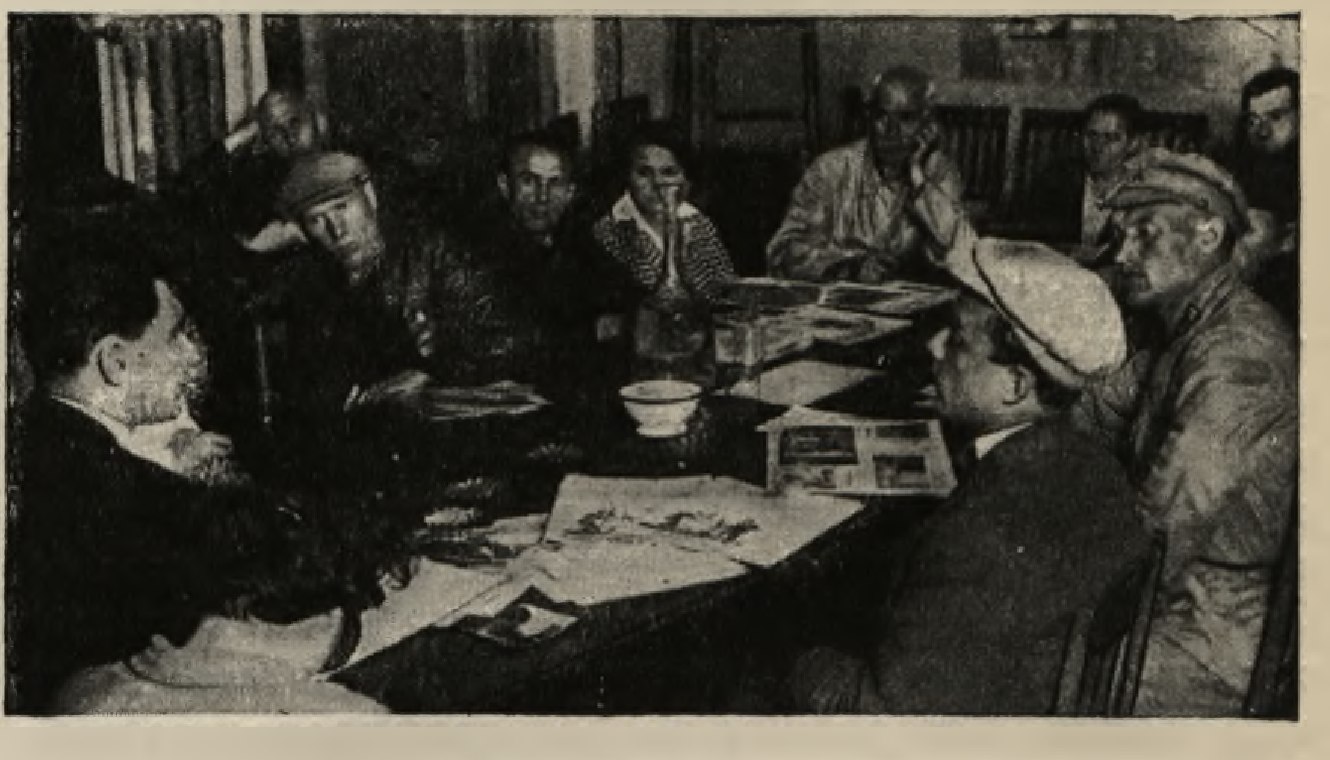
The thought of the need to teach worker-correspondents the work with a camera, of the value of arming the worker-correspondent with a “photo-eye,” penetrates ever more into the worker-correspondent ranks and takes concrete forms. The newspapers more and more often begin to place the shots of worker-correspondents. In the club of the Pravda worker-correspondents named after M. I. Ulyanova (Moscow) a photo-circle has begun to work, in which 18 of the most active worker-correspondents of the central newspaper Pravda enrolled. Before the circle is a great task: to give an example to the worker-correspondents of other newspapers, to create the basic nucleus of worker photo-correspondents. In the shot — the first report in the circle by the head of the editorial office of Ogonyok, comrade Ryabinin, on the theme: “Photo-reportage and the worker-correspondent movement.” — S. Fridlyand
400 shots without reloading!
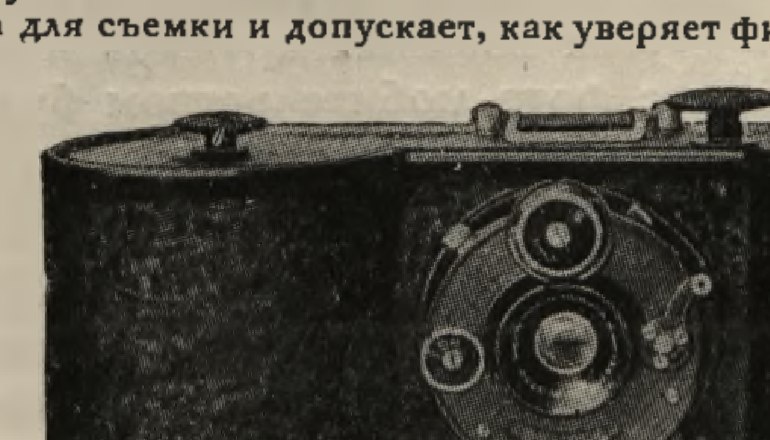
The factory Zeithab & Co. in Nürnberg (Germany) has beaten the record, issuing the photographic camera “Esco,” loading at once with 400 shots on ordinary cine-film. The camera is always ready for shooting and allows, as the firm assures, 150 shots an hour. The apparatus is issued in two models — a dearer and a cheaper. Model “A” is furnished with a Steinheil “Cassar” lens F/3.5 of 35 mm focal length, in a “Compur” shutter (speed up to 1/300 sec.), focusing set from 1/2 metre; model “A” costs in our money 65 roubles. Model “B” is simpler: a “Cassar” F/6.3 (focal length 35 mm), a shutter with speeds up to 1/100 sec., has no focusing, since all objects from 1 metre to infinity come out sharp; the price of model “B” is 37 roubles. A charge of film for 400 shots costs 1 r. 92 k. (half a kopeck a shot!).