
A. Ivanov-Terentyev’s grounded criticism of readers’ shots — the staged “King Lear” peasant, the posed old couple, and the quarter-century-stale “Sunset.”
Shoot, work on yourself, seek subjects, choose themes, give your interpretation, vary reality. Accumulate material for critical evaluation: all that is fresh, interesting, gifted will be marked with praise; all that is weak, dead, far-fetched will be condemned, but not unfoundedly, not without proof. From the whole mass of material sent for this aim there will be sifted, for reproduction and critical evaluation, the most typical in one or another respect and the most bright on the one hand, and the most negative on the other. In order to be able to choose examples well illustrating either the merits or the defects, for the greater clarity of the critical thought, material is needed, much material — the more the better. Therefore the editors address the photographers with the call to send their shots for review. Today only the third number of the journal with the named department appears; in these three numbers only two or three dozen shots are placed — and already general conclusions suggest themselves, the totals climb forward, and involuntarily one wishes to talk about the methods of the little-experienced photographer, his strivings and the breakdowns and disappointments inevitable in any matter. But about this another time, when more material has accumulated and when we can illustrate our positions with many examples from among the shots placed in this department.
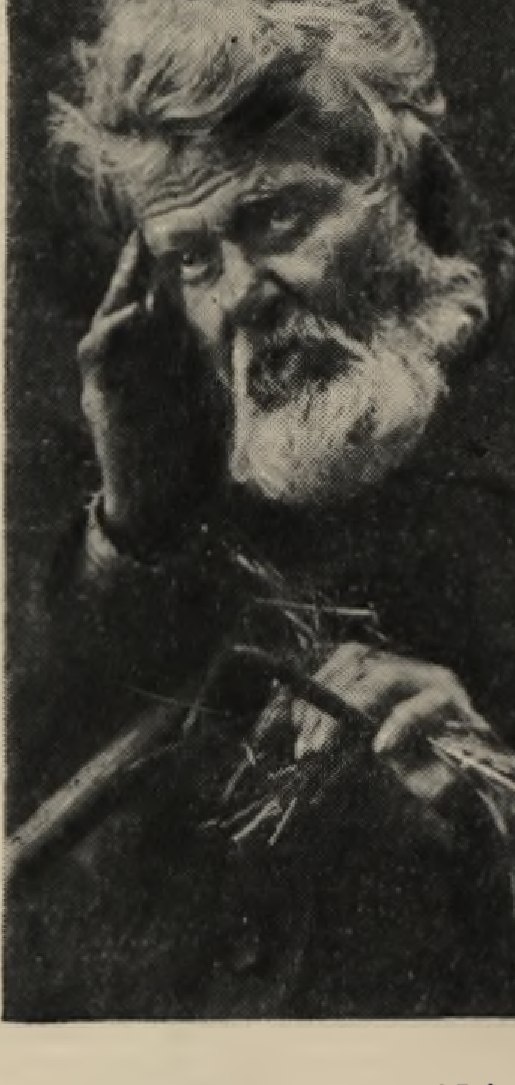
“Failed Again” (M. Kutsev, the village of Terpenье, Ekaterinoslav province). An example of how one can falsely present such a simple theme. The tragedy of the village, the tragedy of an agricultural country depending on atmospheric conditions, on the photographer’s shot turned into the play of a bad actor from a Shakespearean play (“King Lear”). How much lie there is in the pose, so unsuited to the artlessness of the peasant, as out of place as this bunch of straw sticking out in his hand. And at the same time the figure and the main face of the nature are very interesting for the photographer, but one must have very little artistic flair to think that this shot illustrates the set theme. One can only wish the author a more thoughtful and sensitive attitude to his subjects.
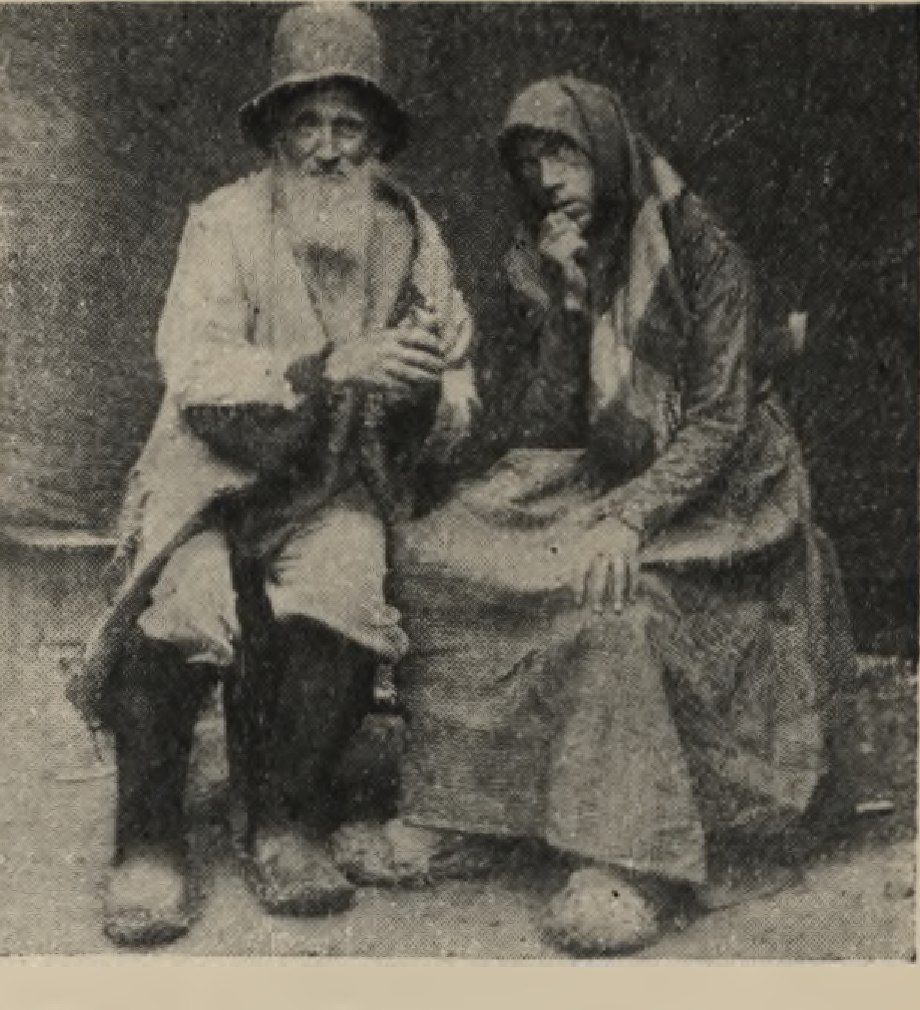
“At Leisure” (I. Zakharov, the village of Pizhanka, Vyatka province). The same reproach, and in no less degree, is deserved by the work of I. Zakharov, where the photographer seated an old peasant couple, made them both look forward and put their hands in a pre-conceived position. And indeed the peasants try with all their forces to please the photographer; only in their gaze, however, as in the whole composition, there is no “leisure,” but simply a bewilderment before the strangeness and unusualness of the position in which the pretentious author of the photograph placed them.
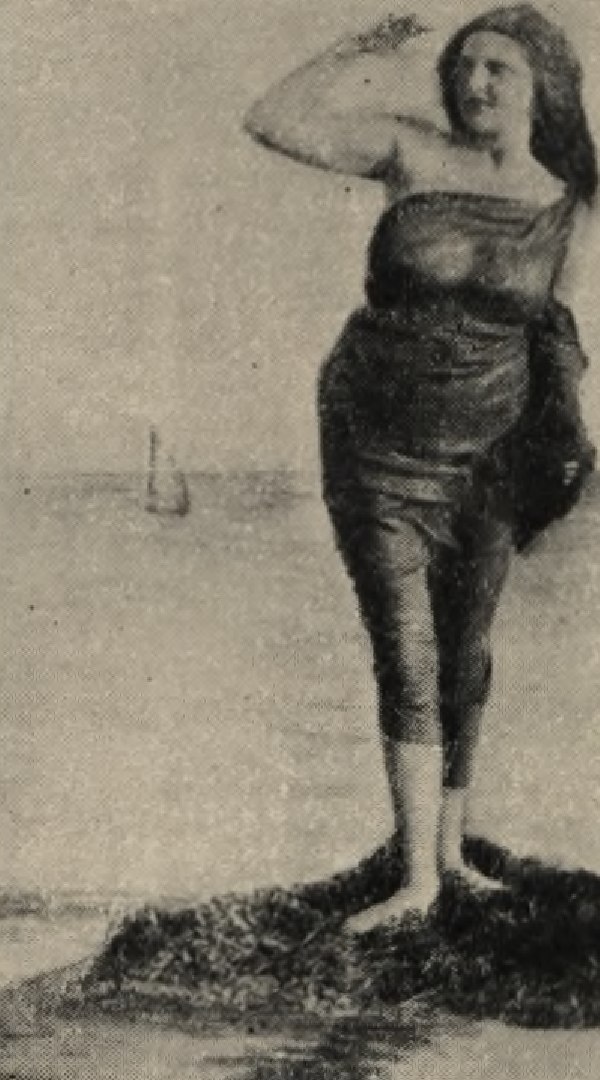
“Sunset” (I. Korbut, Yevpatoria). The shot is not only ultra-provincial but has lagged behind our epoch in style and interpretation by at least a quarter of a century. Such compositions could be consonant with an epoch only in those far times when nothing fresh appeared on the pages of the press and when all manner of countless “panoramas” and weeklies gratified the unpretentious tastes of the philistine. Here are all the elements: the sea, and the sailing boat, and a gull (drawn in!), and, chiefly, a woman wrapped in thin fabric — there is only one thing missing: art. And this strikes the eye the more in that the author, of course, more than all wanted to give a painterly-decorative picture.
“Preparing for Threshing.” Another work of the same author (Kutsev) also does not shine with merits, though, of course, it does not so irritate as the one marked above. A big group scene with a large number of figures, but in it there is no immediacy of an instantaneous shot of a mass subject; instead a deliberate grouping is outlined, made by the will of the photographer. At a look at the photograph, not knowing its name, one will for nothing determine what moment was fixed by the author. Besides, the shot is made in too small a scale for the given subject. Too much earth at the foreground and sky above.
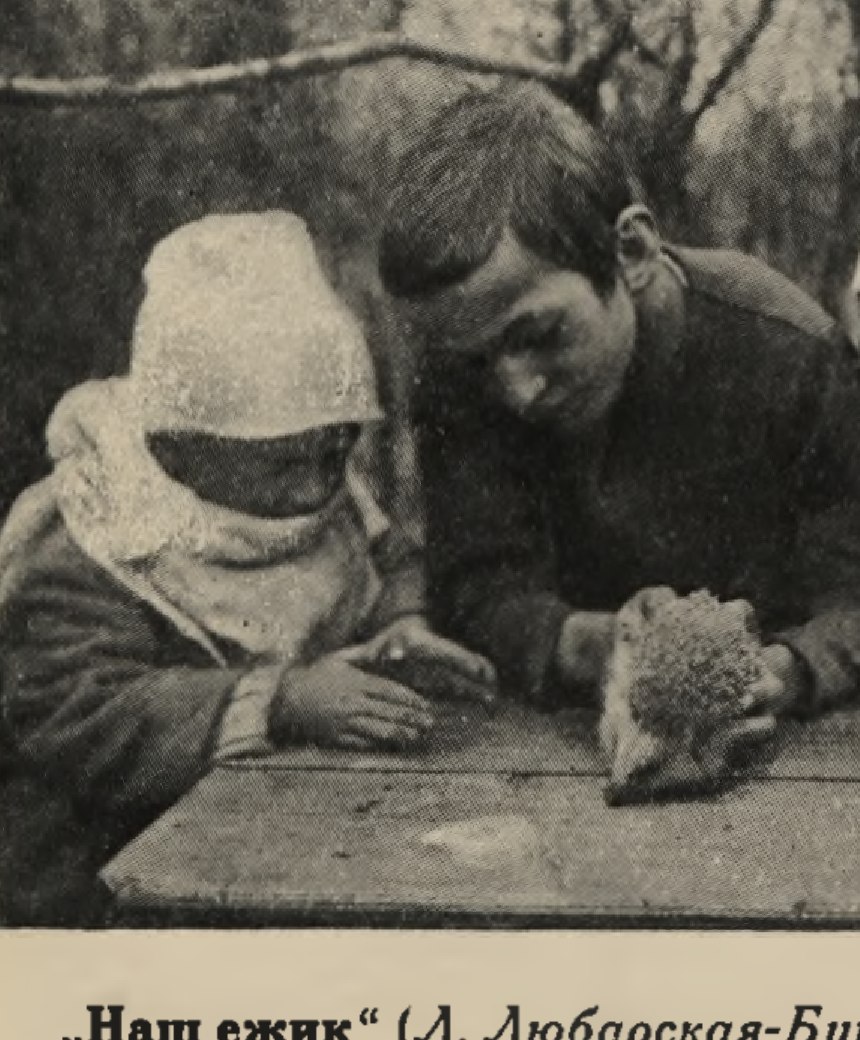
“Our Hedgehog” (L. Lyubarskaya-Butkevich, Moscow). A nice scene from children’s life. The kids are absorbed by their hedgehog and do not think that at this moment the camera is aimed at them; therefore here there is no pose, no artificiality, such as were marked in the works of Kutsev or Korbut.
“At Work.” A piece of daily life, the everydayness in the work of a cobbler-handicraftsman. Simply, artlessly is the nature taken. Here there are no complex tasks, no attempts at great art or mastery, but the shot bribes one by its truth and clarity.
— A. Ivanov-Terentyev
A warning. The editors warn the readers against ordering from the town of Dnepropetrovsk the “Gnom-Emsha-Patent” photo-camera advertised in the newspapers by a certain M. Sheyn, who sends out, for 5 roubles, a cardboard box worth, with all overhead expenses, no more than 75 kopecks; and also against buying the semi-literate booklets on photography of G. Brodersen.