
A. Ivanov-Terentyev and N. D. Petrov review readers’ shots — and note that the real, root trouble of the young amateurs is the lack of a general artistic foundation.
The material of the photo-youth, the works of beginners not yet fully mastering the art of photography, accumulates: from all the towns and the whole of our vast Soviet country shots are sent daily for review. One wants already, there is now the possibility, to make some generalisations, observations and conclusions, to say something in essence about the average level of the young workers of photography, about their hopes and achievements, about their breakdowns and disappointments. They work with ardour, with enthusiasm, with passion, with energy… And in this is the main significance, in this the surety of success! They work with the most varied, at times even home-made, apparatus, overcome — or at least try to overcome — all the technical difficulties, the lack of good photo-materials, they labour, combine, invent… and in the end, this way or that, cope with their designs. Often one can observe a lucky way out of a difficult position, happy discoveries and finds, but, of course, still more often there are met errors, misses, perplexities…
But the true, root trouble of the work of the young amateurs is the absence of a general-artistic foundation, the weakness of artistic flair, and from this — the inability to manage the subject, the theme, the nature, the inability to build the shot rationally. The young photographers have still seen little, learned little, observed little in the field of the wide world of art which contains light-painting too; they should visit the local museums, look at artistic editions, observe and live through creative moments, they should raise the level of their own general and artistic education, and then — only then — this defect will be overcome, outlived. The task is not a quick nor an easy one, as, for that matter, is any work on oneself — a stubborn and systematic one, but quite necessary for everyone who wishes to find a wide application for his work: not only of the photographer-artist, but of the photo-reporter too, modernity urgently demands an “artistic eye.”
B. Dikarev (Kharkov). “Nature morte.” On this work one may dwell with praise. The author splendidly managed to bring out the “material” of his dead nature — glass and cloth; the porcelain on the shot came out weaker, which is quite explained by the general softness of the tone. A pity only that the selection of objects is made insufficiently varied and their placing too ordinary and unpretentious.
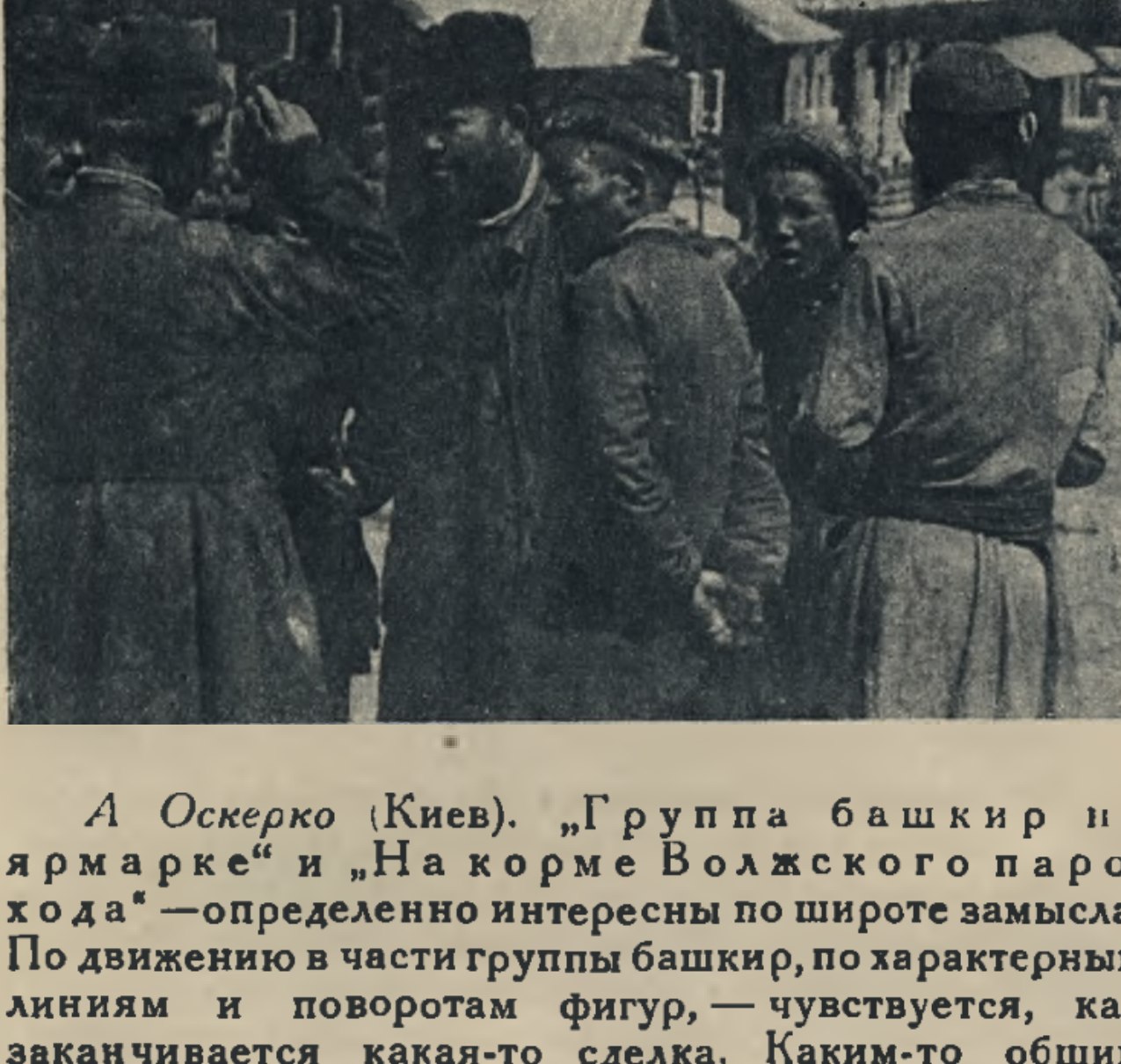
A. Oskerko (Kiev). “A Group of Bashkirs at the Fair” and “On the Stern of a Volga Steamer” — are definitely interesting by the breadth of design. By the movement in part of the group of Bashkirs, by the characteristic lines and turns of the figures, one feels how some bargain is being finished. By some common interest the figures of this group are welded. On the stern of the steamer, in the third class, sitting and half-lying under the rays of the bright sun, are placed men, women, children. An interesting and at the same time difficult theme. Unfortunately, these two shots, interesting in content, are technically weakly executed. “The Bashkirs” is a thin, well-worked-out negative, but the print from it (an enlargement) is flat. The second shot, “On the Stern,” is made in bright sun, and despite the exposure being approximately right, one should not in the development of the negative so “overload it with light.” As a result, the lights on the bromide paper did not print through and gave almost white paper.
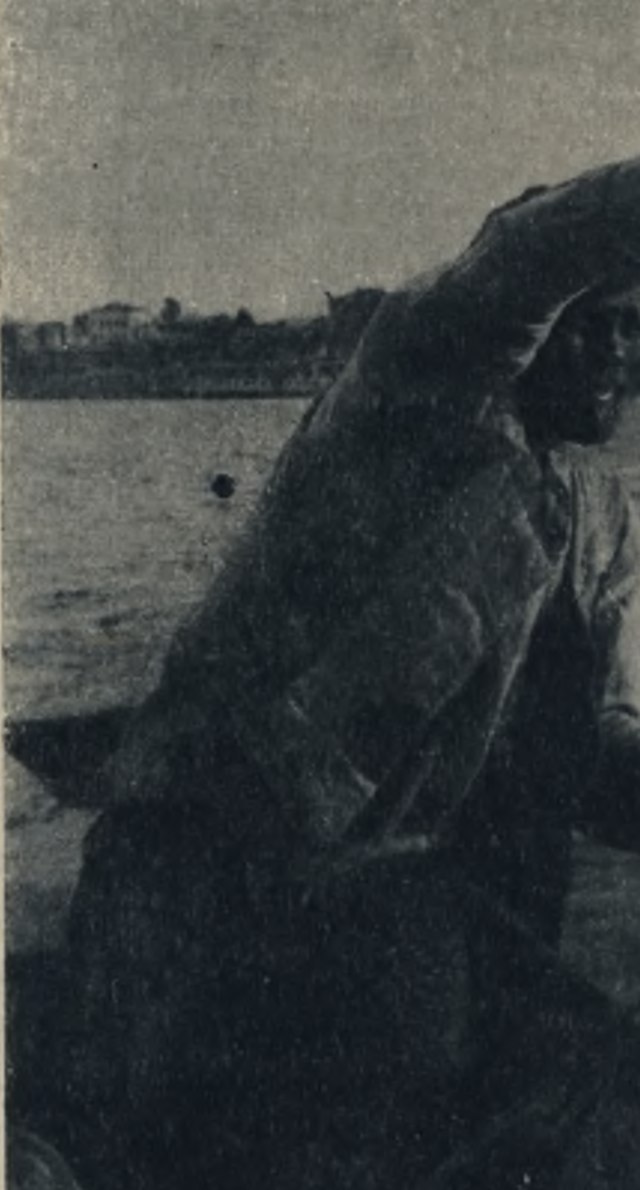
B. N. Genzelovich (Moscow). “The Helmsman” — an enlargement on bromide paper. Sometimes a certain excess softness of the copy does not harm the impression; perhaps it would not have been bad in this case too, if the defects of composition were smoothed by the softness of the printing. But here this is not so. The background is excessively strongly emphasised, it is as if sewn to the figure, and therefore there is no impression of the watery space and distance. The lines of the right arm and of the oar form a triangle, which finally spoils the impression. An interesting and difficult theme to resolve. It seems to us that all the same more of the impression would have remained if the figure in the boat had not been taken so large.
Yu. Zh—ii (Kherson). “An Automobile Catastrophe.” The shot is accompanied by the author’s commentary: “The consequences of a forty-degree overload, a Red-Army man killed,” by which the seriousness of the misfortune is emphasised. Meanwhile, every uninformed viewer, at a look at the photograph, will never think of a catastrophe, but will see on it only a roadside repair of an automobile, noting that almost all the participating persons are not busy with their direct matter of repair, but concentratedly look at the photographer’s apparatus, and the majority of them even smile. The task of the shot was purely reportage — to give the reflection of a tragic episode, but the result is quite unsatisfactory, both from the correspondent’s and from the artistic point of view.
The shot of E. N—й, “Valya,” graphically shows how sometimes, by cropping a part of an uninteresting or even absurd shot (the head, legs and back of the mother are cropped off), one can get a satisfactory little picture. The shot placed on page 345 of this number represents an enlargement of a part of the negative, the contact print from which is placed here. The enlarged part is outlined on the contact print with white lines.
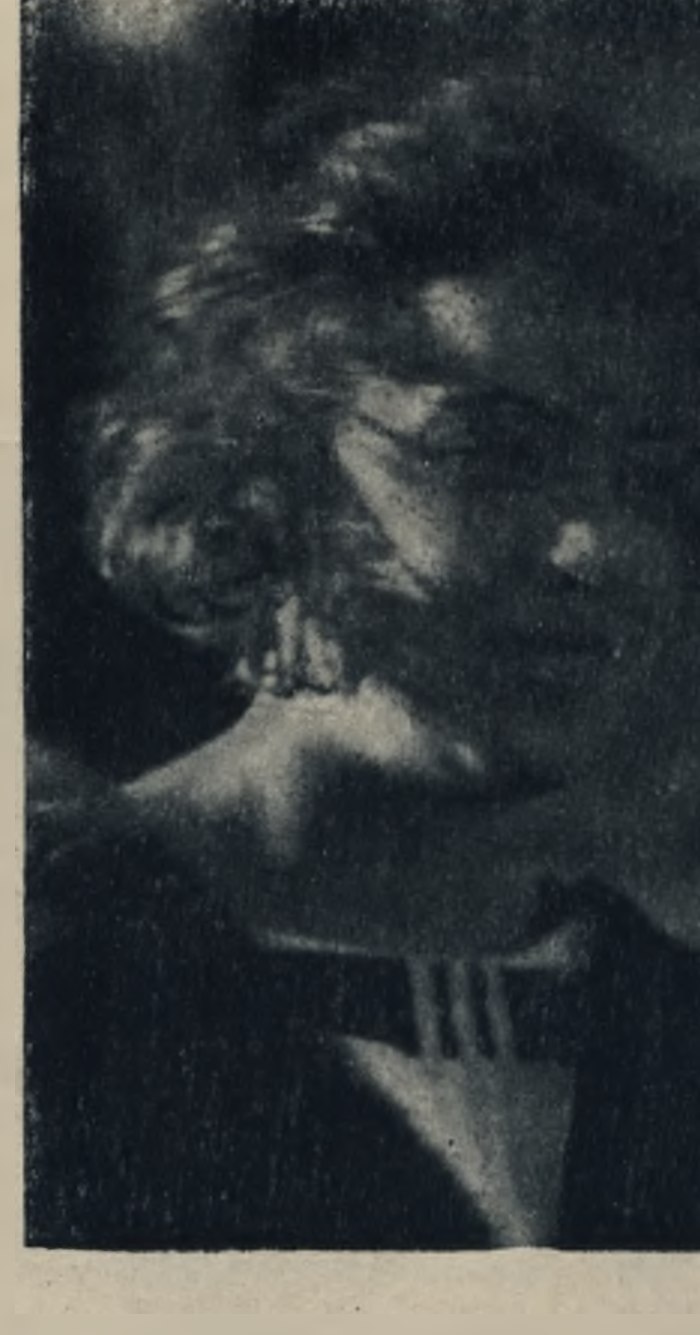
A. M. Oganov. By the author’s brief explanation, his shots are made with the help of a home-made camera and from paper negatives. We suppose that by a home-made camera is here meant something like that photo-apparatus with which the street photographers work, making a negative on bromide paper and then re-shooting it (a reproduction). If this is so, then the more astonishing are the achievements. Some shots are not only unlike the work of the street photographers, but in technique surpass even the works of more experienced amateurs. The author feels the play of light and shade and, with rare exceptions, splendidly uses it. The working-out of the snow cover in the winter shots one may envy. His portraits, lit contrastily, are in the conveyance on bromide paper full of a peculiar softness. If one takes into account the remoteness from the centre, the absence of photo-materials in the localities, then the achievements of the author may be counted an excellent model of self-activity.
— A. Ivanov-Terentyev and N. D. Petrov