
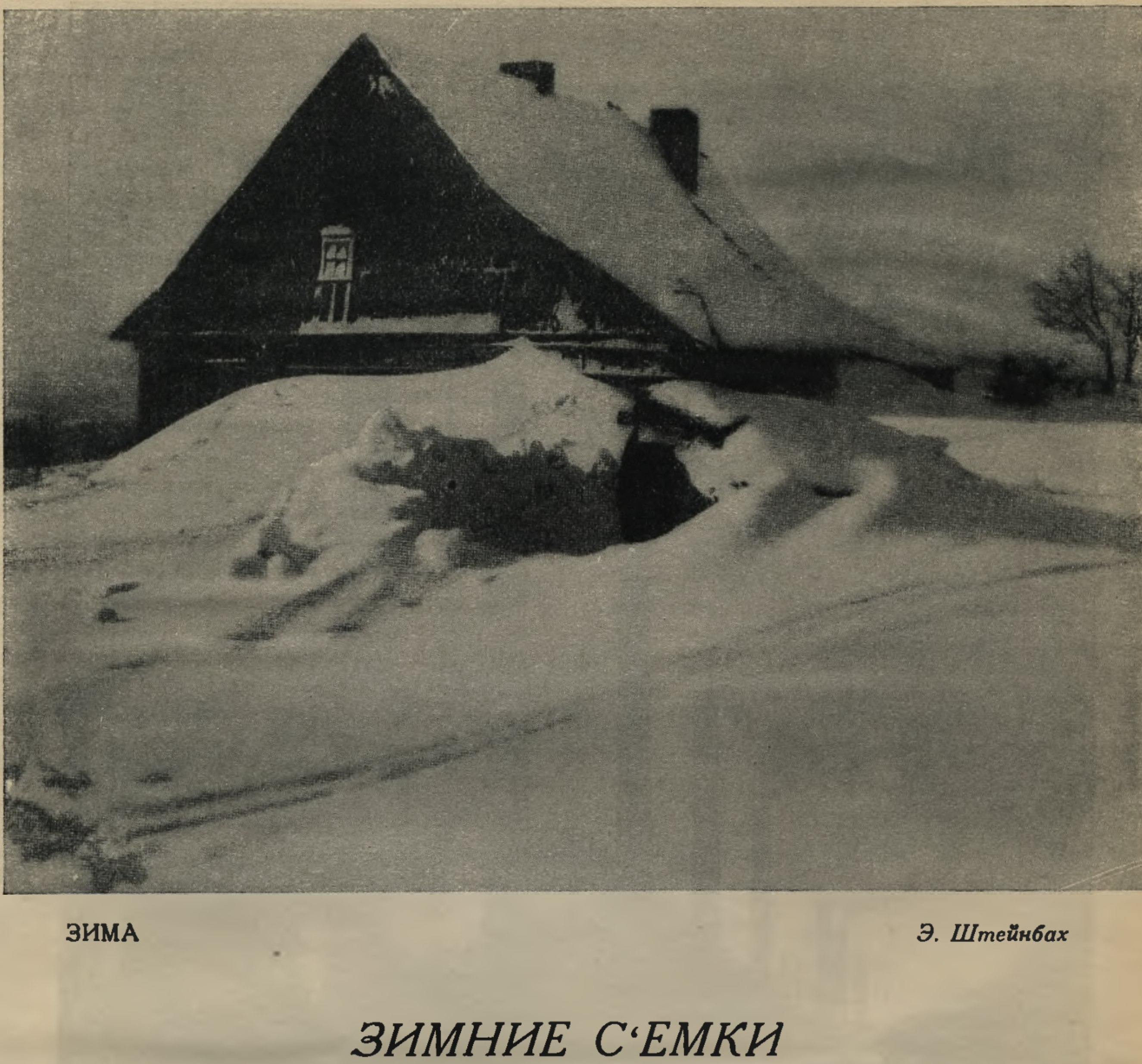
“Ov.” on winter shooting in the open air — an essay that touches also the very essence of winter nature, which so attracts the photo-amateur.
Among a certain part of the photo-amateurs there is developed the opinion that only the summer period is the best for shooting in the open air. With this opinion one cannot agree. True, winter creates for the photographer some inconveniences, bound up with the cold, sometimes with a strong frost — but that is all. For the rest, these four or five months in the year are an enormous practical school for the beginning photographer and a powerful source of getting peculiar effects for the more experienced comrades. Of the peculiarities of winter shooting it has been said more than once on the pages of “Sovetskoe Foto”; besides, the models of typical winter landscapes given by the journal can serve as a proof of the presence of artistic riches in winter nature.
As is known, the snow cover of winter simplifies the landscape. In what, then, in comparison with summer, consists in this case the simplification? In the one-colouredness of winter nature, in the destruction of the colours of the summer period? Not quite so. If one looks attentively at the snow cover, it is not hard to see that here too there is colouring. On a winter day, when the sun shines brightly, it is especially noticeable that the colour of the snow is in essence blue, with these or those very fine nuances. Making the observation more detailed, at various times of day in sunny and in overcast weather, we can note that the colouring of the snow has a considerably long scale of tones. Thus, if the snow is white, then the image of it on a photographic shot everywhere by the tone of white paper would, first of all, not correspond to the essence of winter nature. If one compares two identical views of nature, examined from one and the same point of view, only one in a summer and the other in a winter garb, one can note in what the change of the character of the landscape happened. First of all, under the snow cover all the little details are hidden; the whole relief of the terrain changed in the direction of a levelling, or even a simplification; the landscape as it were became wider. Instead of this, the modulation of light and shade on the snow became its basic content, and the contrasts of the masses (snow, trees, houses and so on) became more underlined. Thus, not in an absolute destruction of the colours consists the simplicity of the winter landscape, but only in the bringing-out and underlining of the basic traits of its character. To convey by photography this peculiarity of winter, to tie it with the filling of the plane of the shot with these or those masses, to tie it expressively — makes up for the photo-amateur a task not so much hard as interesting in content.
What and how to shoot
Winter, with its short days, cannot stop the work of the photo-amateur in the open air. Persistent and observant, he must find both the time and the subjects, for which sometimes one need not even go far. Why, for example, not shoot the district or a corner of the yard of your works, factory or enterprise? It is possible that, if not in itself, then in juxtaposition with a summer shot of this same subject, it will bear not only a personal but a productional or even a public interest. There is decidedly no necessity to seek the so-called “pretty views”: the aimless search for them will not teach you how to shoot, but only take from your occupations their socially-useful character. In respect of experiments and the study of winter shooting, even the street where you live, or rather a piece of the street, should give not a few subjects for photography. He who loves sport, who over the summer more than once shot it in all its kinds, should be stopped neither by the cold nor by the frost in the striving to fix winter sport: skiing, skating and so on. For those comrades who strive somehow to tie the occupation of photography with science — i.e. to study with the help of the camera the characteristic phenomena of nature, or to create material for such a study — for them, as photographers, the winter months will give an enormous satisfaction. Who, for example, of the number of amateurs has shot the processes and forms of the formation of snow-drifts, drifts and snow dunes? Will not the work of fixing these phenomena, being organised more or less methodically, give into the hands of the researcher a great material? Such a work, carried out over the winter, can have even a purely practical significance, as, for example, in the struggle with snow-drifts on the railways. In the same way the subjects of observation and shooting can be the other phenomena of the winter period. The processes of the deposition of moisture on cold surfaces: hoarfrost1 as a crystalline deposit, and ice-crust as a continuous formation of ice. If these phenomena be studied with the help of photography, then in spring one can note the whole degree of their destructiveness for plants. In a word, if one shoots anything of the enumerated in a technically-literate and methodical way, then a collection of such shots will deserve wide attention.
Finally, for those amateurs who are interested in photography as a method of expressing their artistic designs, the winter landscape as such can give a happy possibility of creating simple and expressive pictures. The artistic illustrations of this number once more warn the photo-amateur against his striving to seize on the shot, if not all that the eye sees, then “as much as possible.” If this is impossible in general, then the more should one not strive toward this in the winter landscape, since the monotony of a big snow space can rouse in the viewer nothing but boredom; in the same way the scatteredness of the planes and details on the shot cannot fix his attention. Another time, with this or that lighting, two or three roofs (only roofs!), covered with snowdrifts, one or two high chimneys and… nothing more! Of these elements it is sometimes quite enough for the building of what is called an artistic shot. The whole matter is in how to arrange these elements on the plane of the shot, what lighting to take (the time of day, the state of the weather) and how to process it technically. Just in winter, and not only in summer, such simplified compositions are possible, and, remembering what was said above, it is easy to understand that this simplicity is compensated by the impression of the contrasts of the masses, the bringing-out of the drawing and the light-and-shade of the snow cover. We by no means wish to say that the photo-amateur should avoid shooting fields and forests in a snowy garb or in a receding distance. Here it was wished once more to underline the notion that just in the winter shot there should somehow especially be brought out and underlined the basic thought of the photographer. Let us pass now to the description of the special equipment of the photo-amateur for winter shooting.
The photographic apparatus
If there is a clapp-camera on struts, or a folding apparatus of the universal type of the size 6×9 or 9×12 cm, then this is, perhaps, the best for winter shooting in the open air too. The small size of the shot has no significance, since the true amateur, if he has not yet built himself an enlarging lantern, should build one. With it one may even not make contact prints at all, but use the enlarger directly at printing on bromide paper. A wooden folding or metal (for hand cameras) tripod should always be at the photographer’s side. Some amateurs prefer, in all conditions of shooting, a ground glass to the finder, which for beginners really eases the arrangement of the image and the filling of the frame of the picture. In this respect reflex cameras too are convenient.
The lens
No one will dispute the fact that light-powerful optics are in this case too more desirable. If at sporting shooting a light-powerful lens is necessary, then in all the other cases one may quite content oneself with a light-power of F/6.8 and even F/8. As for the construction of the lens, the anastigmat should be given preference chiefly at sporting and reportage shooting. In the other cases, in particular at landscape photography, not only the aplanat widespread among photo-amateurs, but even a simple achromatic lens2 will give an image more plastic than a dear-costing anastigmat. In focusing one should not be carried away by too small a diaphragm: this aimlessly lengthens the exposure and gives the image an unpleasant dryness. One should especially avoid this with anastigmats, since the majority of these instruments cover the plate to the edges sharply even at full aperture. At wooden cameras the lens is rarely mounted in a shutter; in this case a separate blind shutter of the Thornton-Pickard type, put on the mount of the lens, is needed.
Negative material and light-filter
When the talk is of the correct conveyance of nature on the photographic print, then the use of simple, non-orthochromatic plates is to a known degree a nonsense. The amateur has no need to orthochromatise the plates himself — the Soviet factories of photo-plates now put out such negative material of more or less satisfactory quality. The sensitivity of these plates to blue rays should be counted about 78° by Wynne. The yellow light-filter, which is likewise necessary at shooting on orthochromatic plates, can be placed in front of or behind the lens. As for the intensity of the colouring of the light-filter, it would be more advantageous to apply the so-called “moment filter,” i.e. a very transparent, light-yellow one; such a filter passes all the red and green rays, holding back almost all the blue. The exposure with this filter is almost not increased. Unfortunately, the orthochromatic plates of our production, not having a sufficient sensitivity to green rays, will not give with this filter the proper effect, and the conveyance of the blue colour will not correspond to nature. In this respect the “correct filter,” i.e. a saturated-yellow one,3 able still more to paralyse the sensitivity of the plate to blue rays, will better convey the modulation of the tender-blue shadows of the snow cover. At the use of such a light-filter the exposure is increased 3–4 times.
Exposure and development
The time of exposure is better determined by a photometer or by the tables given by our journal too. One must confess that at the majority of photo-amateurs making winter shots in the open air, over-exposure makes up 75% of their exposures. True, over-exposure is better than under-exposure, but only to a known degree. In view of the considerable actinicity of the snow cover, the exposure should be instantaneous; for example, in December at 3 o’clock in the afternoon, at the diaphragm F/12.5, on orthochromatic plates with a fourfold light-filter, an open landscape with a foreground requires an exposure of 1/5 second. The same landscape, in February at 11 o’clock in the morning, with the “Tessar” of Zeiss diaphragmed to F/6.8, on a plate of ordinary sensitivity (without a light-filter), requires an exposure of 1/100 second. In the same way a great significance is played in this case by the method of developing the plate. First of all, one should not allow the lights (the snow) to be over-developed. The general intensity (density) of the negative should be such that only in the very highest lights, as an exception, it should give on the print the tone of white paper. The negative should be detailed and harmoniously transparent. The writer of these lines inclines to the slowed method of developing winter negatives. In this respect the glycin developer of normal concentration is good too, for which one should, having taken a known quantity of Hübl’s glycin gruel, dilute it correspondingly with water. Especially good for winter shots is the pyrogallol developer:
| Pyrogallol developer | |
|---|---|
| Water | 150 cu. cm |
| Pyrogallic acid | 1 g (a poison!) |
| Crystalline soda | 7 g |
| Crystalline sulphite | 7 g |
| 10% potassium bromide solution | 3 drops |
At a normal exposure, in this bath in 2 minutes the whole image should come out. After this the plate is taken out of the bath, the developer is diluted with a half quantity of water, and the plate is again let develop a further 3 minutes, for the evening-out of the contrasts and the getting of details. The fixing bath should be acid: I — water 420 cu. cm, hyposulphite 120 g; II — water 60 cu. cm, citric acid 2 g. Both these solutions are mixed and filtered; the fixer keeps a comparatively long time. It is very possible that comrades who have not before occupied themselves with winter shooting in the open air will suffer at first a whole number of failures; these failures should not stop the amateur from the further working-through and study of his errors. In the end you will unconditionally achieve quite satisfactory results.
— Ov.
1 See the shot “Hoarfrost” — “Sovetskoe Foto” No. 12, 1927, p. 392. 2 Two cemented optical glasses: a double-convex and a double-concave. 3 A tartrazine light-filter.