
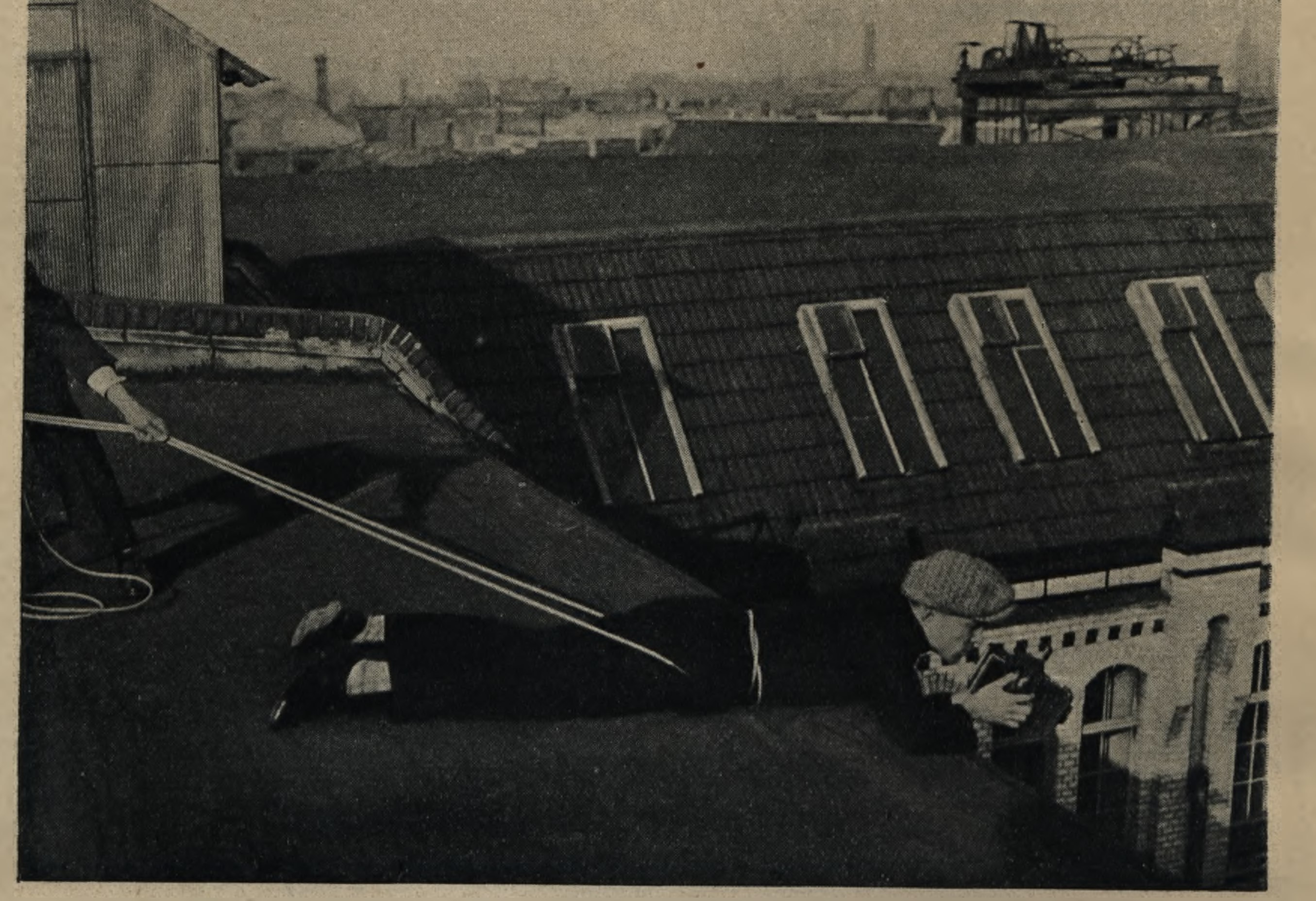
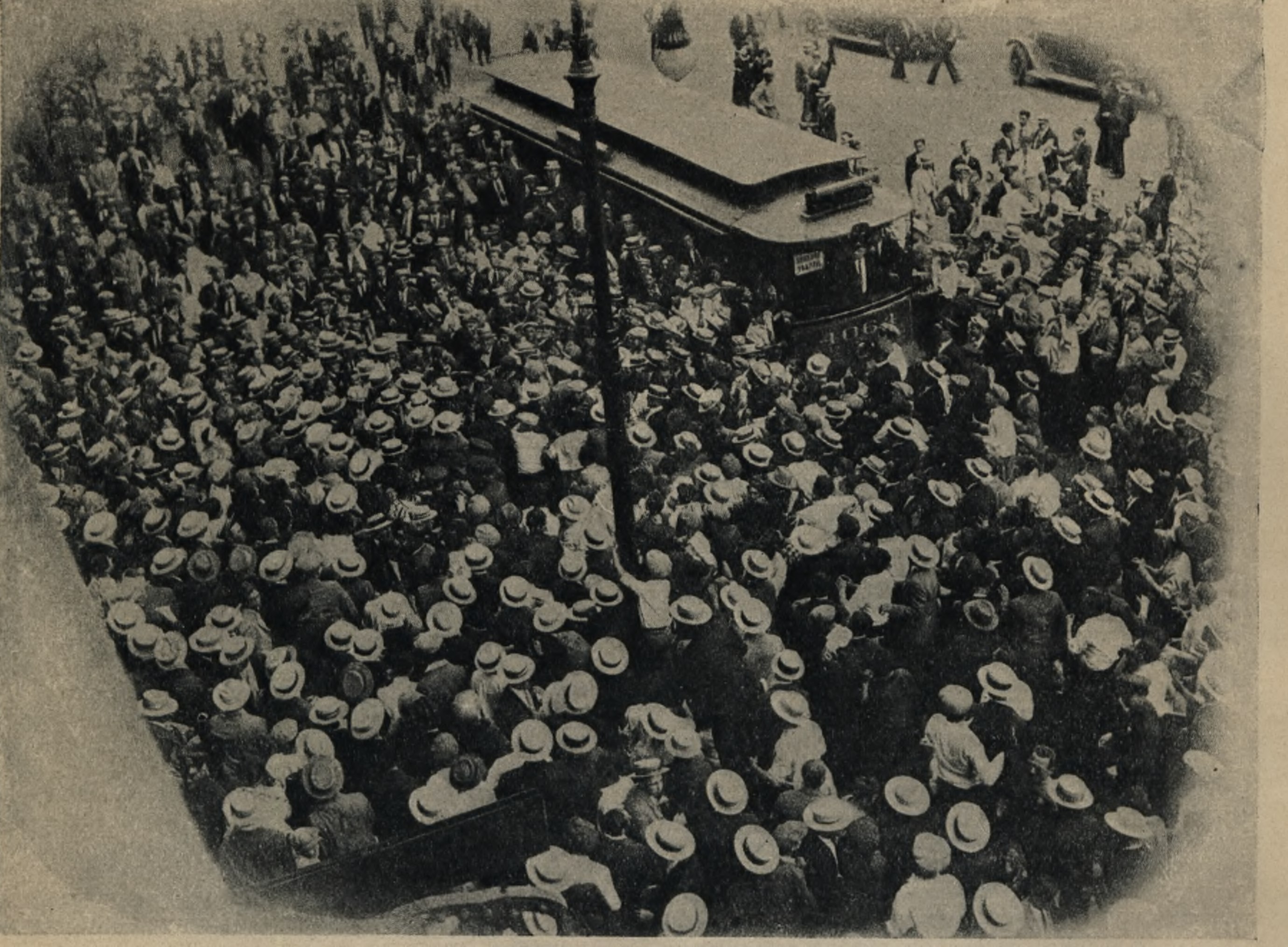
The editors open a permanent department for the amateur who wants to work for the illustrated press. First: what illustrational photography is, and who can photograph for the press.
(From the editors: The number of illustrated editions keeps growing. Not to speak of the central weekly journals — many provincial papers strive systematically to give photo-illustrations. The need for shots is significant. Professional photo-reportage, however well organised it be, cannot reflect all of modern many-sided life. It is necessary to draw the photo-amateur into the illustrated press. From this win both the press, needing an inflow of fresh material, and the photo-amateurs, seeking an application of their forces. No less important is the participation of photo-amateurs in the wall-newspapers. Counting the serving by photo-amateurs of the printed and wall press a task of first importance, “Sovetskoe Foto” from the present number introduces a permanent department, “Photographing for Journals and Papers,” intended for the photo-amateurs wishing to begin work in this field.)
Illustrational photography
The history of the periodic press has never yet seen so significant and firm a demand for photographic illustration as is observed in the last years. Photographic illustration was born two decades ago. In this time it has advanced, from the role of a service material auxiliary to the text, to a quite independent and honourable place in the periodic edition. The illustrated journals tried to get by with draughtsmen, but soon the whole inexpediency of this became clear: in every drawing there are elements of the personal creation of the artist, of his imagination, his fantasy. In photography there is nothing of the kind — the photo-shot is reality caught by a machine, and therefore photography of events and of life has an indisputable superiority over the drawing. A good photograph says more than a drawing or a long description; it is able to give more than the pen of the most talented journalist. Not for nothing did the English paper “Daily Mail,” during the war, pay a fabulous sum for a photograph of the moment of the perishing of the German dreadnought “Blücher.” All descriptions paled before this shot, which fixed the overturned-on-its-side and sinking hulk of the battleship, surrounded by hundreds of people swimming among the waves and trying to save themselves. “One picture is worth a thousand words” — this old Chinese proverb can often be applied to modern photo-illustration.
The informational and propagandist significance of photographic illustration was appreciated not at once. Up to the imperialist war, illustrations served chiefly empty, worthless subjects: aristocratic weddings, a two-headed calf, “the most beautiful woman,” “the fattest man,” a monkey smoking cigarettes. The war stirred up the masses, colossally raised the circulations of papers and journals, awakened new interests. A photograph of a turtle able to ride a bicycle ceased to satisfy the readers. There was needed an illustration telling of an event, of life. So developed and strengthened photo-reportage. The photo-reporter had to keep in step and keep up with his colleague — the ordinary reporter and correspondent — had to assimilate his tempo and devices of work. The photo-reporter succeeded in this fully — illustration began to depict all the events of the life of the whole world. Now in England three daily illustrated papers come out, with a daily circulation of over a million copies each: the “Daily Sketch,” the “Daily Graphic,” the “Daily Mirror.” In them photographic illustrations daily occupy three-quarters of the whole number; to the text is allotted a service, explanatory role. A multitude of photographs are reproduced with unchanging regularity daily in these three papers, which graphically testifies to the significance and growth of photo-reportage. True, they as before abound with trashy little shots of the kind of dogs in spectacles and prize-winning ostriches, but alongside this there has firmly strengthened in them a genuine systematic photo-reportage of internal and foreign events. In the Soviet press — the press of the wide toiling masses — to photo-illustration by right belongs an honourable place, a significant present and a still bigger future. The illustrated paper and journal can gradually accustom to reading the backward woman, the little-literate population of the city and especially of the village, and be for them a transitional step to the ordinary paper.
What requirements should a journal illustration satisfy? We shall not speak for the time being of its being technically good — let us stop on its internal qualities. A photo-illustration should not only protocol, and not only show purely mechanically: it should speak, tell of an event. It should easily reach the viewer’s consciousness, be understandable to the readers of the papers without an explanatory caption, by one only brief heading. A boring, insipid shot is not needed by the reader. A photograph should be substantial, should have mood and convey it to the viewer, should interest. A photograph should be dynamic — convey movement and, if possible, give the subject and the participating persons in action. A photograph should be topical. A shot illustrating an old event is good in most cases only for the editorial basket. Not to speak of the papers — even in the weekly journals the suitability of a shot is sometimes reckoned by hours, especially before the cessation of the delivery of material into the number of the journal: in a day it loses its value, since it cannot get into the current number, and for the next it is not suitable, because by that time the event becomes outdated and other journals, having more punctual photographers, have already placed it. “Catch the moment” — that is, if you like, a fitting motto for the photo-reporter, who should hurry not only to the shooting but to the laboratory, and from there with the ready print — to the editorial office.
To give a good photo-illustration is not so simple. Photo-reportage requires qualification, and a fairly high one. Not every old professional-photographer, who has spent his whole life in the atelier and the laboratory, can at once become a photo-journalist. Both the beginning amateur with an unpretentious twenty-rouble apparatus and the experienced photographer with a complex three-hundred-rouble reflex camera, both can give shots interesting for the readers and suitable for placing in a journal. But if they wish seriously to occupy themselves with work for the journals, and are not experienced photo-journalists with a big length of service — and of such in the USSR there are two dozen in all — then at them not seldom arise questions and difficulties. To help them is the task of these essays. And if in the result the Soviet press gets even several new photographers-journalists (and before our eyes there is a number of examples where beginners quickly took their place in the ranks of the professionals), if the beginning comrades find here several practical indications useful to themselves — the aim of our essays will be reached.
Who can photograph for the press?
When, for example, “Ogonyok” began, in journalistic circles they were perplexed where its editorial office would get the needed quantity of photo-shots. “You will use the archives,” they said, “enough for half a year, and then what?..” However, “Ogonyok” comes out already in its fifth year and, for want of place, places less than half of the photo-material it would very much like to print. The other numerous journals too do not sit without photographs. This does not mean that journals do not need photographs and that their sale is difficult. Our journals are not spoiled with good shots, and a really interesting photograph will always be willingly accepted by the editorial office, from whomever it comes. The permanent photographers, carrying out shots by the assignments of the editorial offices, serve the smaller part of the journals. The rest of the material goes of itself, is sent from all ends of the Union and from abroad.
Even in the eleventh year the Soviet press is poor in photo-journalists. The old pre-revolutionary photo-reporters have quite gone from this work; the several real professionals who advanced over the years of revolution cannot satisfy the need of the journals. Almost all the Soviet photo-reporters-professionals came from amateurs — which is understandable, because, in contrast to the craftsmen, amateurs have the greatest flexibility and freshness. This gives us the right to expect from the amateur milieu new real photo-journalists by vocation. Undoubtedly there will be found not a few amateurs able to become photo-correspondents. One must teach them to make shots suitable for journals, one must raise the general qualitative level of journal photo-illustrations. If Moscow is more or less fully served by professionals, then in the province the whole field belongs to amateurs. Almost all that is sent to the central illustrated journals from the province is the work of amateurs; the overwhelming majority of the photo-correspondents in the localities are amateurs. So far their work does not quite embrace all the many-sided life of the Soviet country, and leaves enough for those amateurs who, instead of shooting relatives and acquaintances, also wish to occupy themselves with work for the journals and to help unfold before the wide masses an all-sided, bright and varied picture of the daily life and construction of the separate regions and the most distant corners of the boundless Soviet Union.
Among the worker youth an interest in photography has appeared and grows; almost everywhere at the workers’ clubs photo-circles are organised and work. The illustrated journals can thus get a new cadre of collaborators. The worker, the rabfak-student, the Komsomol member, able to handle the apparatus, can give from their milieu many living, un-strained shots. The near and well-known-to-them life of the factory, the village, the daily life of the workers and peasants of all the motley nationalities of the USSR, is a rich soil for photographic work. The excursionist and the traveller meet many interesting themes for shooting. It is not at all needful for this to climb into the wilds of Africa — our two dozen union republics and regions give more than sufficient and still unused space for shooting. Much of that which seems ordinary and everyday to a permanent inhabitant of some corner of the USSR, an excursionist arrived from another part of the Union will find interesting both for himself and for the readers of an illustrated journal. In travel one should shoot not landscapes: they are valuable only for books with descriptions of travels. The editorial office will refuse a collection of views of nature, however beautiful they be: a mass Soviet journal cannot allot dear place to views and little-landscapes. But if the traveller brings shots illustrating the life and daily round of the toilers of some country, then the editorial office takes them with pleasure, since such shots are important and the editorial offices get them rarely. A view of a locality is interesting only when it is tied with an event: so, views of Shanghai, which earlier no one would have printed, acquired interest in connection with the Chinese events.
To place one’s shots in journals, everyone can. However, in order to become a real photographer-journalist, besides a good camera and a knowledge of photography, a special newspaper flair is needed for what can interest the reader and what it is really worth shooting. The photo-journalist should have his camera always with him and everywhere, wherever he is, be reporter-observant, at once feel and grasp the interesting, evaluate the situation and quickly orient himself in all the possibilities. Artistic observation is also a necessary element for him: without it the photo-journalist, even at the best technique, will hardly reach any outstanding success; but it too will help him find a subject for shooting there where another passes by, noticing nothing. If a beginner has an inborn vocation and gravitation to work in a journal, all the needed qualities can be developed by way of practice. The photo-reporter should be in the course of social and political life, should systematically read the papers, be politically literate. Sometimes unexpected demands are presented to the photo-journalist: one Moscow photographer, who came to the village to shoot peasant daily life for his journal, was surrounded by the peasants, put on a barrel and not let go for an hour and a half, being made to give a report “on the current moment.” The more the photo-journalist is developed, the more successfully will his work go. And if he can accompany his shots with essays, there will be no price to him. Now the journals, for the working-out of some theme, usually commission two people: one — writing, and the other — shooting. The beginner should, however, remember that one cannot become a photo-journalist in two or three weeks. In our matter especially, “success is built on failures.” The work of the photo-journalist requires a special persistence and diligence, in order to take a noticeable place among the many photographers with which the editorial office deals. Few achieve success and advance, but the beginner should not be frightened of this: too many untouched corners are before him, and the editorial offices await new and fresh photographers. Even if the beginner does not make photo-reportage his profession, he will be able from time to time, at a chance, to place his shots in journals. But beginners firmly resolved to advance in the field of journal photography should not grieve at the first possible failures, but seek their causes; and in the case of success they will with surplus be rewarded with interesting and fascinating work, giving much satisfaction.
— V. Mikulin