
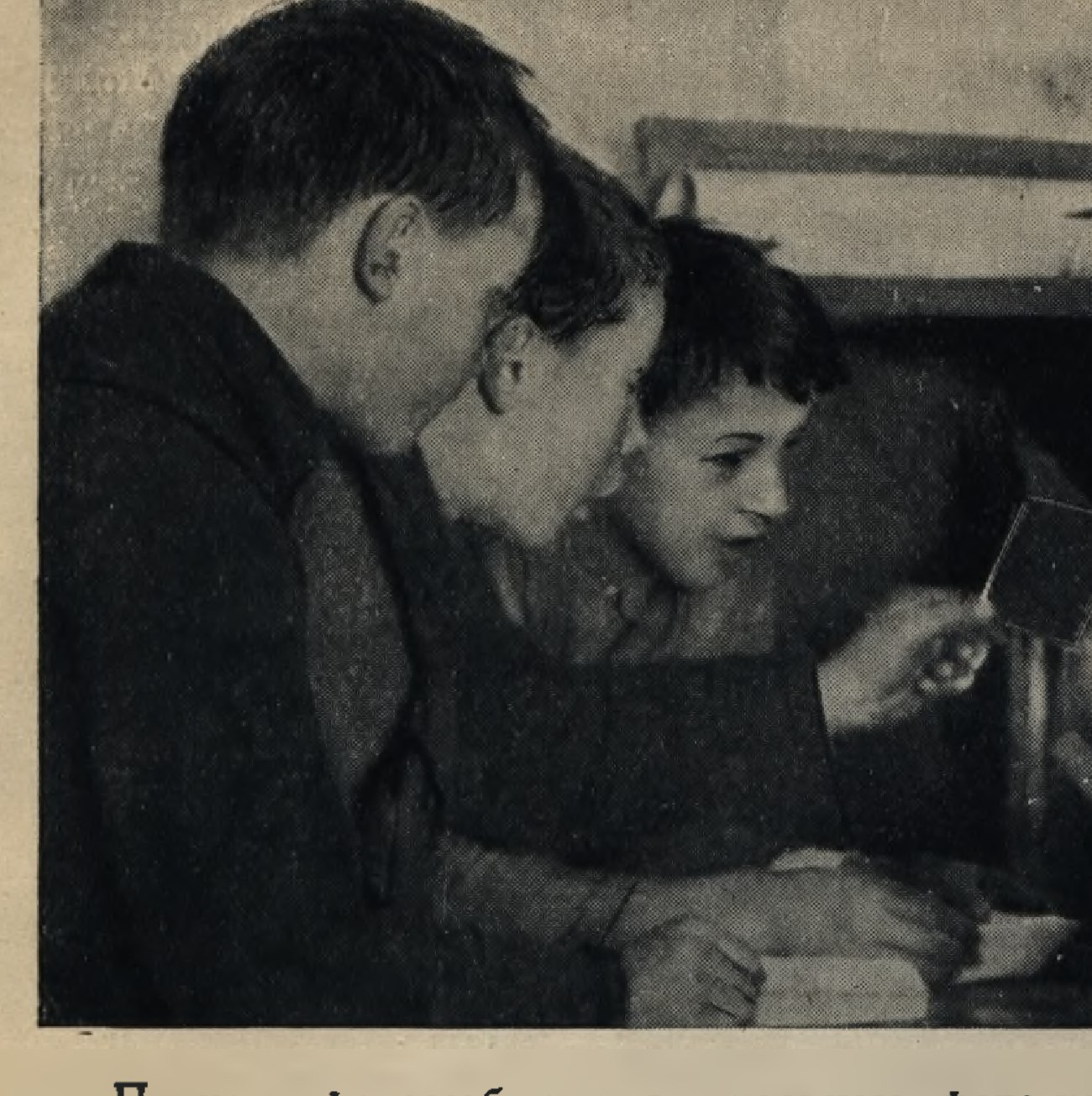
The mass, almost elemental striving of the photo-amateur toward unification in photo-circles — that is the content of the enormous quantity of letters received by the editors. The editors will systematically give practical indications on the questions of the organisation, equipment and work-plan of the photo-circle. F. L. begins.
First of all let us note the following: if a photo-circle is built as one of the forms of trade-union cultural work — and otherwise we do not conceive of it — then, wherever the circle may arise, whether at a club or directly at a production or institution, nowhere is it subject to any obligatory registration except in its own trade-organisation. Such organs are: the local committee (the factory committee) at enterprises and institutions, the cultural department of the trade-union and the workers’ club.
Let us picture such a case. On the soil of an interest in photography there came together, somewhere in Minsk or another town, 8–10 comrades wishing to unite in a photo-circle. In essence there is no need to argue about unification, since each of you is long ago already united by his trade-union. For the realisation of your photo-cultural intentions one should go immediately to the corresponding organ of your trade-union (up to its cultural department) and raise this question just there. If in the town (or district) there is an all-union club, the question is simplified: in that case you should enter the number of the club’s members and advance there the organisation of a photo-circle at the club. The question of organising a circle at an institution or enterprise is also simple: it is enough to discuss this question with the comrade from the local committee in charge of cultural work.
Further, before the circle-members arise more complex questions: the premises for a laboratory, and means. Here it is hard to expect that the organisation would at once provide you with everything. One must not only trouble oneself, but prove — not in words but rather in deeds — that the occupation of a group of comrades with photography bears not only a cultural but a socially-useful character. We are sure that sooner or later persistence and the wish to work will conquer the initial indifference, and the circle will get a premises and perhaps a small allocation of means for the first time. Let us suppose that the main thing is done; now the circle should consolidate its organisation still more thoroughly: the initiative group convenes a general meeting of the circle-members, where a Bureau of the circle (3–5 comrades, by the number of members) and an elder are elected. There is no need to work out and carry through any statute of the circle, because, like all circles, it is subordinate to the directives of the cultural department of the trade-union. Far more important is to work out and confirm, in the circle’s midst, the rules of internal order, which every circle-member will be obliged to fulfil unquestioningly — otherwise discipline, extremely necessary just at occupations with photography, will totter, and the circle will simply fall apart.
On the consolidation of the internal organisation will begin the epoch of self-activity. One must compose a plan and programme of lessons, work out a plan of the gradual equipping of the laboratory, beginning with the most necessary, take into account the presence of photo-apparatus among the circle-members, reveal the degree of the photographic preparation of the comrades, and at once — at least by one or two more experienced ones — enter into the public work of the club with the apparatus in hand. One must at once justify one’s existence and not make people wait for the showing of one’s circle-work. Often the most experienced in photography among the circle-members becomes also the leader of the circle, at least for the first time; if such a comrade is not found in one’s own midst, he will have to be found on the side. The joint reading of photographic literature, the discussion and working-through of technical questions of photography, are extremely useful, but the skilful leadership of an experienced leader is all the same, sooner or later, necessary. In the first time of the circle’s activity one should exactly distribute the functions of the work among the circle-members. For the equipment of the laboratory — as far as possible by one’s own forces — for the acquisition of inventory, literature, chemicals, vessels and so on, all the forces of the circle should be mobilised. By our experience, the minimum norm of the area of the premises of a laboratory should be counted 3–4 square arshins per person, counting in that number the place for setting cabinets, work-tables, stools and so on. At a smaller norm it will already be difficult to work. If there is no ventilation in the premises, such should be arranged — both intake and exhaust — otherwise in the laboratory conditions harmful for work and health may be created. The direct neighbourhood of the laboratory with a lavatory (sometimes such a premises too is given!) is quite inadmissible, since, besides all, the ammoniac and sulphurous gases will spoil all your photo-products; from such a premises it is better to refuse. In the same way there exist minimum requirements which can be presented to the inventory of the laboratory, the equipment, the vessels and so on. But of this we shall talk another time.
— F. L.