
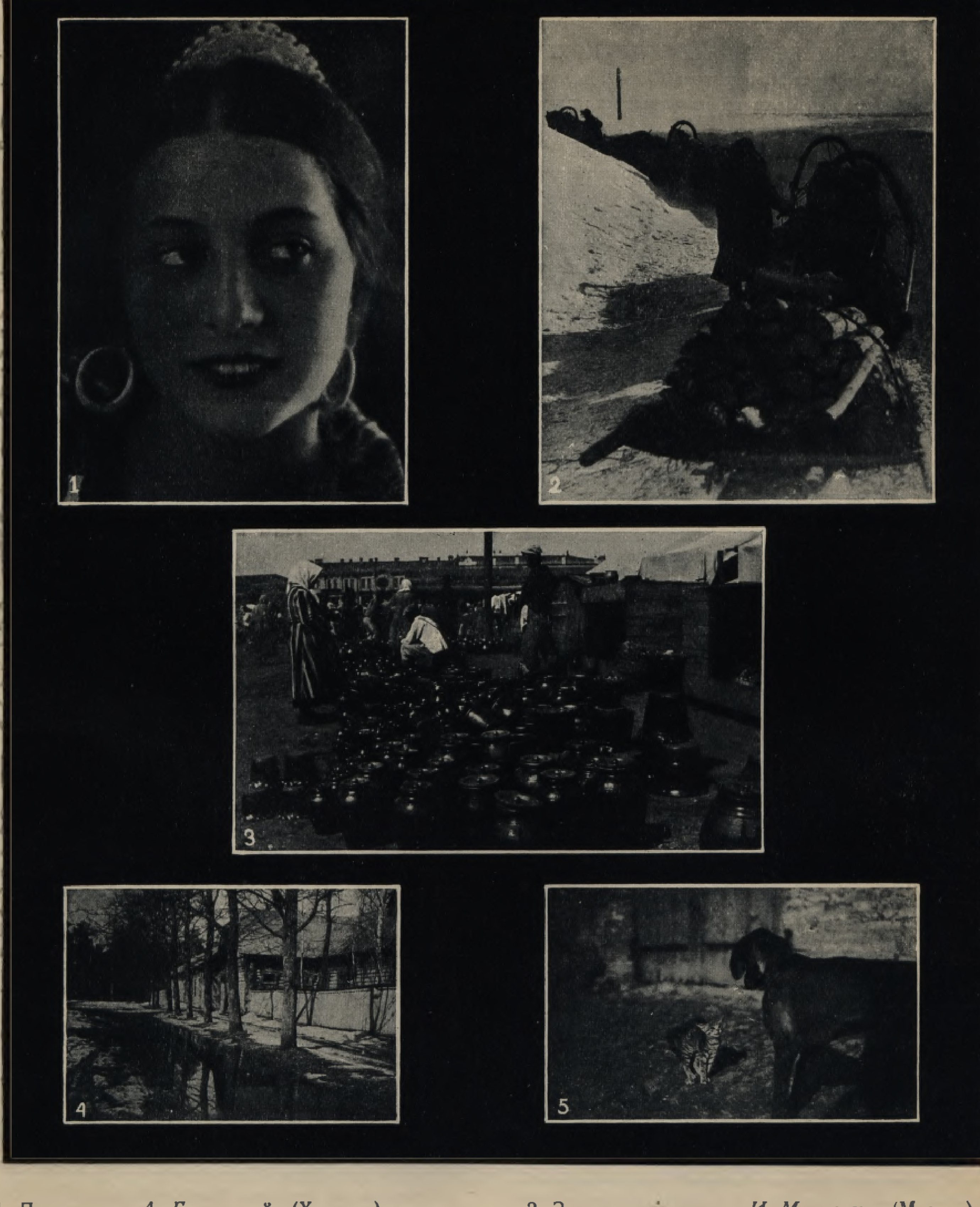
N. D. Petrov’s guiding criticism of twelve shots by succeeded photographers — on the foreground, the superfluous detail, and the trap of a false “prettiness.”
A. Gladshtein (Kharkov) is evidently one of those authors who wish and love to work seriously over the problem of the portrait in photography. In his “Woman’s Portrait” (1) the most valuable for us is the lighting. It, being by type more or less usual — a combination of front and side — did not distort, as sometimes happens, but emphasised the peculiar softness of the woman’s face. Quite correctly is the negative worked out (softly), the modulation of the light-gamut well conveyed. This portrait could be a very valuable work of the author, if the organisation of the frame were… simpler. The little-natural turn of the model’s eyes, giving an unneeded tension and importunately baring the white of the right eye, these huge earrings in the ears and this comb, that violated the calm clearness of the drawing — all this speaks not in favour of the shot. Comrades! Do not distort your possibly-good shots with an unneeded and sugary “prettiness.” Organise your pictures more simply.
I. Milovanov (Moscow). In every shot there should be expressed the author’s thought. Probably the author wished to show on the shot a string of horse-transport characteristically winding along the turns of the road (2). The month of March. The sledge-road is already hard. Slowly, one after another, the horses drag the sledges loaded with firewood. To express a road winding among still snowy fields, and on it a black line of carts — is an interesting theme. But if the shot wishes to say something of this kind, then first of all it lacks the main thing — the expressiveness of the planes, and the movement is in no way emphasised. The logs of firewood of the first cart so persistently climb into the viewer’s eyes only because on the shot the foreground is quite absent. And meanwhile it was just its presence that should have emphasised the movement.
Yu. Amursky (Blagoveshchensk) boldly and generously fills the frame of his shot. Possessing an uncommon technique, this author gives works quite deserving wide attention. His “Pottery Row at the Bazaar” (3) is quite successfully conveyed in technique, but the design is too prodigal. There happen such successful shots in which all the same something is lacking; to this type belongs the work under examination. It seems to us that here is lacking just that main thing on which the author should masterfully have stopped the viewer’s attention. Indeed, the treacherous post on the back plane as it were forces the viewer to divide the plane of the shot into two independent pictures, perhaps even more expressive. Evidently, in this scatteredness of the subject is hidden the defect of this good work.
By his shot Legran (Moscow) (4) strives to convey to the viewer the impression of that period of spring when the last layers of snow swiftly thaw under the rays of the April sun. This subject is unconditionally interesting. Quite correctly is the shooting organised by the author — orthochromatic plates and a yellow light-filter were taken. The exposure, greater than needed (1/25 sec. at F/4.5, the month of April, 2 o’clock in the afternoon, a sunny day), made the negative excessively flaccid. In the work a serious attitude to the processes and a skilful approach to the subject are seen. However, he too is not spared the inability, still inherent in the majority of photo-amateurs, to fill the picture expressively: the presence on the shot of the first tree at the right spoils the perspective.
F. Fain (Mariupol) gave a shot (5) rare by the happily caught moment of the meeting of two enemies: a cat and a dog. The shot is, of course, instantaneous; the viewer’s attention is well centred by the skilful focusing. R. Korop (Lyubotin): “If only the dog doesn’t attack, if only I don’t fall, don’t break anything. Eh, and a hard work — to carry breakfast on the field” — with these verses the author accompanies his work (6). Besides being a poet, he is also a photo-amateur, able to find and take a subject. Of course, in the shot there are compositional defects and even technical ones (the absence of details in the lights), but the author’s sincerity and the simplicity of the design make one as it were not notice this. Amazingly truthful is the figure of the child carrying the breakfast, and naturally-expressive the figure of the mother, skilfully taken out of focus. If the author had given before the figure of the child even a little foreground, the impression would have been still stronger.
By his shot Sindeev (Tashkent) tries to show one of the typical representatives of the town handicraftsman-loner, a grinder (7). Not badly conveyed in technique, it all the same gives no representation of that specific setting in which this work goes on. The grinder on the shot is alone, and the viewer does not know for whom and where this work goes on. V. Zhemchuzhny (Moscow). The “new” point of view of the author on the subject is not justified in the given case by the impression got from it. The shot is called “A House on the Arbat” (8); it is incomprehensible what the author wished to say by his device. N. Levenshtein (Moscow) very successfully took on the shot the “Steamer Wheel” (9). On the picture-plane there is decidedly nothing superfluous, nothing distracts the viewer’s attention from the main thing — the cascade of water-foam at the steamer’s wheel. Successful in design and technique, this photograph, besides, quite conveyed the movement, and in this dynamism of the shot is its value. “A Grove of Poplars,” P. Leontyev (Simferopol) (10). Rarely does a photo-amateur manage to convey so simply just a grove. In this work there is something extremely interesting that attracts the viewer. A. Trishevsky (Moscow) showed on the shot a corner of one of the Moscow-area estates (the former Yusupov one) (11). The architecture of the dwelling-houses and the whole ensemble of the buildings of the “Moscow-area” estates not seldom represents a valuable artistic work; in shots of such estates their face, character and style should be seen. Meanwhile, at the author just this side is insufficiently clearly revealed: the palace is taken in an unfavourable angle, giving the viewer an impression neither of its architecture nor of its volume. “Sets up the Samovar,” A. Rogulin (Bogoroditsk) (12) could be a very expressive shot, if the author were not so sparing: the woman and the samovar are cramped in the frame. One should have given more planes and not over-developed the negative so strongly. The theme is interesting and deserves that the author should work over it more.
— N. D. Petrov