
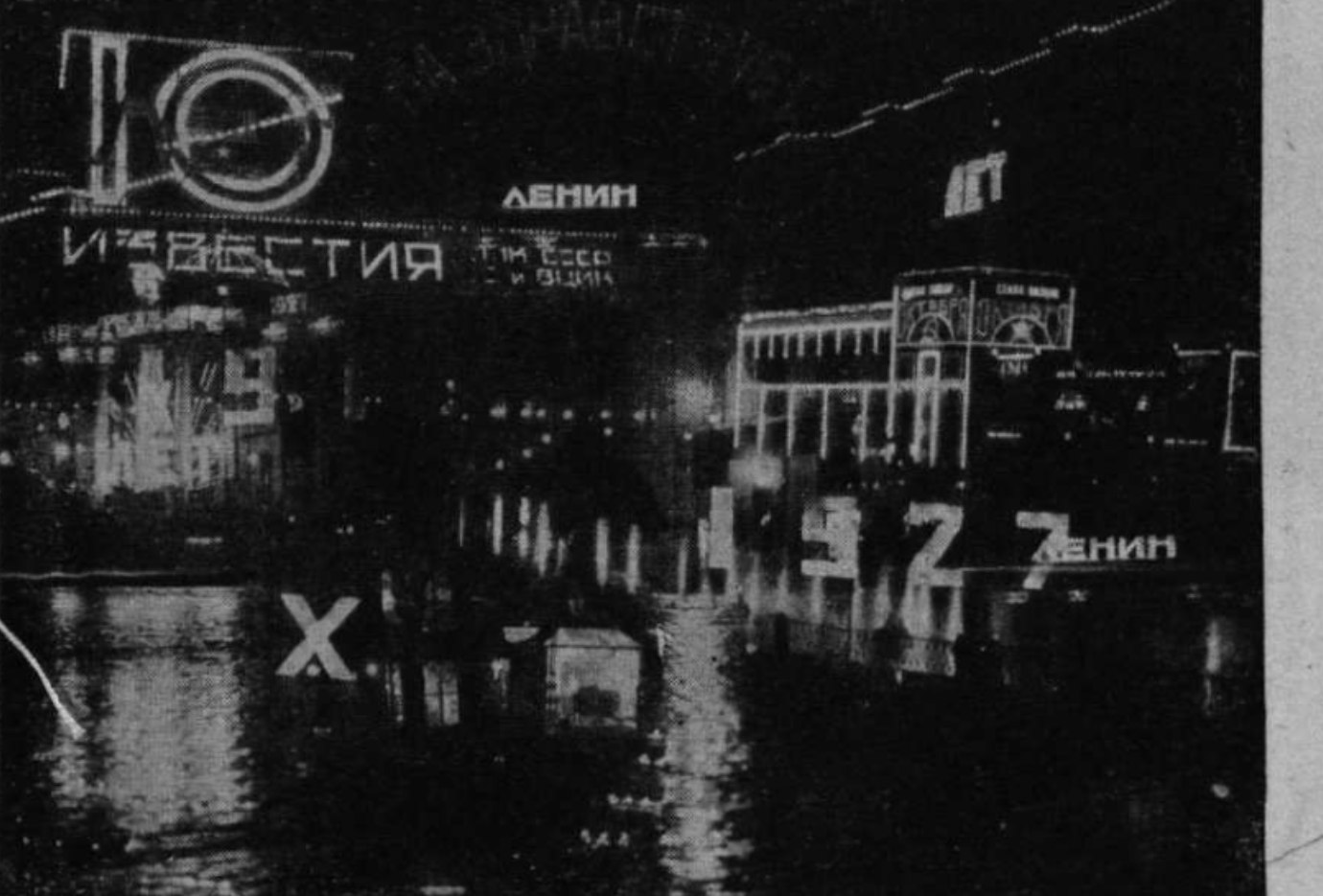
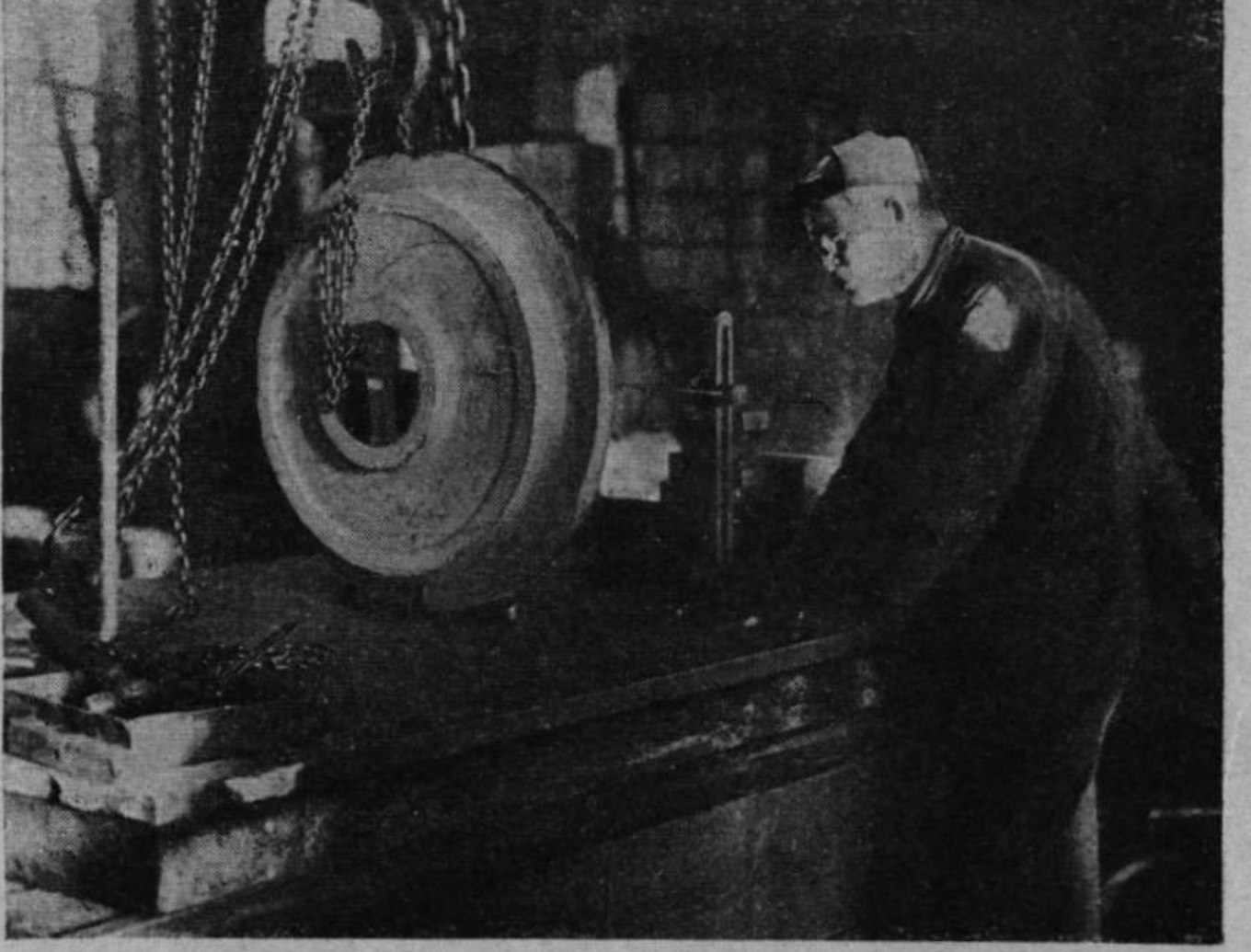
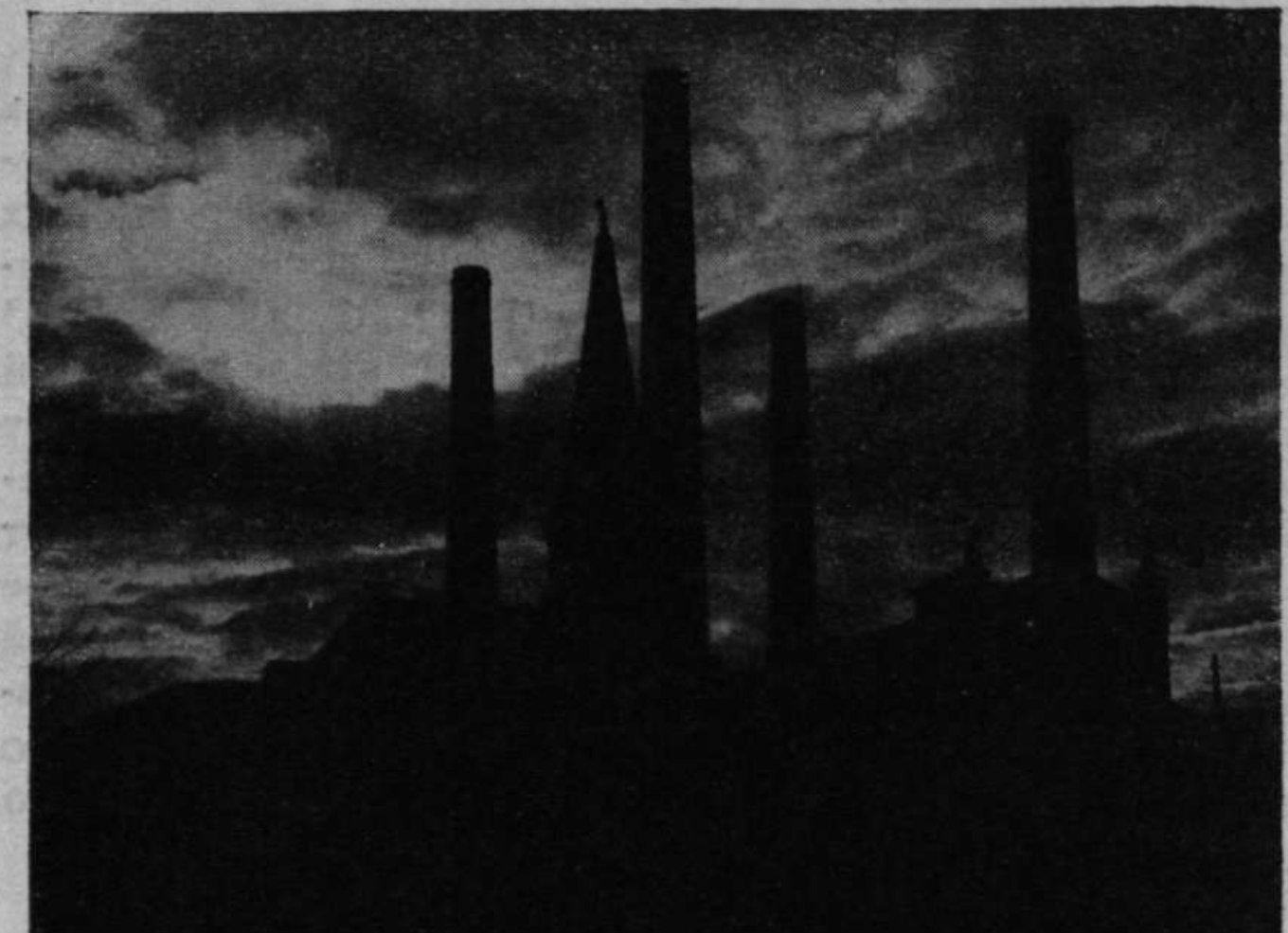
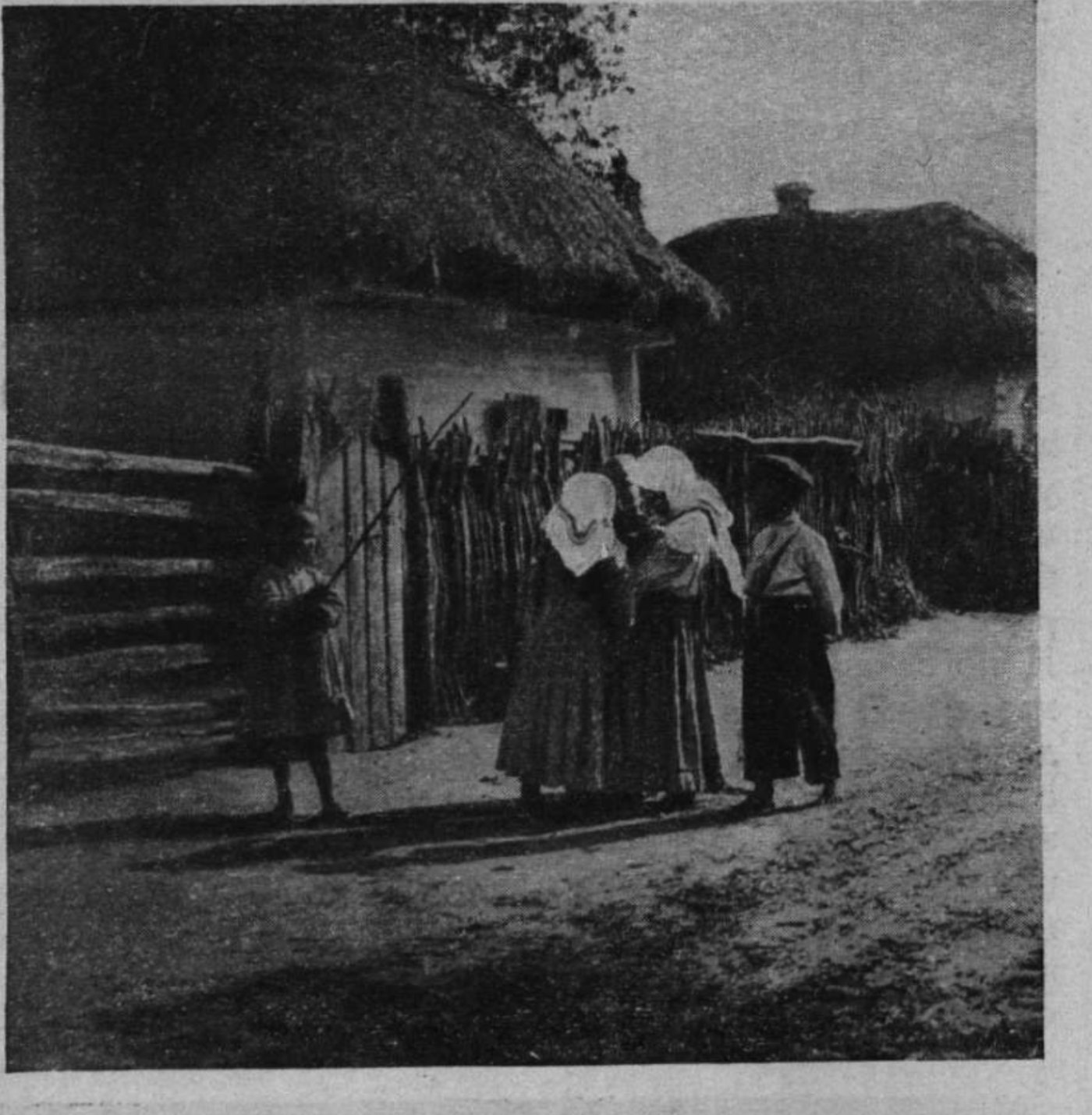
N. D. Petrov’s critical review of readers’ shots — Troyanovsky’s whole “symphony” of the October illumination caught on a single plate, Chebotaev’s technically brilliant but posed slab-grinder, Debabov’s over-busy “Night,” and Vasyukov’s unforced village scene.
It is natural that every photo-amateur, approaching one or another subject, sincerely wishes his shot to be good. Sometimes this aspiration expresses itself in the desire to reveal his thought by the shot: in this case the result may be truly good; not seldom the desire blindly to imitate a more experienced comrade or a well-known photographer leads to sad results.
In all the shots considered in this note one very gratifying phenomenon strikes our eyes: in them there is neither imitation nor chasing after “prettiness.”
Let all these photographs be far from perfection, let the majority of their authors still have much to work over themselves; but on the other hand, in their works there is neither the routine of professionalism nor the deliberate picturesqueness “à la Corot,” “à la Levitan” and so on. In the shots there are not a few technical and compositional errors, but together with that there is in them freshness of thought, simplicity and the signs of creative force.
Look at M. Troyanovsky. In the days of the celebration of October, at night, this photographer walked along the Moscow streets and from the sea of illumination lights absorbed impressions into himself. He conveyed them as he was able: simply and in full accord with his thoughts. The photographic apparatus is his notebook. It may be that, enchanted or struck by the grandeur of the festival, he could not, did not want to, shoot each illuminated building separately. His impressions are more generalised: to a single photographic plate he gave the perceiving of all that he saw. He shot everything on… one plate. Agree that this is extremely sincere, simple and strong. At the same time this is interesting also because the author did not miss the sides of technical execution: his plate was anti-halation and orthochromatic (of the German factory “Agfa”). It seems to us that this photograph is not simply “October Illumination,” but a whole symphony of October lights.
Not quite well does the matter stand with the production by Z. Chebotaev (Saratov). His “Slab-Grinder” is a very well technically executed shot. Notwithstanding the very difficult conditions of lighting, the negative is ideally worked out right down to the details in the shadows. Excellently made is the bromide print (an enlargement). From this side the author’s work can fully serve as a model. And by the lighting of the model the shot could be first-class. Unfortunately, all these merits are brought to nought by the deliberateness (the falsity) of the construction. To whom much is given, from him much will be asked. What is this worker doing: thinking, or simply standing, posing to the photographer? Where is the grinder? Indisputably, of the whole series of works considered here, this one is the least sincere and therefore the least interesting.
Not new, but interestingly conceived, is “Night” by Debabov (Moscow). Shots of such a kind can often be very effective, but the desire to give an effect often leads the inexperienced photographer to a bad result. If this cannot be said of the author’s work, then in any case the light effect is not developed by him to the end. It is hard to say whether it was necessary here to take another point of view, or whether, perhaps, it would have been better to refuse shooting altogether. The thing is that the silhouettes of four chimneys and a tower, the broken line of the roofs of the building — all this too much distracts the viewer’s attention from the main thing. With the given effect such profiling silhouettes are necessary, but they should enter into the shot as a logical element of the composition, and not break up the attention. It is very possible that in the case considered it was impossible to shoot otherwise, but the viewer has no concern with that. Thus, with a very good technical execution, the author’s work is all the same insufficiently convincing.
To develop in oneself observation, to be able to see that which others often pass by, to take as a subject the very simplest, the living — is one of the basic tasks of the photo-amateur. From this point of view N. Vasyukov (Kharkov), with his work “In the Village,” presents an uncommon interest. On a village street, a group of youngsters. Evidently they are examining some unpretentious find. The author did not pass by this ordinary theme, having seen in it a subject for shooting. He was not mistaken. The beautiful sunny lighting (the long shadows — evening), the natural background of wattle-fence and huts (only two!) — all this, surprisingly well harmonising with the group of children, created an impression. Good technically and uncommon in composition.
— N. D. Petrov