
N. D. Petrov’s critical review of readers’ shots — provincial and big-city amateurs who, happily, do not imitate the professionals’ showcases: Ovzer’s prize-winning “Afraid,” Zelmanovich’s “In Uzbekistan,” Gladshtein’s “In the Flood,” Peshon’s Tashkent pottery, Aristov’s retoucher and Leontyev’s fine “On the Neva.”
To the rank-and-file Soviet photo-amateur successes do not come easily; in the province there are absent not only photo-goods, but photo-leaders too; and if in the large centres of our Union the matter stands with this somewhat better, then here there is the temptation of imitation in the form of… the “artistic photographs” of the professionals. But the photo-amateurs of the province do not lose energy, and those of them that live in the large cities, happily, do not all imitate the banality of content of the photographers’ street showcases.
The authors considered in the present essay live in large centres: Leningrad, Kharkov, Tashkent and so on, and each of them has his own themes, his own thoughts, and the main thing — his own approach.
True, successes do not come easily, the forward tempo of the development of the amateur youth is slow. One cannot keep silent about the fact that the paths of improvement are full of errors, but it would be strange to keep silent about the fact that the new amateur photography stands on the correct path of development. The technical successes, we believe, will not be slow to tell; moreover — they already exist.
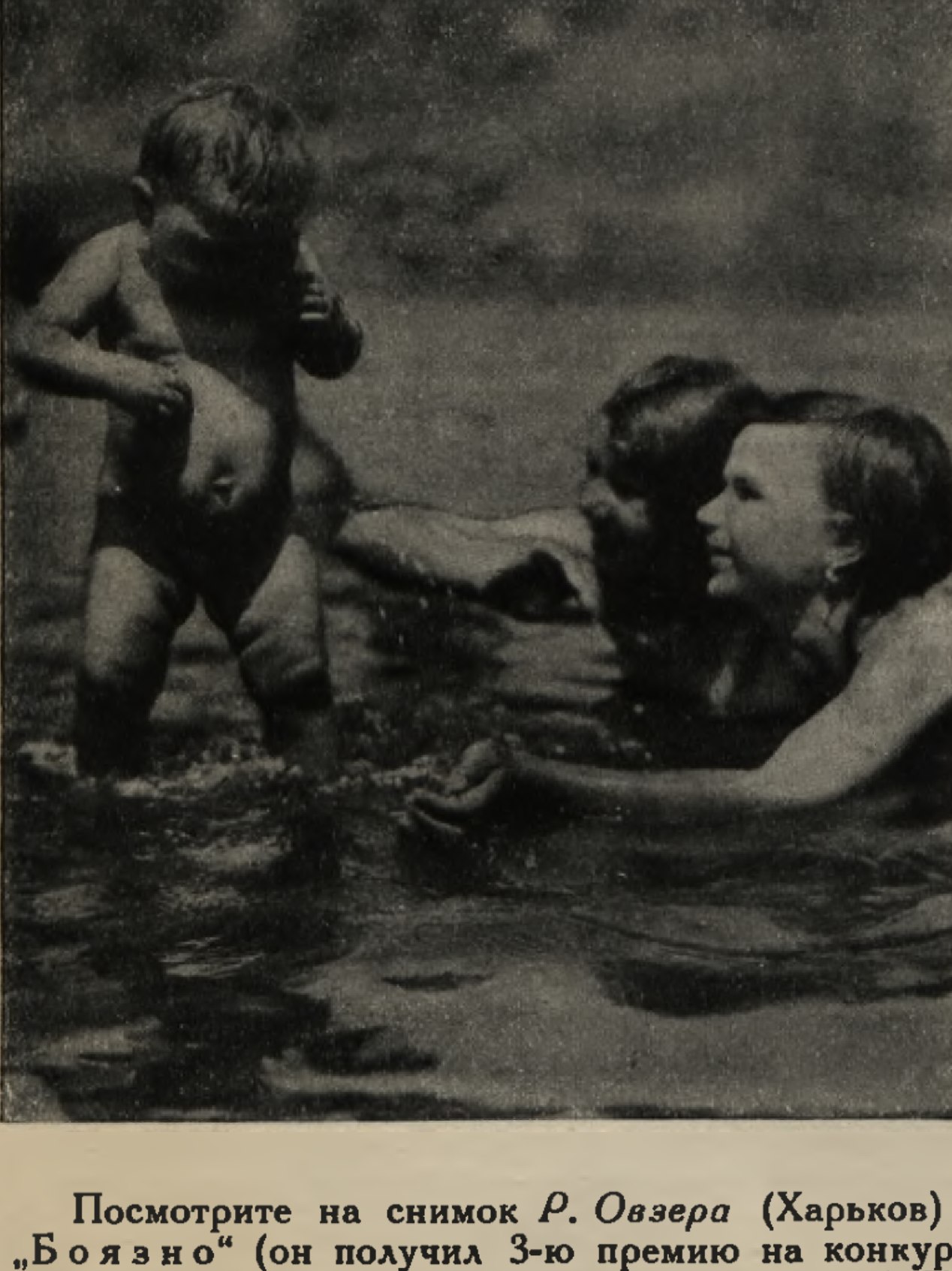
Look at the shot by R. Ovzer (Kharkov) — “Afraid” (it received the 3rd prize in the competition of “Sovetskoe Foto” — “Physical Culture on the Water”). How the title of the shot corresponds to its content. This instantaneous photograph did not give something frozen in movement, as often happens, but revealed it. One feels that the child has only just, perhaps for the first time, entered the water; the grown children accustom him to the water, with quick movements of the hands throwing over him its splashes. They laugh; he, ready to cry now, in a minute will be playing with them. In the shot the water is well conveyed, and the aptly chosen point of view gave the shot a certain completeness.
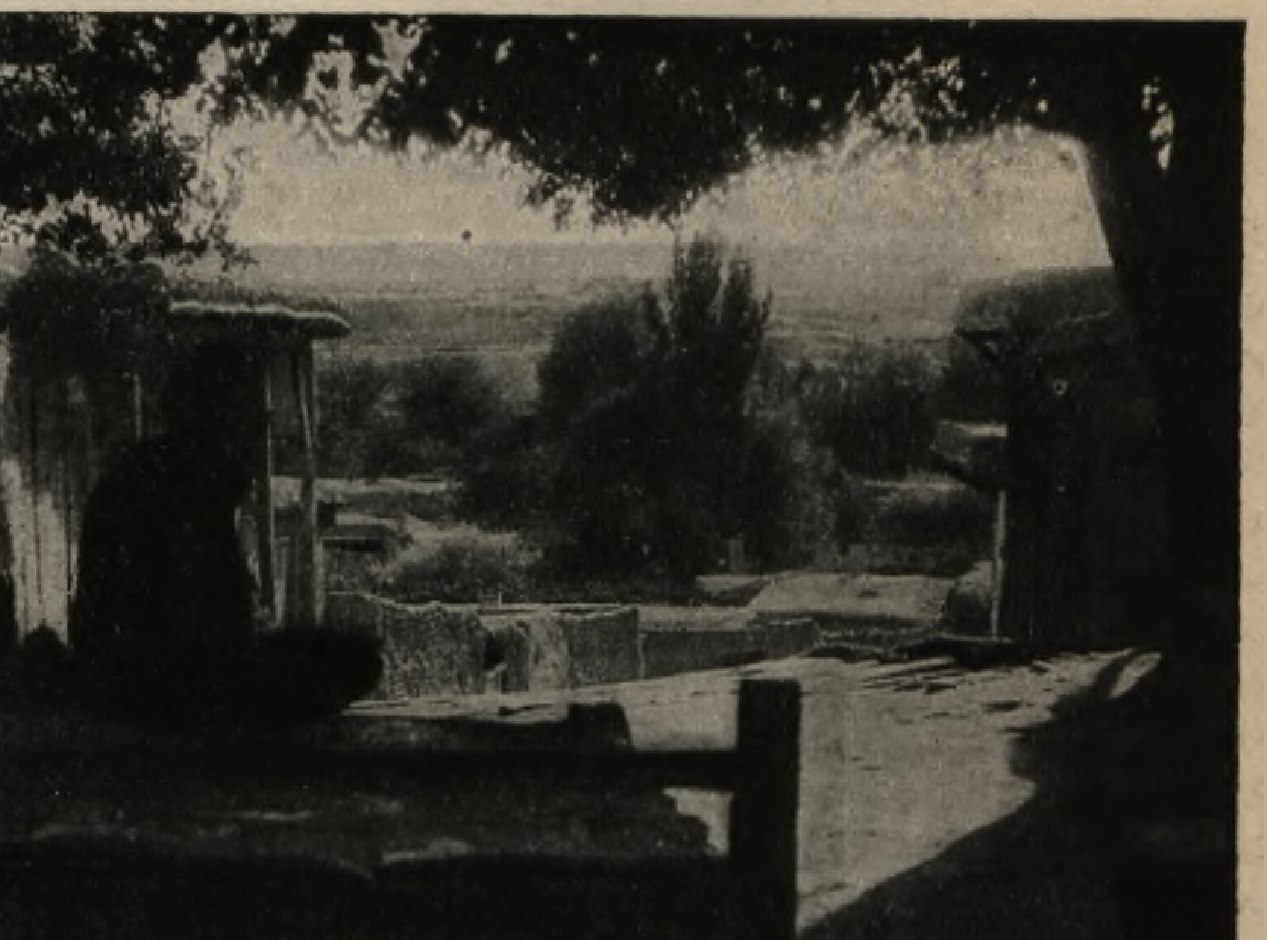
“In Uzbekistan” — G. Zelmanovich (Tashkent). Notwithstanding that in this shot there are somehow many elements of the construction of a picture, it does not irritate the viewer and is viewed with interest. The attempt to give an impression by means of the tonal difference of the elements of which the shot is built is more or less successful; perhaps it is this that attracts the viewer. The tonal difference is well balanced by the figure at the left — the darkest — and by the sunny patch — the lightest. Technically the work is quite satisfactory.
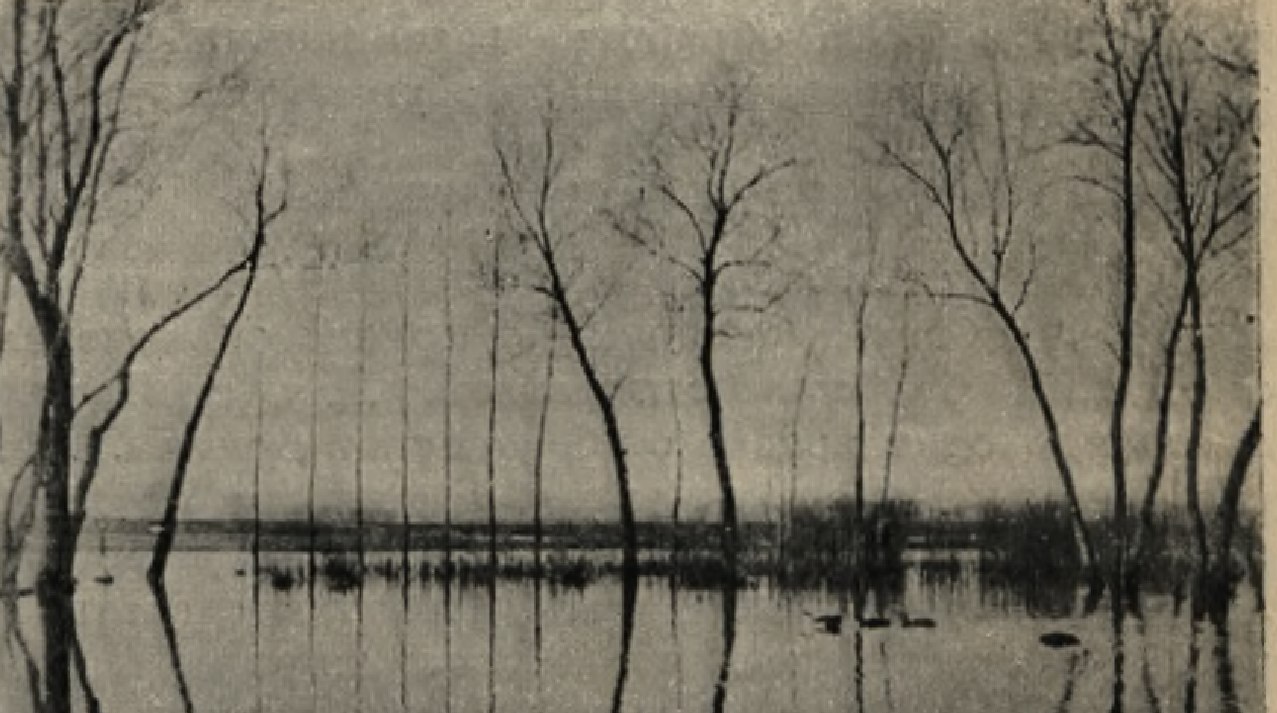
The work of A. Gladshtein (Kharkov), “In the Flood,” is simple, interesting and could be significant in impression. However, the line of the horizon, dividing the area of the shot into two almost equal parts, creates an impression of boredom. One should have taken another point of view, rather lower than higher; in that case the part occupied by the water space would be larger and the shot would become more interesting. Not in the shot’s favour speaks the identical tone of sky and water, when in reality their colour was different, and this difference can and should be conveyed in photography by a tone of different force. Of course, if one discards these requirements — though they should all the same be fulfilled — then the author’s work cannot be called bad.
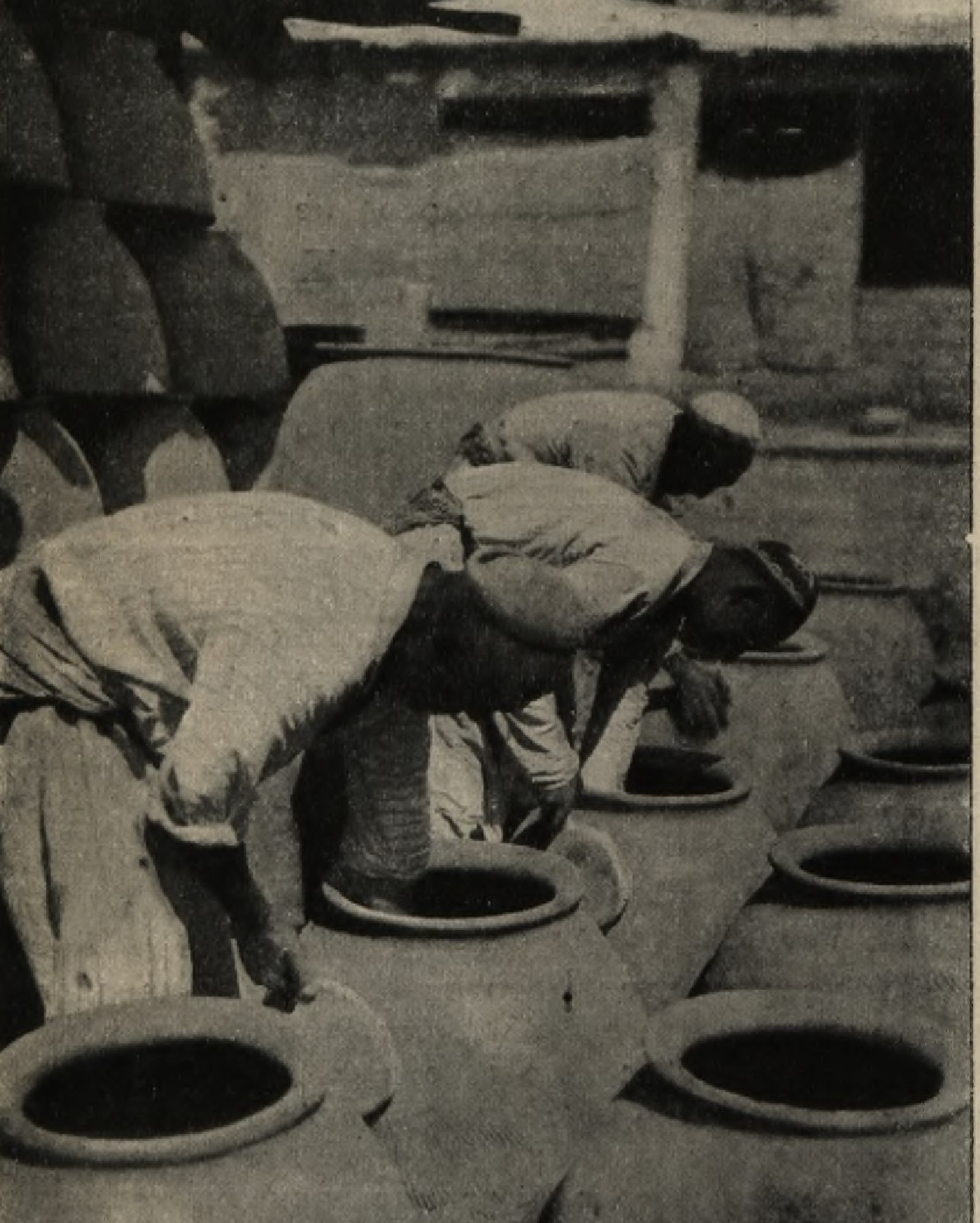
“Pottery Production in Old Tashkent” — M. Peshon (Tashkent). Here little has been revealed of that which the author set as the heading of his photograph — the production. A number of large pots, incidentally seeming already finished, several workers bent over them — all this cannot, in the given case, give an idea of pottery production. Somehow differently should one have organised the frame and revealed more prominently this interesting theme. Besides, the shot is grey, there is no sunlight in it, of which there is not a little in Tashkent; the round form of the articles has not been revealed by light, and the viewer does not know who these people are and why they have bent over. But let not the author scold us — his interesting conception is as yet insufficiently worked out.
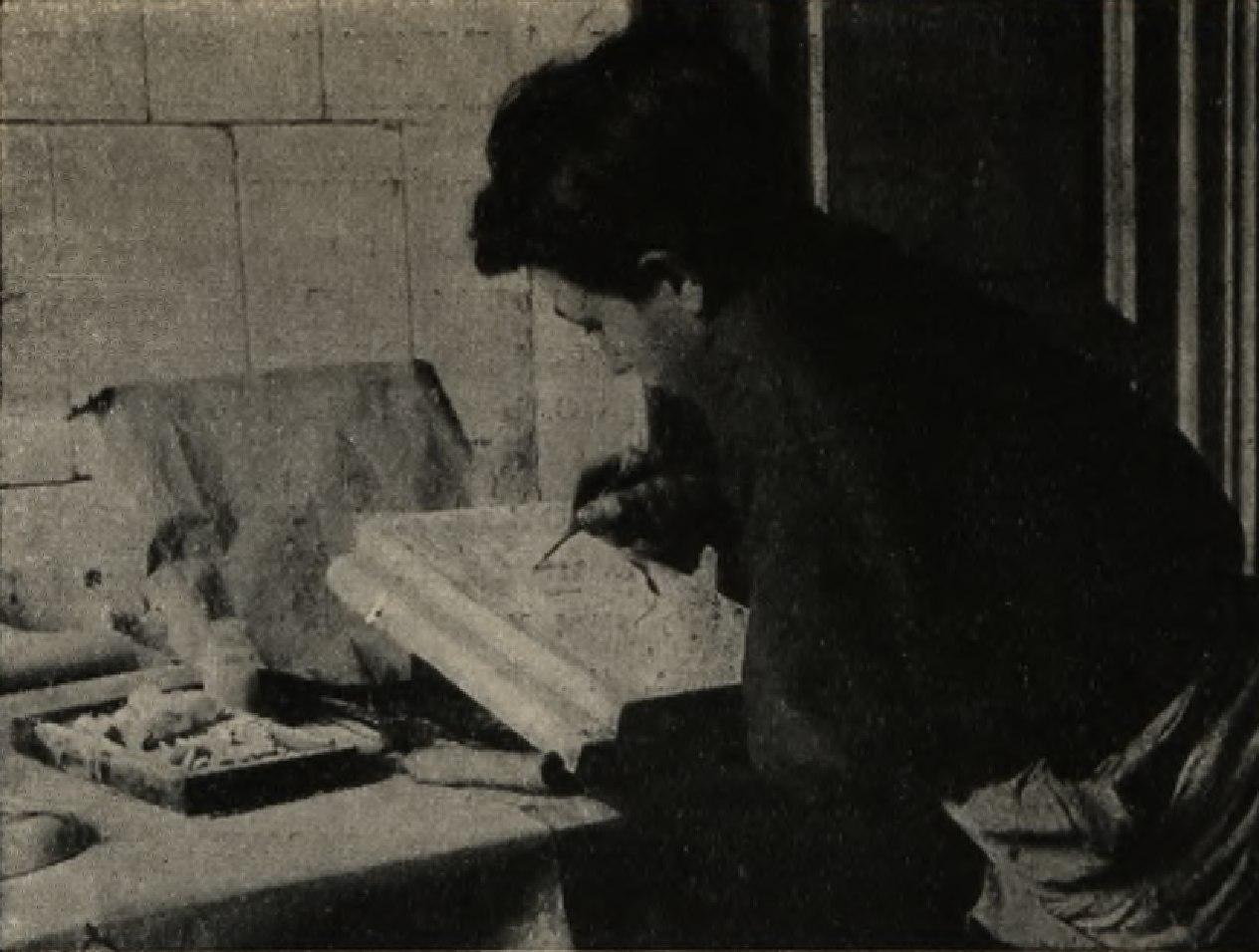
Here is the work of an author not sophisticated by a knowledge of technique: “In the Izo Circle” — S. Aristov (Serpukhov). The model also posed for him, but look how much simplicity there is in this pose and how this pose corresponds to the model’s occupation. Of course, the stripes of light on the door, which serves partly as background, scatter the attention of the viewer, but on the whole this unpretentious photograph is sincere and pleasant. Quite not bad are the negative and the print.
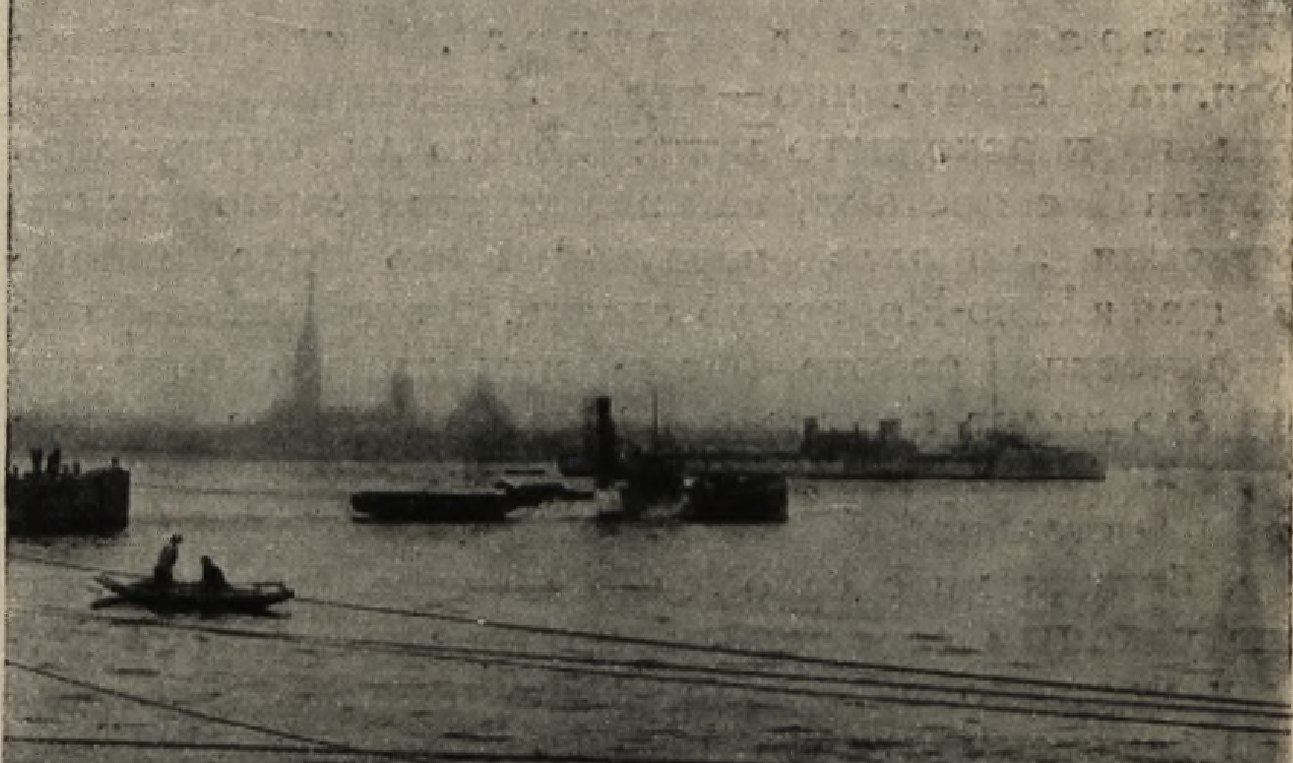
The work of P. Leontyev (Leningrad) — “On the Neva” — is one of the very best amateur works. Rarely does one succeed in so revealing the water in the foreground and, in a misty haze, the distance. And the filling of the surface of the river from the first to the last planes is sustained in almost correct tones. But, strictly speaking, here there is something superfluous, which breaks up the attention and almost destroys the effect of perspective. From the attentive viewer this superfluous thing should not be hidden: both by tone (too dark) and by the compositional plan of construction, the half-barge at the left hinders the viewer. Cover it with a little piece of paper matching the tone of the water, and look what results.
Of course, all this is quibbling, but it bears the name of the law of the filling of the picture plane.
And let all the comrade photo-amateurs — both those “criticised” by us and those reading the “Critical Notes” of our journal — fear praise most of all. The latter not only obliges, but may halt on the paths of improvement all those who have so much data for development.
— N. D. Petrov