
N. D. Petrov’s review of readers’ shots — Ovver’s cramped blind beggars, Shveikheimer’s sugary but instructive “Sea Bay” and his “Fishermen,” Sipyagin’s Yalta porters spoiled by a restless background, M—ov’s tired “Crossing,” and a senseless “boy in a glass of water” that a photo-circle made to its leader’s assignment.
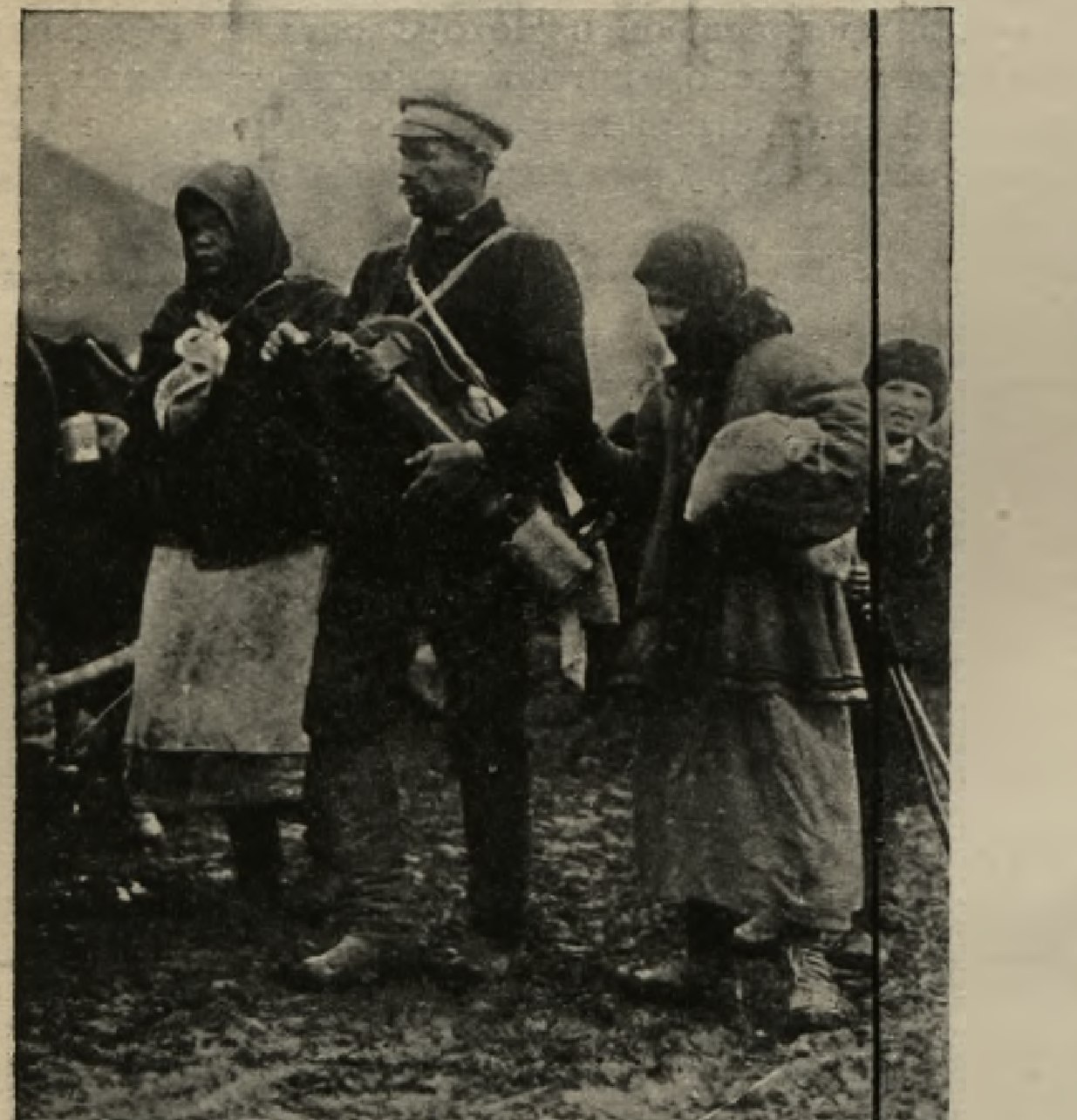
R. Ovver (Kharkov). On the shot are three beggar-blind men. They go somewhere along a bazaar street, holding one another. In their movement there is the petrifaction of the blind. Technically it is a not-bad shot, but the blind men are cramped in the frame of the shot. In other words, their figures are taken too large, there are no planes: one should have given more foreground, and taken the figures themselves smaller. One should develop the negative so that at printing the sky should at least a little cover the white paper. The boy-guide looks into the photographer’s apparatus: he should either not have been included in the frame, or given ahead of the blind men, which would have been more logical.
Shveikheimer (Rostov-on-Don). What rich themes sea shores can give the amateur photographer and, at the same time, how hard it is not to repeat the already-hackneyed treatment of the subject. “Sea Bay” at the moment of the sunset of the sun… One feels the distance and the air, the foreground is definitely-boldly emphasised, a small vessel in the distance logically determines the perspective. The well-worked horizon complements the impression. If, for completeness, one removed from the shot all the superfluous that breaks up the viewer’s attention, then one could say that the author resolved the task quite satisfactorily. Notwithstanding that the shot bears a character of some sugariness, it can all the same serve as a model of how, by the direction of lines and the distribution of masses, one should fill the picture plane. The print and the negative are technically almost irreproachable.
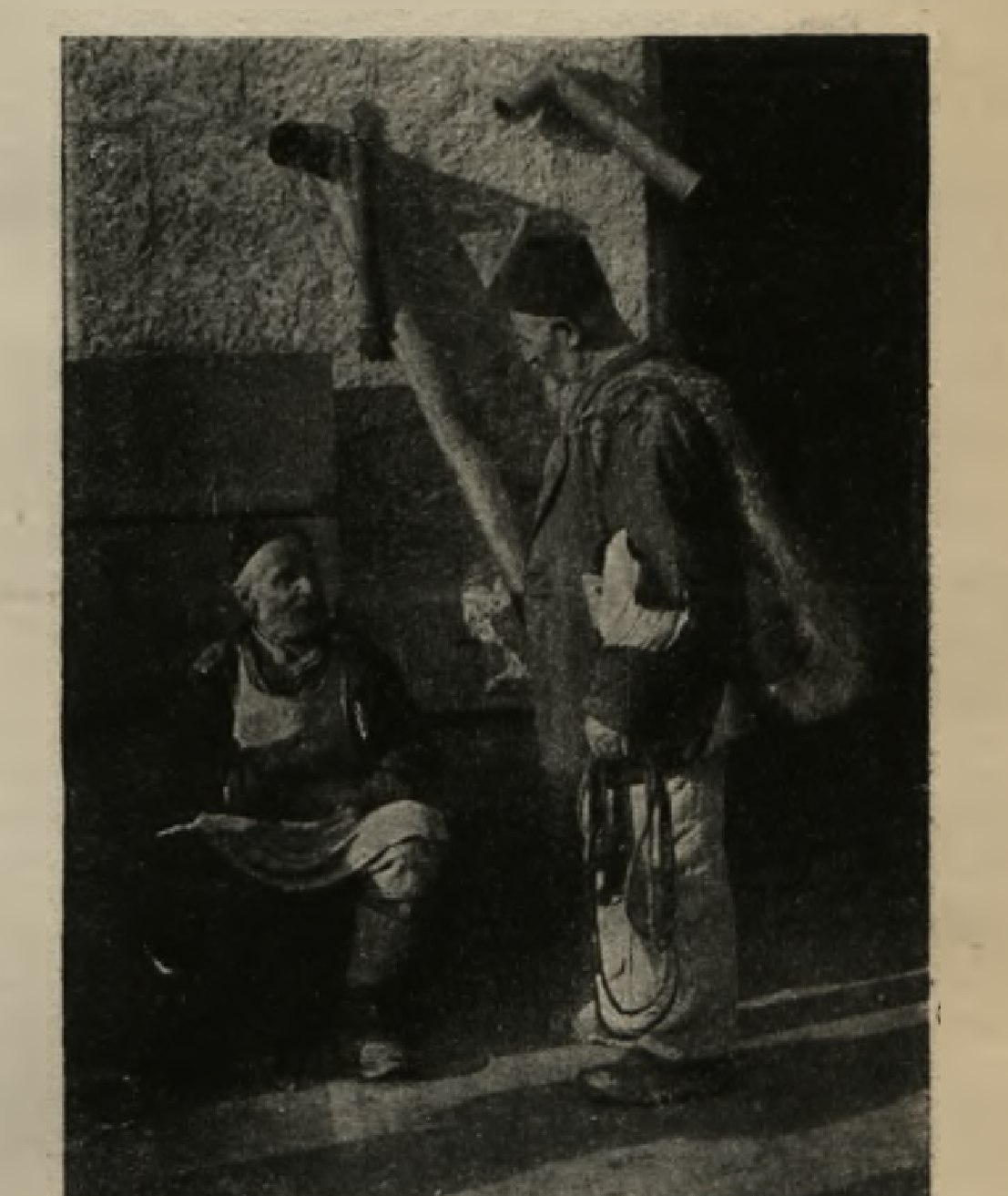
Sipyagin (Yalta). The labour life of the street of a southern city is so colourful and full of peculiar movement that it fully deserves the serious attention of the photo-amateur. From this point of view the author’s intent — to give types of the local worker-porters, loaders, fishermen and so on — is unconditionally interesting. The matter is only how to execute this intent. In both shots movement is felt, and especially in “Fishermen” (the movement of the hands). “Porters” — by the pose of these picturesque people — could be a magnificent shot: let the reader note how in the whole figure of the old man who has sat down to rest there is still felt the only-just-interrupted movement (the carrying of heavy loads). Only closer to the sunset of the sun, or early in the morning, can these pleasant lines of light-shade (on the ground) occur. But the shot is completely spoiled: the sharply emphasised background with some screens, pipes, creates a restless impression and does not let the viewer concentrate the attention on the main thing — on the figures. Besides, the copy should have been printed somewhat more contrastily, in order to emphasise the unconditionally interesting light patches. Just so, the print “Fishermen” could win if the sky were not white paper, but somewhat covered; then there would be revealed that which is lacking in the shot — air and the impression of the horizon, and for this one should have developed the plate in a softer developer.
L. M—ov (Moscow) — “The Crossing.” How many plates, how much paper, how many efforts have been expended on tens and hundreds of thousands of similar glades, brooks, forest-edges and crossings!.. And this shot is old, as old as photography itself… Somewhat irritatingly the trees crawl out: the shot would win, being cropped on the left with the removal from the field of the big birch.
Does anyone understand anything in the last photograph? A boy in a glass of… water! We shall not conceal that this work is done in a photo-circle by the assignment of its… leader. First of all, this photograph is senseless in general, notwithstanding that the author, evidently, is proud of it. But the main trouble is that these circle members do not yet see what the foundations of the work of photo-circles consist in and what role photography occupies in our public life. This is hindered for them by their… leader.
[A final shot shows by what means the photograph “Nature morte” (the running doll, p. 183) was obtained — a doll suspended on threads.]
— N. D. Petrov