
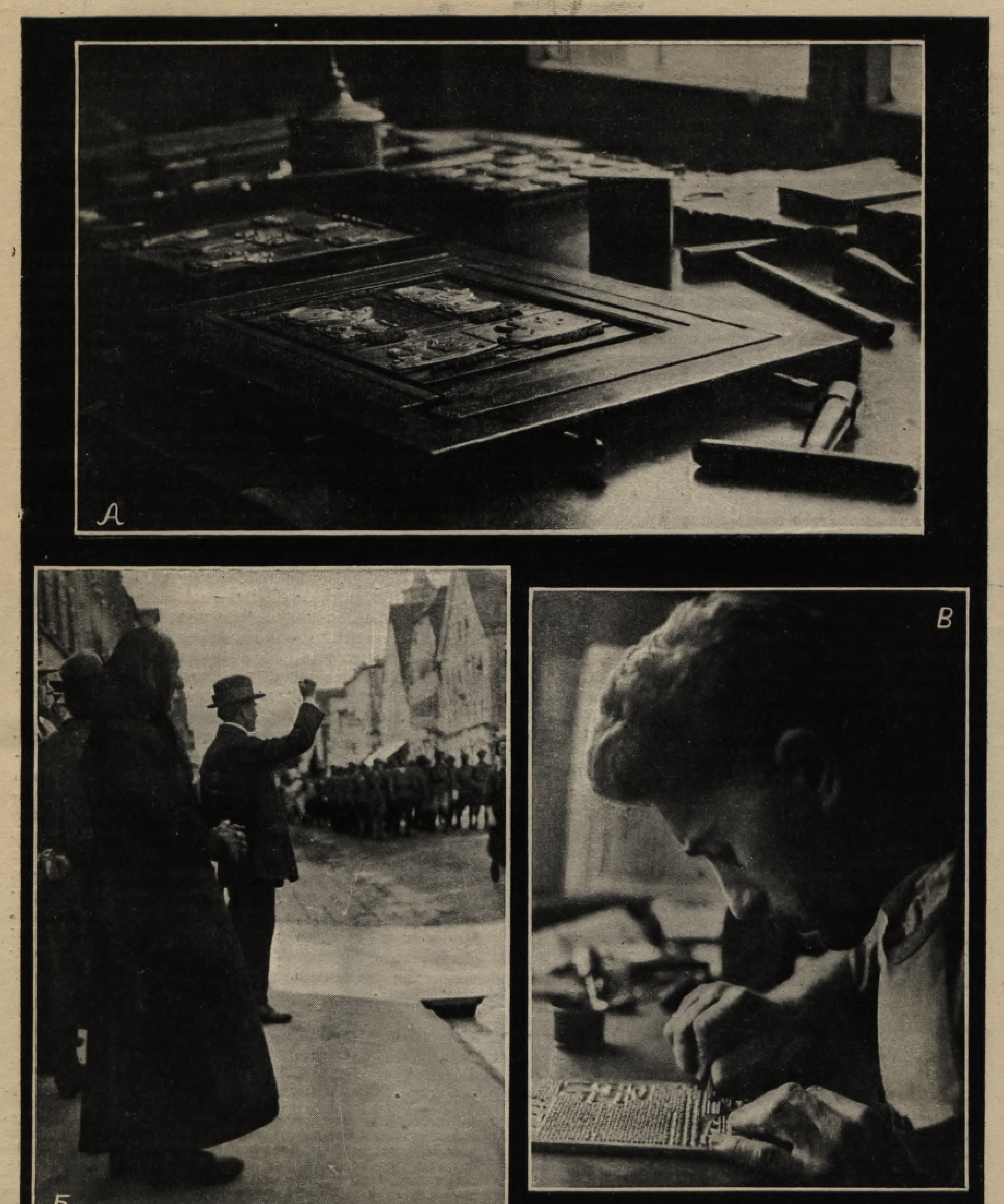
The ties between Soviet amateurs and the German worker-photography movement take shape: “Der Arbeiter-Fotograf” reprints articles from “Sovetskoe Foto,” which in turn sent a collection for the Leipzig exhibition “The Worker-Photographer as Reporter and Artist.” Here, three technically superb shots by comrade Heilig of the Stuttgart section — his engraver’s still-life, “Red Front-fighters” on a city street, and a worker portrait bent over his work.
The connection of Soviet photo-amateurism with the German worker photographic movement little by little begins to be established. Soviet photo-amateurs and their German comrades mutually show interest in each other’s works. The organ of the All-German Union of Worker-Photographers “Der Arbeiter-Fotograf” (“The Worker-Photographer”) reprints articles of “Sovetskoe Foto”; “Sovetskoe Foto” began to print the correspondence of the editor of “Der Arbeiter-Fotograf,” comrade M. Pfeifer. Fulfilling the wish of the Leipzig Department of the All-German Union, the editorial office of our journal sent to the latter a collection of shots of Soviet photo-amateurs for the exhibition arranged in Leipzig, “The Worker-photographer as Reporter and Artist,” at which will be presented the works of proletarian photographers of a number of countries.
In the present number the editorial office, for the beginning of the acquaintance of our readers with the works of the German comrades, places (on the next page) several photo-shots of comrade Heilig — member of the Stuttgart Department of the All-German Union of Worker-Photographers.
Three shots of comrade Heilig, being superbly conveyed technically, cannot but interest us also from the side of theme. The upper shot, “Nature morte,” reproduces the professional tools of production of the author (he is a worker-engraver). “Red Front-fighters” (below left), on the streets of a big city, are greeted by passers-by, among whom, as the personification of old daily life, in bewilderment froze some “God’s” little old woman. “Portrait” (below right) is not a licked-smooth photograph in festive attire, which we see often, but a living portrait of a worker, concentrated over his work.
There is something to learn for Soviet photo-amateurs from the German comrades, and especially in the choice of themes.