
A dispatch from the journal’s Berlin correspondent on the All-German Union of Worker-Photographers. How the camera, long a weapon of the exploiters through the illustrated press, is being turned into a tool of proletarian enlightenment; the union’s non-party programme under communist leadership (“Worker-photographers serve national enlightenment and the proletarian class struggle”); its growth to nearly 1,000 members in 50 cities despite slander from the social-democratic press and the bourgeois photo-societies; how the groups learned on the nearest subjects — above all the housing crisis — and now feed some 200 workers’ papers, delivering usable shots within 24–48 hours of a wire.
Worker photo-amateurism is widening and growing abroad, and the German workers occupy one of the first places. All information about workers’ photographic unions is met with enormous interest by our Soviet photo-community. The editorial board places the article sent by our Berlin correspondent on the tasks of the All-German Union of Worker-Photographers.
As in old Russia, so in the capitalist countries until recent years, photography was a monopoly of the well-to-do classes. At first this amateur sport served private needs, and subsequently became a mighty instrument for the exploiters. Proceeding from the supposition that a photographic shot requires much less mental work than the reading and pondering of newspaper articles, illustrated journals were created, which showed themselves all over the world as a weapon against the proletariat. In the class struggle — in the striving to enlighten the broad masses and make them conscious for the social revolution — the opponent must be defeated not only by the same, but if possible by strengthened means.
In what way must the camera be used for the proletarian class? It is a peaceful weapon, but a very suitable means for enlightenment work. When, by several dozen conscious communist workers, the All-German Union of Worker-Photographers was founded, it became evident that all forces must be strained so that the organisation should bear a non-party character, and that unorganised workers and members of the social-democratic party should be drawn into it. The whole essence is in not allowing the fragmentation of the German working class in this new cultural work, and in ensuring in this all-uniting organisation communist leadership. The chief point of the programme reads: “Worker-photographers serve national enlightenment and the proletarian class struggle.”
In a short time the organisers recruited, in 50 large German cities, almost 1,000 members, who accepted the programme and work by it, preserving the non-party character of the movement. This did not pass without struggle. The worst enemy of the union are the bourgeois photographic societies, which have widely-distributed organisations with technically perfect journals, broadly supported and financed by the photo-industry. The second opponent is the behaviour of the social-democratic party: already from the first steps on this new field, the organisation and its journal were slandered by the social-democratic press and dubbed a “communist undertaking,” and workers were warned against taking part.
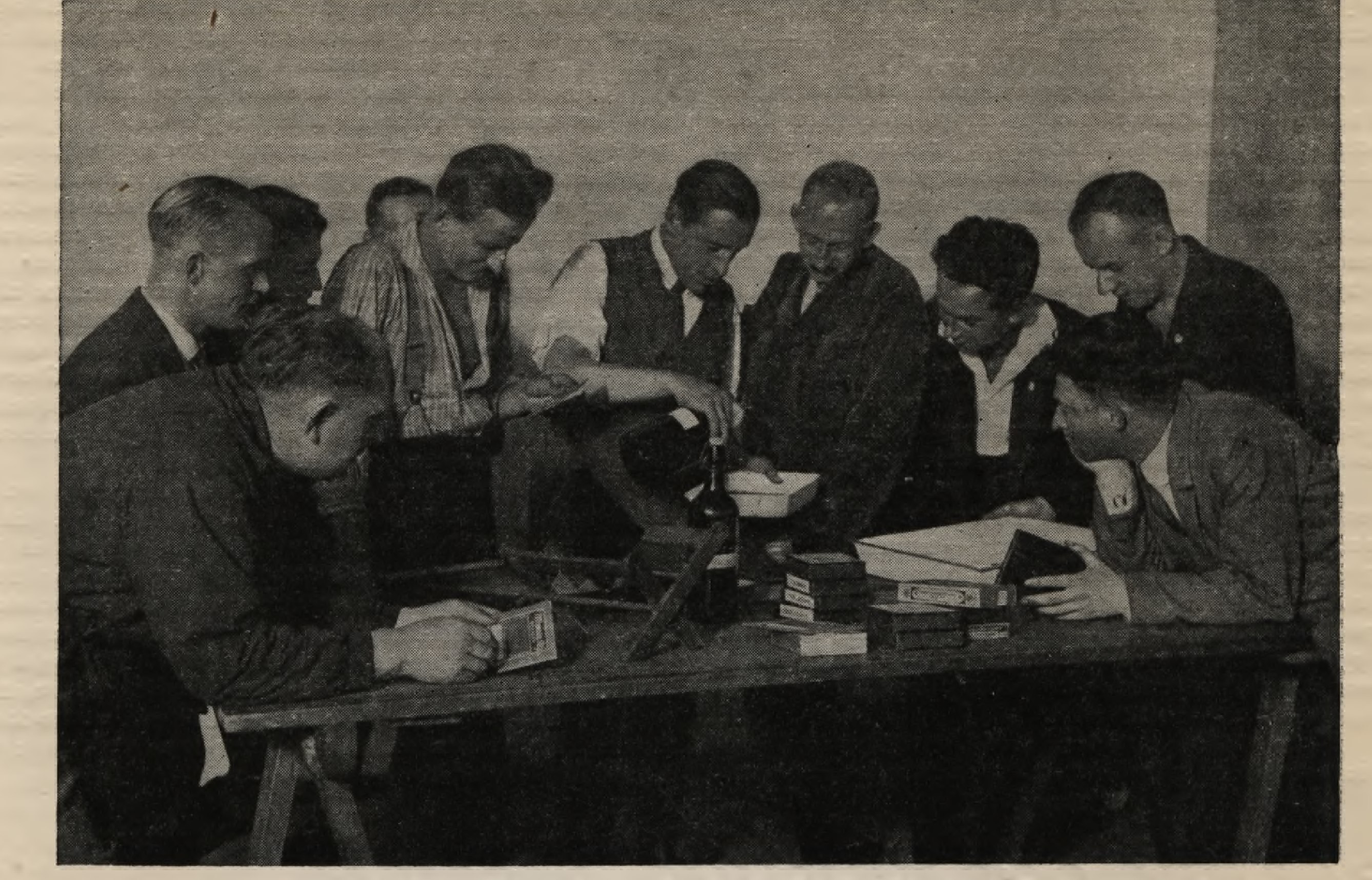
The leaders nevertheless insisted on their own — not in theoretical discussions but in practical work. A year ago there were in the union about 10 workers who really knew how to photograph; but then appeared hundreds of proletarians with their apparatus, who wanted to learn and were not content with photographing landscapes needed by no one and portraits of their acquaintances — they had, as class-enlightened fighters, the striving to put their weapon, their camera, to use. Everywhere there was a technical leader, courses for beginners were created, photo-laboratories slowly arose, enlarging apparatus were installed and auxiliary devices acquired, and gradually satisfactory photographs began to come in — the majority, interestingly, depicting the heavy and intensifying housing crisis. Thus the German worker-amateurs began with the nearest objects, technically not so difficult; for a long time afterwards came shots of demonstrations with processions and music, or small groups; then the members stepped over this stage. Now the majority of active members, shooting, can evaluate whether a shot has only personal or general interest, whether it is valuable only for the given locality, or can be shown to a broad circle of readers scattered not only in Germany but over the whole world.
For the union it is of secondary importance whether a lone individual can photograph well — it is important that the shots be suitable for the workers’ press, travelling exhibitions, albums and collections. Only from this point of view can the movement of worker-photographers be valuable; otherwise it will be only an amateur sport for private aims, delaying other generally-useful tasks. In this direction the local groups are systematically instructed through the union’s journal “Arbeiter-Fotograf,” in theoretical courses and at practical works. In Germany there are about 200 communist and social-democratic daily newspapers and hundreds of small journals for the various branches of industry, cultural life and sport of the working class. All strive to supplement their content with suitable images, and one can with satisfaction state that the greater part of the illustrations are delivered by worker-photographers — not only the housing crisis and demonstrations, but whole series of the development and course of the strike movement, the needs of domestic workers and the poorest peasants, and the conditions of work at the factories. One can confidently expect, after a telegraphic request to a local group, to receive suitable shots within 24–48 hours.
The tasks of the All-German Union of Worker-Photographers — to create a social photo-reportage and to make workers photo-correspondents, who will always be ready to struggle with the capitalist system and to enlighten the masses of the labouring with factual material. Thus the union became a basic link in the proletarian struggle for liberation.
[Illustration: an evening of exercises of the group of the German worker-photographers’ union “Norden-Berlin.”]