
When the automatic shutter is missing or badly broken — and cannot be bought, from cost or from sheer absence in the province — the amateur is reduced to the lens-cap. The author’s remedy is a home-made focal-plane shutter costing almost nothing: two tin plates, a strip of bicycle inner-tube for the spring, and one ordinary pin.
Not seldom the amateur is put in the necessity of shooting only with the lens-cap — either from the absence of an automatic shutter, or because of its serious breakdown. Such a photo-amateur is in a very sad position, for under these conditions the possibility of shooting is extremely limited. To acquire a shutter that fits over the lens does not always succeed — either from its costliness, or from the complete absence of such shutters on sale, especially in the province. The shutter described here cost me almost nothing. As material I used tin — a narrow strip two millimetres wide — rubber from a bicycle inner-tube, and one ordinary pin.
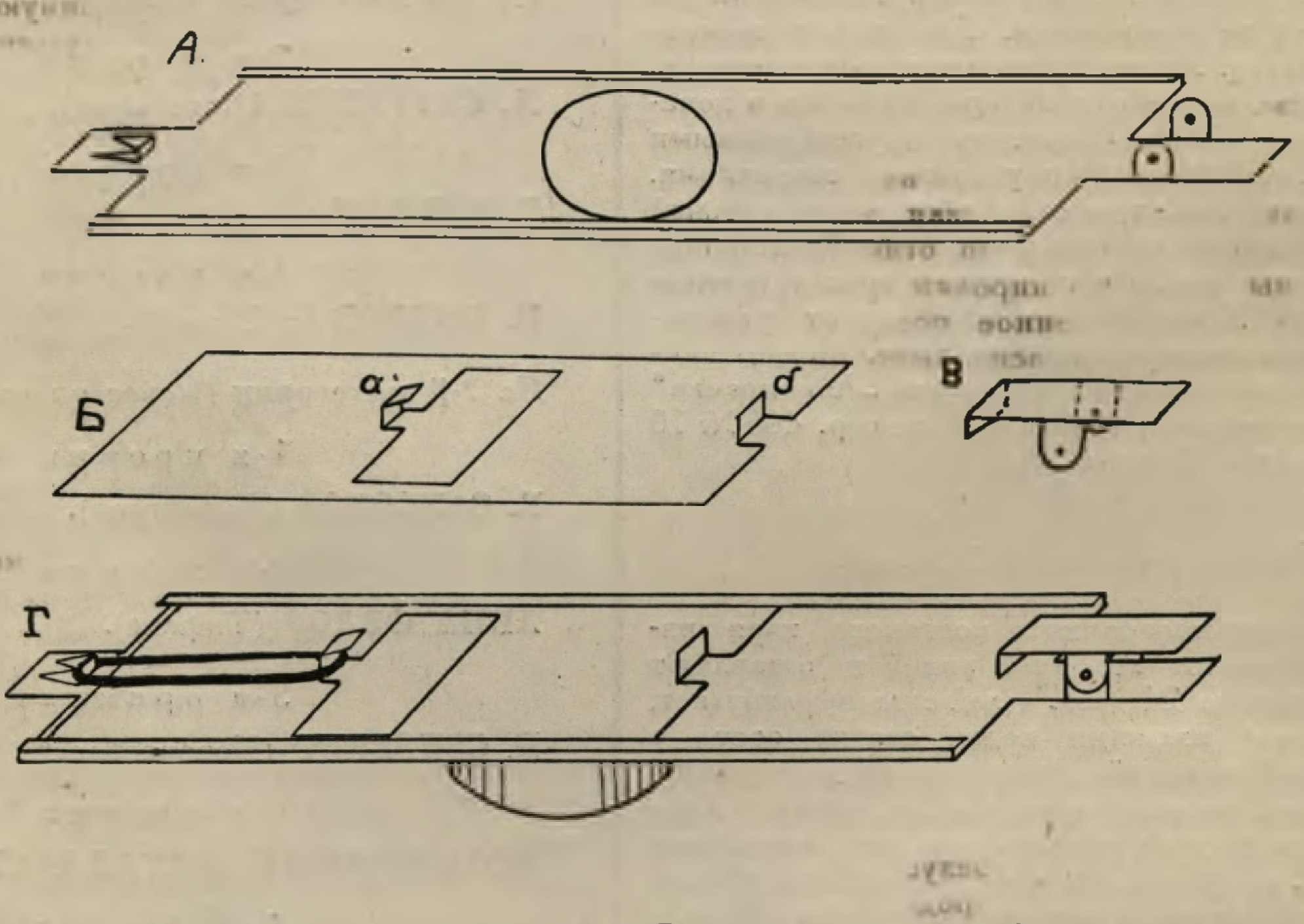
One strip of tin I cut with scissors, 20½ cm long and 5 cm wide; the edges, along the length, I bent over by about 2 mm on each side. In the middle of the strip I punched, with a round chisel, a hole equal to the diameter of my lens; on one end of the strip I fixed a hook for fastening the rubber ring, and on the other — something like a valve-hook. Thus the first part of the shutter took the form shown in fig. A.
The second plate (fig. B), also of tin, should be along its length somewhat more than ⅔ of the first — about 15–16 cm — and narrower, so that it moves freely along the other, being clamped between the flanges. On this second plate, in the middle, a hole is likewise made, which during the shutter’s action passes over the hole of the first plate.
The valve-hook that charges the shutter must be made from a small piece of tin and fastened to the right end of the first plate with a simple pin, like a hinge (fig. V). The rubber ring (a piece of bicycle tube) is put on the hook of the first plate “A” and fastened to the hook “a” of the second plate B.
The second plate, pulled “to the stop” to the right, is held by the valve-hook behind the bend “b” on the second plate. By pressing with two fingers on the valve-hook, the released upper plate, obeying the tension of the rubber, is driven to the left, opening at the same time, for an extremely short instant, the lens.
To fix this shutter on the lens, a sleeve of tin, of a diameter calculated to the lens, is soldered to its back side. The shutter ready for action is shown in fig. G. With all its imperfections, this shutter may prove useful for a momentary exposure in the case when no more perfect device is at hand.
— A. Zh.