
A. Kandidov offers two simple yet very precise ways to set the ground glass exactly parallel to a drawing being copied, when camera and original stand apart. In the first, a mirror hung flush in the copying screen replaces the drawing; the camera is turned and tilted until the lens’s own reflection sits dead-centre on the ground glass — the lens axis then being perpendicular to both planes, which makes them parallel. The second, as exact as the setting of astronomical instruments, uses a 1 mm cross-slit and a small mirror on each plane: a light beam bounced from one to the other, brought back onto its slit by rotating each plane in turn, guarantees the two are strictly parallel. After either, camera and screen are locked and focus found by moving the lens alone.
Everyone who reproduces drawings or pictures knows how hard it is to set the ground glass parallel to the subject when camera and picture have no rigid connection — are not on one stand. Many methods exist, but all are either very complex and hard to carry out, or simple but unsatisfactory. Here are two that combine simplicity with almost mathematical precision, fit for the most serious reproduction work.
First method
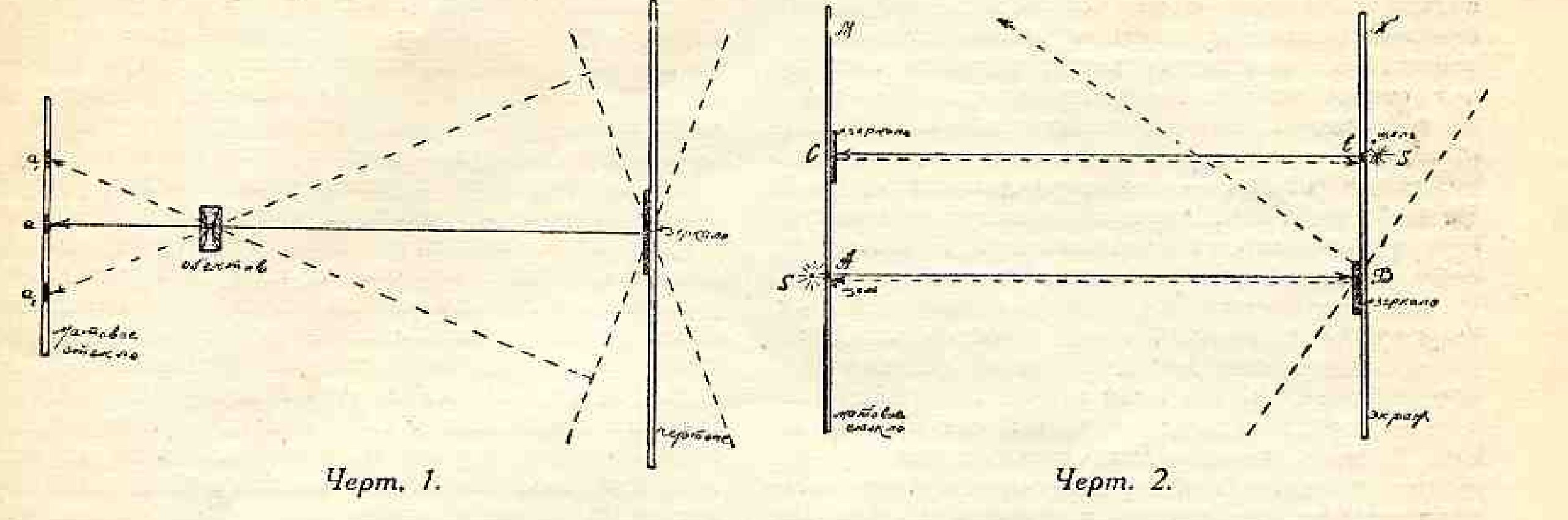
In principle: a mirror strictly parallel to the drawing’s plane is hung in place of the drawing, and the camera is focused on it so that the mirror reflection of the lens’s centre falls exactly at the centre of the ground glass. Then geometrically we have a line (the lens axis) perpendicular to two planes — and such planes are parallel. From Fig. 1 one sees that at various inclinations of the drawing the image of the lens’s centre moves off the centre of the ground glass (up or down), and at turns of the drawing (right or left), to a wrong position a1 or a2; rotating the camera until the reflected centre coincides with the centre of the ground glass sets the parallelism.
In practice: stretch a cross of threads along the diagonals to find the exact centre of the ground glass; if it has play in the rebates, fix it firmly and mark the centre in pencil. The mirror must be attached to the projection screen perfectly parallel to it — I much recommend setting the mirror flush into the screen, for then, after the parallelism is set, no further focusing is needed (with a hanging mirror it is). The seeming difficulty of aligning the centres of lens and ground glass is simple in practice, since the lens’s reflection comes out as a very small circle whose centre is easily judged by eye. If in focusing the reflection goes right or left, rotate the camera to catch the centre; if it goes up or down, tilt the camera. Before focusing, set the lens board so the lens is central in the camera.
Second method
Giving exceptional precision (astronomical instruments are set so): take two planes — the ground glass and the screen with the drawing — each carrying a narrow cross-shaped slit about 1 mm wide and a mirror strictly parallel to the screen’s plane. Setting them by eye at the needed distance opposite one another, bring them into parallelism (Fig. 2): pass a beam of light through slit A so it reflects in mirror B of the screen. If the screen’s plane N is perpendicular to the ray, the reflected ray returns along the perpendicular and lights slit A of the ground glass; if not, and the reflection from B falls to the side, rotate plane N until it falls on the slit. Having fixed the screen, pass a beam through its slit E onto mirror C in plane M of the ground glass and, rotating the latter, bring the reflection from C onto slit E of the screen. When this is done, planes M and N — ground glass and screen — are strictly parallel.
In practice: lay over the whole ground glass a mask of black paper with a cross-slit about 1 mm wide; from the lens side glue a small piece of mirror on the ground glass, its plane strictly coinciding with the glass. Remove the lens board for the focusing. In the screen make the same cross-slit and hang a mirror likewise coinciding with the screen’s plane. With these ready, set as before: first catch the reflection from the ground glass on the screen (set the screen), then do the same for the ground glass. Then carefully replace the lens board, remove the mask with the ground glass (the mirror may stay, taking little room, only cover it with black paper), and make a sharp focus on the drawing hung on the set screen.
One must warn that after focusing, in both methods, the camera and screen must be fixed immovably, and any further focusing done only by moving the lens, never by shifting the apparatus and screen. Moving the lens board is quite admissible, since by the camera’s construction the lens board is always parallel to the ground glass; and if the ground glass is inclined, this parallelism must be checked by a level before focusing.
— A. Kandidov