USSRPhoto.com

Forums / Collectors and Users Open Forum

Belarus

8 posts in this thread
Reply with Quote Edit Reply Delete Reply
Really Belarus* camera was derived from the German Bauer 88 series,
The same mechanical devide was applied in Kama*, all Ekkran" models and and Neva" models. Quarz cameras although similar have much different kind os mechanics.

*Belarus and Kama produced before Quarz era.
"Ekran and Neva were market alternatives of Quarz during the same period.

Next segment I will show Bauer cameras
LP
Reply with Quote Edit Reply Delete Reply
Here images of Bauer 88B and 88D which can be seen at:
http://www.agassiztrading.com/cameras-film/cameras/cameras-8mm/8mm-bauer-88-B.html
Note that here was also previusly manufactured a Bauer8 (around 1950 which used the sme single 8 film of Kama and Ekran 1 and 3
http://www.flickr.com/photos/bancoimagenes/2418842009/

http://www.ussrphoto.com/UserContent/1252011_bauer 2.JPG


http://www.ussrphoto.com/UserContent/1252011_bauer1.JPG


http://www.ussrphoto.com/UserContent/1252011_bauer3.JPG

Reply with Quote Edit Reply Delete Reply
About 1x8mm... taken from:
http://lavender.fortunecity.com/lavender/569/8mmfilmgauges.html

Also....long before Super 8mm, there was also a Regular 8mm filmgauge called Straight 8 or Single 8, depending which company was making it. Straight 8mm film is film that is single width Regular 8mm film and was offered on tiny 30ft(7,5m) spools such as the UNIVEX from the Universal Camera Company, and in Magazines such as the AGFA Movex cameras using a reloadable magazine similar to those of the 9.5mm Pathex magazines, and another magazine design from Russia for the Lomo Comany's EKRAN Straight 8mm cameras. The Straight 8mm film format had a hard time keeping users since when Kodachrome was introduced in the mid 1930's....Kodak opted NOT to make it in Straight 8mm, ONLY in Double 8mm. Straight 8mm continued to lose users and it's use dwindled here in the USA. However....AGFA made their own color reversal film, as did Svema in Russia, so those magazine formats flourished a bit longer in Europe and within the former Iron Curtain countries. But Double 8mm film was much more popular, since it was always quite economical to use in the small 25ft spool sizes.
Reply with Quote Edit Reply Delete Reply
Single eight or straight eight were released around 1938! following 1930's magazine Pathe 9.5 next I willl show some movie camersa of the era. Probably the firsr single 8 was the American Univex with films made from Gevaert and the Agfa movex of the same era using Agfa films.It was ressurrected by Fuji using the new gauge identical to the new Kodak super 8
Regards LP
Reply with Quote Edit Reply Delete Reply


http://www.ussrphoto.com/UserContent/1672011_agfa movex8 1.JPG

Movex 8
Als erster 8-mm-Apparat von Agfa erschien 1937 die Movex 8 für 145 RM. Sie wog 750 g und arbeitete nur mit der Standardgeschwindigkeit 16 Bilder/s, wie damals üblich von einem Federwerkmotor angetrieben. Bei ihrem Agfa Kino-Anastigmat f/2,8 mit 12 mm Brennweite handelte es sich um ein Fixfokus-Objektiv mit einem Arbeitsbereich von 2 m bis unendlich. Diese Kamera benutzte die Agfa-Movex-Filmkassette, ein benutzerfreundliches System mit 10 m Filmvorrat, bei dem Ab- und Aufwickelspule nebeneinander lagen – ähnlich dem späteren Single 8-System. Diese Filmkasette gab es fertig konfektioniert zu kaufen.
Die Variante Movex 8 L von 1939 ließ sich an einer unübersehbaren


Selenzelle unterhalb des Objektivs erkennen, es handelte sich nämlich um die erste Schmalfilmkamera mit halbautomatischer Belichtungssteuerung: Die Selenzelle bewegte einen Zeiger, welcher durch Drehen des Blendenrings mit einem zweiten zur Deckung gebracht werden musste, um eine korrekte Belichtung zu erhalten.
Nach dem Krieg bot Agfa die Movex 8 L für 435 DM erneut an. Eine Filmkassette dafür kostete mit Schwarzweißfilm gefüllt 9,60 DM, mit Agfacolor-Farbfilm gefüllt 13,50 DM.
From wikipedia
http://de.wikipedia.org/wiki/Agfa_Movex#Movex_8
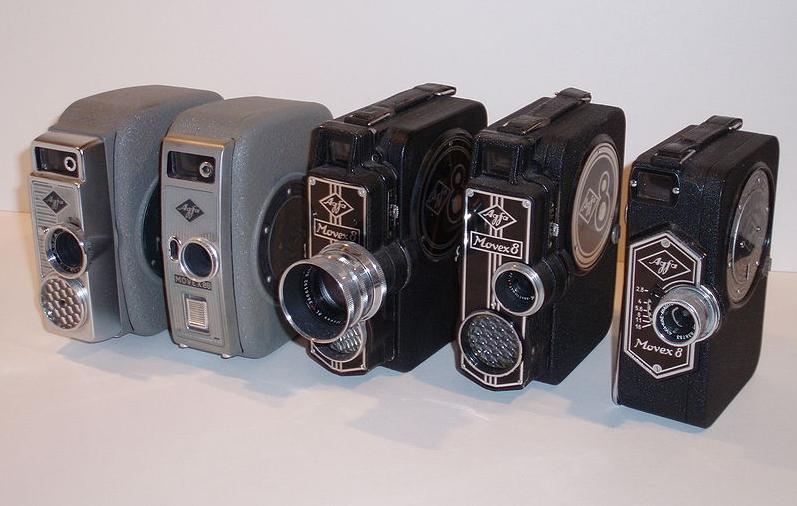

http://www.ussrphoto.com/UserContent/1672011_agfa movex8.JPG
Set of Agfa single eight cameras

Other pictures can be seen at:
Single eight camers of 1939 and 1940
http://www.samlarkameror.com/smalfilmkameror.htm

Pictures for the extreme right
http://www.samlarkameror.com/KAMERABILDER/Filmkameror/240.jpg
http://www.samlarkameror.com/KAMERABILDER/Filmkameror/240a.jpg
http://www.samlarkameror.com/KAMERABILDER/Filmkameror/240b.jpg
http://www.samlarkameror.com/KAMERABILDER/Filmkameror/240c.jpg

Pictures for the two intermetiate black cameras
The camera in the middle has a telephoto converter lens
http://www.samlarkameror.com/KAMERABILDER/Filmkameror/245.jpg
http://www.samlarkameror.com/KAMERABILDER/Filmkameror/245a.jpg
http://www.samlarkameror.com/KAMERABILDER/Filmkameror/245b.jpg
http://www.samlarkameror.com/KAMERABILDER/Filmkameror/245c.jpg

The 88 model uses standard double oight
http://www.samlarkameror.com/KAMERABILDER/Filmkameror/210.jpg

Regards
LP

Reply to Topic

Forum code enabled