Invention of Photography
"The first permanent photograph (later accidentally destroyed) was an image produced in 1826[ by the French inventor Joseph Nicйphore Niйpce. His photographs were produced on a polished pewter plate covered with a petroleum derivative called bitumen of Judea, which he then dissolved in white petroleum. Bitumen hardens with exposure to light. The unhardened material may then be washed away and the metal plate polished, rendering a positive image with light regions of hardened bitumen and dark regions of bare pewter. Niйpce then began experimenting with silver compounds based on a Johann Heinrich Schultz discovery in 1727 that silver nitrate (AgNO3) darkens when exposed to light.
In partnership, Niйpce (in Chalon-sur-Saфne) and Louis Daguerre (in Paris) refined the existing silver process. In 1833 Niйpce died of a stroke, leaving his notes to Daguerre. While he had no scientific background, Daguerre made two pivotal contributions to the process. He discovered that exposing the silver first to iodine vapour before exposure to light, and then to mercury fumes after the photograph was taken, could form a latent image. Bathing the plate in a salt bath then fixes the image. On January 7, 1839 Daguerre announced that he had invented a process using silver on a copper plate called the daguerreotype, and displayed the first plate. The French government bought the patent and almost immediately (on August 19 of that year) made it public domain."
http://en.wikipedia.org/wiki/History_of_photographyRegards, Bill
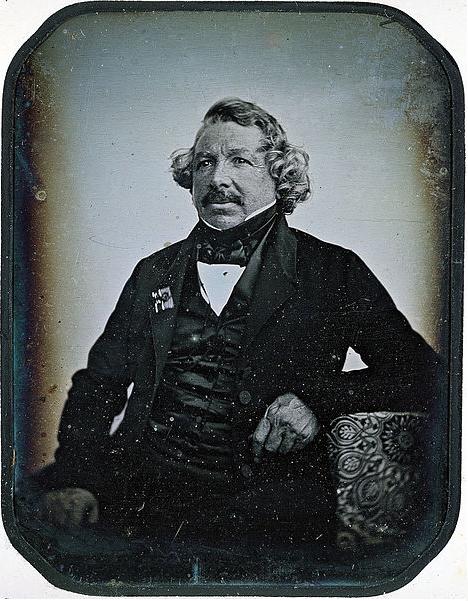



 (http://www.club-daguerre.de).