USSRPhoto.com

Forums / Collectors and Users Open Forum

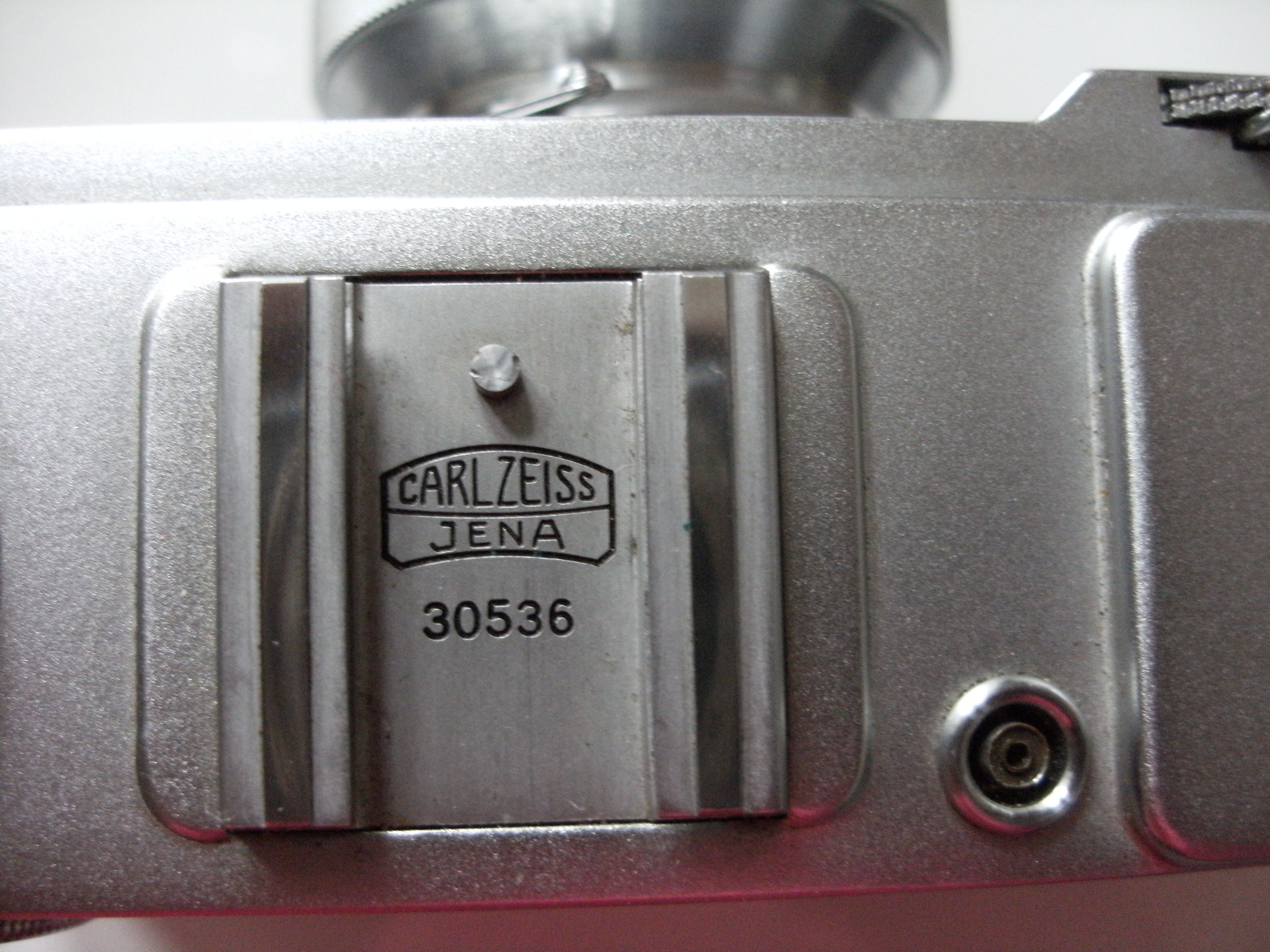
A curious Contax II

59 posts in this thread showing replies 21-40 of 58
Reply with Quote Edit Reply Delete Reply
Jacques
there is no doubt about diferences in helicoid between TSVVS and Contaxes but what you has shown is a very strange fact.
Although lenses boyond normal ones could fit on this Contax prototype, they will never focus properly. Pictures seems to me that this helicoid is prepaired to receive Nikon lenses.
At the same time one must remenber the unknown câmera, on Princelle book perhaps a TSVVS 2, should also have such diferente helicoid
see http://ussrphoto.com/wiki/default.asp?WikiCatID=50&ParentID=49&ContentID=316 and if possible obtain details on scale marks os such câmera in the Milos collection
oher pictures at
http://www.novacon.com.br/odditycameras/tsvvs2.htm
and
http://www.novacon.com.br/odditycameras/tsvvs.htm
Regards
LP

Reply with Quote Edit Reply Delete Reply

Hi Luiz!

You say that this helicoïd should receive Nikon lenses...
I know the differences between Contax/Nikon mount, but you can say that just by the outside?

Has it something to see with the lens, a 2,8 Tessar, rather than a 1,5 Sonnar which is much better?

Jacques.
Reply with Quote Edit Reply Delete Reply
My dear Jacques
Nikon or Contax mounts operates through two diferente principles
Normal lenses focuses through axial displacement together rangefinder
nothing anormal and exactly as all other câmeras.

Accessory objectives operates through ANGULAR displacement of the bayoner which differ on this prototype from Contax/Kiev câmeras

Remember that each accessory lens has its own helicoid whose angular displacement must equals the original câmera helicoid for correct focusing.

One can use normal lenses from Kiev, Contaxes or Nikon albeit their diferent focus length because he error will follow in the tolerance standards

But the angular evolvement of the telephotos will largely differ in the mounts not prepared to match. Remember each lens has its own focusing thread.

Regards
LP

Reply with Quote Edit Reply Delete Reply
From the outside!

observe the angle formed between the segmenst that came from the center of optical axis to 0.9 and the other to infinity

in this prototye it is much near to Nikons than true Contaxes

LP
Reply with Quote Edit Reply Delete Reply
Dear Jacques and Luiz

My explanation of this strange "Nikon" bayonet is very simple. Most probably Zeiss engineers were asked by Soviets to construct new Kiev cameras in such a way that it would accept optics with Leica-standard lens flange-to-film plane distance. Since Soviets were concentrated on mass production in huge quantities of interchangeable lenses this requirement would simplify the production of lenses for FED-like and Contax-like cameras.

It seems that Nikon chosen this strange bayonet pitch by mistake and it seems that Zeiss had requirement to go to Leica standard but by some reason this idea was abandoned. Probably Soviets had too much Contaxes from Dresden to refurbish them with new bayonets.

best regards
altix
Reply with Quote Edit Reply Delete Reply
Hello Jacques.
Apologies if this repeat previous people’s observations on this special Contax. I have a book by Minoru Sasaki, which has many photos comparing Dresden, Jena Contaxes and Kiev’s. I have also compared various cameras in my own collection.

The different spacing of the shutter speeds is strange – basically for the Contax type shutter to achieve the ‘B’ setting it needs to be wound a specific distance. Now, if on this special Contax, the actual distance between 1:1250 and ‘B’ is less, than it implies the design and gearing of the shutter mechanism is totally different to either Dresden, Jena Contax or the Kiev.

Rangefinder screws (from the picture on ZICG pages, not posted here) – this is of the Dresden type.

Focussing mount – Engraved on the front face to 0.9 meters same as TSVVS and Nikon – the engravings are differently spaced to a standard Contax as 0,9 on my examples would line up with the first screw of the bayonet locking spring. So looks like a TSVVS type threaded portion of the mount was used – the outer part is different to either Jena , Dresden or Kiev as it is missing a slight kick-down in the pressing (bottom left as seen from the front of the camera).
Jena Contax focus mounts used a round topped number 3 with a comma for the decimal; the dot appears to start being used around 1949. So the flat topped Jena style 3 is interesting – the method of engraving looks different to the Dresden method, and to the TSVVS style.

Shield for large flywheel gear inside camera – this seems to be built into the camera body itself and is missing from the chrome front plate – again unique.

‘C’ of Contax is more like that seen on the post-war Contax IIa cameras, and is out of alignment with the rest of the name.

Bezel around the frame counter appears to be like the Jena Contax, i.e. more pronounced ridge.

This is certainly a strange camera - I wonder if it is worth contacting the Zeiss Historica Society for any information?

Cheers,

Steve
Reply with Quote Edit Reply Delete Reply

Hi Steve!

Many thanks for your comments! and if you have a Sasaki's book in double, think of me...

About the speed ring, there is no difference in the spacing, just in the position of the ring which was "turned" of some degrees to the right, when looking at the front of the camera. I must say that the speeds are fully working, except the "B" position.

The focussing range is special. Certainly, there must be an explanation: it's difficult to imagine that the engineers didn't know the basical characteristics of the Contax baionnet. So, the modifications would be dued to researches, as Altix says?
The inside of the mount is very interesting too, by its metallurgy. Even the internal baionnets are different...

I had forgotten to point the "Contax" logo. The "dancing" position of the "C" and the stroke of the "t" (too high!) were other strange détails, in fact the most evident at first glance.

I will contact soon the Zeiss Historica Society if we have no news through the ZICG.

Amitiés. Jacques.
Reply with Quote Edit Reply Delete Reply
Dear Luiz,

The PC socket on this camera seems to be original. So it is also from 1953 Question Smile


http://www.ussrphoto.com/UserContent/952015_51.jpg

Ok, jokes aside.
The PC socket of Jacques Contax looks like to be taken from the Prontor or Compur shutter. This connection is not professionally made. The flash synchronization cable can slip very easily which is irritating if you use disposable flash bulbs and your shutter does not allow double exposures (e.g. as on Nikon M,S). Initially flash synchronization slots were double like on Exaktas. The plug of synchronization cable in this case firmly connects to the sockets and cannot be easily slip during taking flash photography. This is because friction between socket and plug is twice as much for double connection than for the single one. The cable in this case is also not so easy to take out since you need to pull it strictly perpendicular to the plane with two sockets.

The Prontor and Compur shutters from fifties had one socket since it is the most elegant and cheapest way to attach the synchronization cable to central shutter. If you look on the PC connection on these shutters you will see that the shutter housing form a round rim around the PC connection itself. This rim helps to hold the plug and cause additional friction between the plug and the socket. This constructive feature protects PC plug to slip easily during taking the flash photography. In the same way all good PC connections on cameras have additional rim like the Jena Contax here http://www3.telus.net/public/rpnchbck/zconrfKiev.htm or PC connection on later Kiev cameras.

So I do not believe that this synchronization connector was done by Zeiss. The engineers there were not stupid to put the connector without the rim as they did on later Jena Contaxes. It was done by some repairman who had spare part from central shutter and used them for upgrading this camera. Same type of connectors without the rim I saw on several FED NKVD that were upgraded for flash photography. There sockets from central shutters were use in order not to spoil the top plate aesthetics.

with best regards
altix

Reply with Quote Edit Reply Delete Reply
Hello,

Jacques was very kind to give me the opportunity to inspect the curious Contax. The inspection is not finished yet but I would like to share some observations and findings. I use for reference Jacques Kiev 1948 and my no-number Kiev that is almost Dresden Contax.

In general the curious Contax, which i tend to call "Ur-Contax Jena", is very well made camera assembled from well manufactured details and good materials. It is definitely the creation of camera production factory. Some details were modified after the production manually for better fit of details. In general it has very high similarity with the standard Contax cameras. However some mechanisms of the shutter were redesigned or improved.

The inspection of bolts that hold the shutter assembly showed that this camera was repaired someday. I tend to believe that it was the repairman who installed the flash synchronization mechanism. Some other details also support this conclusion. The synchronization mechanism is very smart and it seems that it was designed to work with bulb flashes only.

The most striking feature of Ur-Contax is the completely different concept of rangefinder focusing from the standard one. It is of Leica type (no sliding wedges anymore!) with original coupling to the bayonet.

Here is the picture of two partly dismantled bodies of Kiev 1948 (top) and Ur-Contax (bottom).


http://www.ussrphoto.com/UserContent/18102015_p5.jpg

The closer look into rangefinder mechanism. The brass tube (idicated by yellow) is hollow and was placed there in order to make the flare effects smaller. I am not sure if it was originally installed. Probably it is later modification together with synchronization


http://www.ussrphoto.com/UserContent/18102015_p6a.jpg

The drawing of rangefinder scheme from above for Ur-Contax (top) and Kiev 1948 (bottom)


http://www.ussrphoto.com/UserContent/18102015_p1.JPG

The close-up of rotating mirror

http://www.ussrphoto.com/UserContent/18102015_p3.jpg


http://www.ussrphoto.com/UserContent/18102015_p4.jpg

The mechanical coupling to the bayonet is similar in many respects with the standard one. The mirror rotating mechanism and its coupling to the focusing wheel differs however in many respects from the mechanism of sliding wedges.


http://www.ussrphoto.com/UserContent/18102015_p2.JPG

This rangefinder was cheaper to manufacture than the standard one, however it gives poorer visibility and is less precise. I think that after trying this system on a prototype camera it was decided to equip after-war Contaxes and Kievs with the sliding wedge rangefinders.

altix

Reply with Quote Edit Reply Delete Reply

Fantastic job, Altix!

So, this camera is certainly a prototype based on the trial of a new rangefinder. I imagine the German workers, urged by the Red Army to build a new Contax range, trying different solutions to lower costs and spare time. All that before they could restore the drawings...

Certainly we will have other surprises with the mechanism and the bayonet.

Thanks, Altix, for your fine and perfectly clear drawings...

Amitiés. Jacques.
Reply with Quote Edit Reply Delete Reply
Hi, the Contax type pencil prism and sliding wedges would have been quite a complex optical assembly to make. That optical wedge looks somewhat like the FED/Zorki type wedge, which coincidentally lived in a square tube in the FED. I think you are right - this looks like a 'what-if' prototype to see if the Leica/FED type RF could be used should the pencil prism etc., prove hard to manufacture. The gearing would have had to be re-calculated to allow for the approx 3 degree wedge movement needed to focus from 3ft to infinity.
Point is, when was it made? Was it an early prototype, or something that was later adapted to test the swinging prism set-up.

Cheers,

Steve
Reply with Quote Edit Reply Delete Reply

Probably, this camera was made during a "hollow" period of the factory. By hollow, I mean a period of research, when you have nothing sure as a real basis to produce a complete camera.

An ordinary prototype would have been an adaptation . A Contax O series or a Jena Contax modified to try this new rangefinder. It's not the case here: we have too many new parts which are not in relation with the rangefinder. The "Contax" on the front, the chrome, the arrow on the rewind button, the main screws inside, the back, and even the camera body itself are slightly different.

But I don't have the camera for the moment. Altix will tell more, for sure.

Amitiés. Jacques.

Reply to Topic

Forum code enabled