
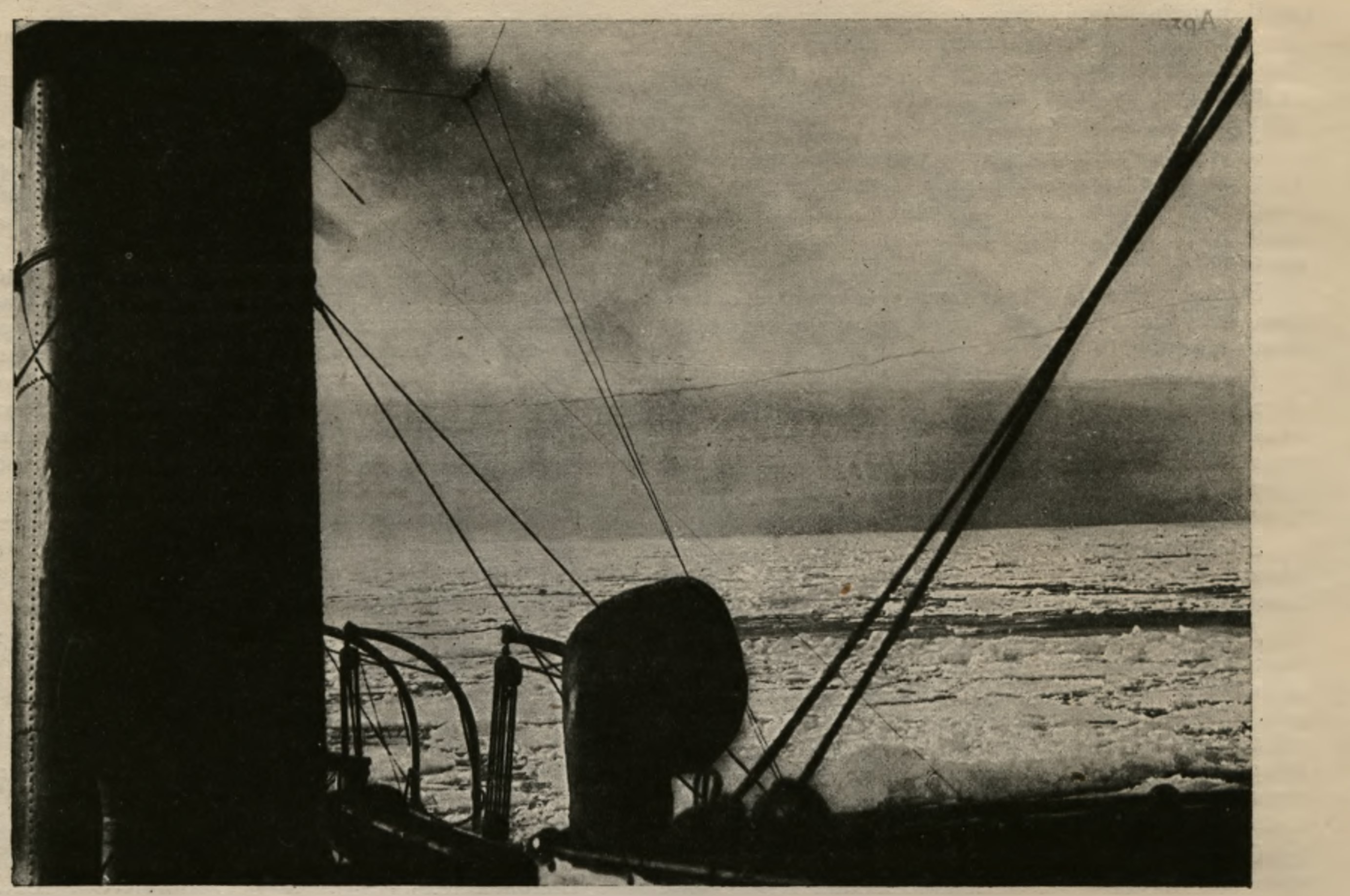
Travel-notes by Z. Ostrovsky, the lone — and amateur — photographer of the icebreaker “Malygin” on its search for the airship “Italia.” The editors use them to expose a scandal: the expedition, of world-historic significance, was sent off with eight journalists and not one experienced photo-reporter (the “Krasin” had none either). With three cassettes, a borrowed English reflex, plates cut by a 10-rouble diamond bought from a Murmansk watchmaker, water filtered through coal, and a developing-cabin crawling with cockroaches, the beginner nonetheless brought home some 200 negatives, 150 usable — which for a month filled the Soviet and part of the foreign press.
The travel-notes of one of the participants of the “Malygin” expedition are interesting, of course, in that they are written by a photo-amateur. But these same notes reveal one incomprehensible thing — the expedition forgot to send experienced Soviet photo-reporters. As far as we know, there were none on the “Krasin” either. Thus the icy campaign of the Soviet icebreakers — a campaign of historic world significance — was not served in due measure by photo-reportage.
Eight journalists — and not one photo-correspondent… This I learned on the very first day, when I arrived in Arkhangelsk to board the icebreaker “Malygin,” which was going in search of the airship “Italia.” Later the number of journalists fell to five, but of a photo-correspondent there was still not one. One can imagine the great responsibility I — a young, beginning photo-correspondent — felt on my shoulders. By the will of fate I turned out the sole photo-fixer of so complex and responsible an expedition. With mournful love I examined my reflex for the hundredth time. Alas, with the camera there were in all three cassettes! And that was all.
With hope the journalists and all the participants glanced at me, still in Arkhangelsk. I knew what they thought: “Here is the man who will supply the whole press with shots, will fix and show the world the campaign of the ‘Malygin’ from beginning to end…” They cared for me tenderly. My conscience tormented me when I caught the glances of my comrades and when they spoke of my future photographs. I hid my helplessness from all… I was ashamed for myself and for those who had equipped me for this expedition. Three cassettes! But I did not sit idle. I fought for my future photo-work with all my strength. From Moscow I had got ready literally within two hours; my camera was torn from the hands of the master who “had not managed” to remake the back wall to the size for which there were cassettes in Moscow.
But in Arkhangelsk I was ready for anything. Quickly finding several amateur and professional photographers, I offered to trade; alas, there were no takers for a camera with three cassettes. A complex plan of negotiations was worked out with a certain citizen who had an English camera of my size — 8×10½ cm — with a fabulous store of cassettes and a plate-magazine; these negotiations gave no result. My stock of plates of my size proved insufficient in Moscow and Arkhangelsk; I had to buy 13×18 cm to cut later, but to my horror I could find no diamond in Arkhangelsk. In Murmansk, where we soon arrived, I set out to find a diamond at any cost. The day was a Sunday, trade was dead; luckily I dropped in on a watchmaker, who showed me a good diamond, with which he there and then cut mirror-glass. “How much?” — “10 roubles…” I stoically endured this frank robbery.
The open sea… We are desperately tossed. We wait for the ice, the longed-for ice, dreaming of it as only one exhausted by long sleepless labour can dream of bed. There can be no talk of any shooting when the sea “takes” you. In the rare minutes when the sea calmed, the cine-operator and I dreamed of how we would set up photo-laboratories when we entered the ice. The sailors assured us: “In the ice it will be good. We shall go as if over parquet…” And the ice showed sooner than could be supposed: on the third day out of the Kola Gulf the sea calmed, and twelve hours later the small separate floes gave way to huge solid fields of floating ice. As if enchanted, we watched from the forecastle how the ship, bearing down with all its weight, broke the ice-fields in two and freed itself a path. Here the photometer — the “Diaphot” of Ika, whose readings I usually trusted — began to deceive: when by my supposition one could boldly shoot at 1/100 second, it showed 1/25; fearing under- or over-exposure, I agreed with myself to take the mean between the meter’s reading and what I judged by eye.
I did not mean to develop all the negatives here on the icebreaker, but it was absolutely necessary to check the exposure. All who could help came to meet me — though not without self-interest: everyone who lifted a finger thought it his duty to remind me that he hoped to get a photo-shot, and I scattered promises right and left. In return, the boatswain sat a whole night fitting up a dark room, the stoker made water from steam drop by drop, the cook hospitably opened the galley where plates could be washed in fresh water. But what water it was! We had taken fresh water in Arkhangelsk, from the yellow-turbid Northern Dvina; in the boilers and ballast tanks of the “Malygin” it only grew dirtier. Over two days I filtered the litre and a half needed for developing, drop by drop, through ten superimposed layers of coal and blotting-paper. The second-class cabin given me for the purpose swarmed with cockroaches: during development they crawled under my clothes, into the cuvettes; turn away for a minute and whole parties of them were on top of the emulsion. I had to abandon the idea — the first and last time I used that developing-cabin. To my boundless chagrin I learned that not one of the exposures I had so far made proved correct.
Of the 33 days of sailing in the ice, the indifferently-stern nature of the north smiled on us with only seven days of bright sun; all the rest was fog, white and thick as milk. How to photograph when at two or three paces an object cannot be made out? And there were many such days. For long hours I stood on deck or on the captain’s bridge to catch the instant when the dim sun broke through the thickness of the white haze — and these instants were so few that at times, in despair, leaving the bridge, I lost all hope of bringing back tolerable shots. So it was at Hope Island, around which the “Malygin” drifted about nine days: I made no fewer than twenty shots of it, of which only three or four came out well. Special attention, as a photographer, I had to give to the flight part of our expedition: before each flight I went out onto the ice to shoot the start of the aeroplane, and when Babushkin returned I was again first on the improvised aerodromes — the floating floes — meeting the brave flier with the click of the shutter.
Arctic ice-and-water landscape still appears to the participants in dreams and endlessly lures them back. The Arctic is fine when the bright sun shines: the brilliant-white snow, flecked only now and then by the black spot of a seal crawled out to warm itself; sun and snow merge into a blinding, eye-cutting light, so sharp that without dark “conserve” goggles one cannot look. However close the white bears came to the icebreaker, the distance was still 20–30 paces, and without a telephoto there was nothing to think of in a “bear-hunt”; in general a telephoto is absolutely necessary for work in the Arctic. But then — fog; the wind strengthens, snow falls; the ice-needles and hail quickly turn to a blizzard that plasters the eyes and seems about to bury you, and all around nothing is visible — the white shroud hides objects at two or three paces, and you seem buried alive in the ice. All this, of course, could not be caught; and now, recalling that fairy campaign in the Arctic, one realises one’s full helplessness as a photo-fixer.
Still, I clicked the shutter tirelessly, peered into panoramas and landscapes, made one and the same shot ten times over. But I was in all only a photo-amateur, venturing for the first time as an independent photo-correspondent — and only because the special photo-correspondents did not rouse themselves for this trip, or simply slept through it. We had not yet reached the highest point of northern latitude the heavy ice let us reach when my stock of plates of my size ran out. With horror I thought that my work was growing many times harder: I should have to cut the plates. Of course that is not so complex when you sit at home — but I was not at home, but on an icebreaker that shook every minute from the blows of the ice and heeled over; there was not one place that could be called a horizontal plane. Several hours I spent in the icebreaker’s machine-shop making a template of brass-aluminium for cutting plates to the needed size; then I set to cutting. For a long time nothing came of it — the magnificent ten-rouble diamond with which the Murmansk watchmaker had cut mirror-glass before my eyes almost refused to serve, and I spoiled more than a dozen plates before I adapted to the work. Alas, by the time I had learned to cut plates properly, we had almost got out of the ice to its edge; the “Malygin” had run out of coal and fresh water, and I had run out of hope of returning the irretrievably-lost ice-landscapes.
The voyage lasted 50 days. My impatience as we neared Arkhangelsk was chiefly the wish to see the results of my photographic labours. My heart beat hard when the first plates sank into the freshly-prepared developer and vanished in the solution. I do not know whether to put it to my caution at shooting or to chance, but the reject rate did not exceed 15%. I consider myself entitled to draw here some results of my work. They are modest — more modest than one might imagine. The single consolation left to my share is that even these modest results our expedition would not have had, if I had not, despairing from the very start, taken with me the camera with the notorious three cassettes. I brought back about two hundred negatives, 150 of them quite usable. During the first month after my return, the whole Soviet press, and partly the foreign, was filled with shots of my work. Let our photo-organisations draw the conclusion from these lines. Who will now seriously assert that the photographs fixing the exceptionally complex historic campaign of the “Malygin” are less important than the tens of thousands of words transmitted by the special correspondents the big and small Soviet press had on the “Krasin” and “Malygin” expeditions?
— Z. Ostrovsky