USSRPhoto.com

Forums / Collectors and Users Open Forum

Fed Red Flag

74 posts in this thread showing replies 41-60 of 73
Reply with Quote Edit Reply Delete Reply
I see you have become an avid collector of NKAP fakes!

The history of these is interesting in itself, I wonder when they were made. Nowadays it's probably too expensive and people lack the skill and equipment. My guess would be 80s-90s?

Maybe we should distinguish the 2 types of probable fakes - big and small letters - in the wiki?
Reply with Quote Edit Reply Delete Reply

Ha! Thanks for your comment, Christian! I was feeling a bit alone on this thread...
Probably the fakes can help to identify the genuine cameras, when they belong to rare series. It's the case here: we have two probable series of fakes, with a stronger identity than the genuine ones! Now, I am nearly sure that the only certain parameter is the engraving of the cover.

I am going to complete the wiki.

Amitiés. Jacques.
Reply with Quote Edit Reply Delete Reply

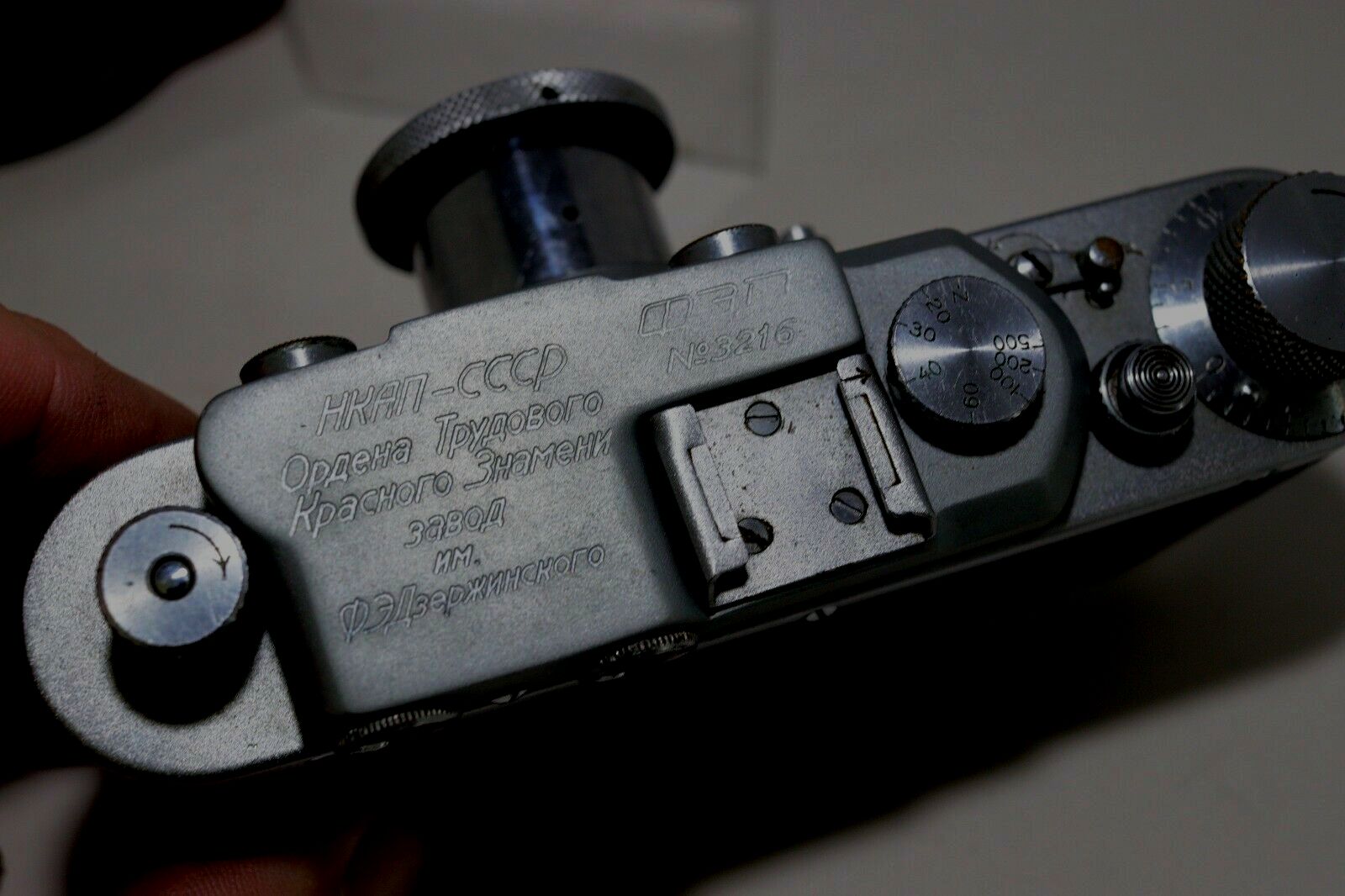
I have just received the fake Red Flag # 3216.
Nothing really particular. Very probably, it was originally a Fed 1d (or perhaps a 1e), which is confirmed by the s/n of the lens: 158001. Something strange about the lens: though with a prewar scale of diaphs (3,5 - 4,5 - 6,3 etc), it is coated.
I hoped that the internal date could help to identify the body, but it is only half visible (29/?).

A photo of the cover, with the engraving:


http://www.ussrphoto.com/UserContent2/2142020_IMG_0091.JPG

Reply with Quote Edit Reply Delete Reply
Jacques, do any of your obvious fakes have traits we consider "original"?
What about vulcanite, milling and yellow viewfinder, shutterbox?
If so, could you make list or table with all your Red Flag cameras, "original" and "fake" and their traits for comparison?

About the coated lens, it's relatively easy for a repairman to replace the lenses, I had this done in one of my FED1 I use for photography.

What makes me wonder the most is the fine milling. Do we know that these parts are truly identical with FED1'a' or are they exclusively made for the Red Flag?
It is hard to imagine why exactly 'a' parts should have either been shipped to Berdsk in larger quantities or survived the war in Kharkow. Both makes no sense and we're talking about quantities of many hundred of not thousand. Then again many RF seem to be made from parts of relatively early cameras. Maybe they kept those parts in the factory. who knows?

Also the yellow viewfinder - where did it come from?
By the way, my FED 1'a' #1233 has a yellow viewfinder as well. Was this seen in any other early FED1'a'?
Reply with Quote Edit Reply Delete Reply

None of my two obvious fakes has what we consider as "original" features.
About your demand, I can compare my Red Flags under the following parameters:
- vulcanite,
- milling of main buttons,
- milling of releasing button,
- shutterbox
- film plate,
- engraving,
- magnetic properties of the two plates and the cover.

Do you see something else?

About the milling of the main buttons, it is fine on Red Flags. But not so fine as on my 1a-s. I cannot say if this type of milling had been used previously on the NKVD-s: problems of sight. In fact, that question is poorly documented: one usually counts two types of milling (fine and coarse); there are probably at least four: "ultra" fine (1a), fine (1b), coarse (from 1c) and the Red Flag one, between the 1a and the early 1b as it seems to me. But all that must be checked.

Concerning the rangefinder, all my RF have a normal one, except my #200209 (yellow). As to say why...
Reply with Quote Edit Reply Delete Reply
Yes, that would be great!
I could think of chrome properties of the top plate (seems coarse on the ones we deem original).
If you have an accurate scale, weighting the cameras wihout lens and spool would probably be interesting too. And maybe - if you can say - the type of FED you think was used for the body.

Regarding the milling I had forgotten it is also found in early b, I will check mine and provide pictures.
We should make an extra thread as it concerns different types of cameras.
Good macro photos should help, apart from that all I can think of is measuring the diameter of the knobs with a caliper but I have none right now.


About the yellow rangefinder, no idea why it is on my early FED1'a' either. The rings are original brass. If we assume the Red Flag was made from parts these yellow pieces must have come from somewhere. But in a single camera it may as well be some later modification and repair. Doesn't TSVVS also have yellow rangefinders?

Well, one step at a time, I am preparing further thoughts on the Red Flag to post in the coming days but I'd like an overview over the properties of the cameras first...
Reply with Quote Edit Reply Delete Reply
So, a short comparison between my 5 "so called" Red Flags.

-----------------------.-----200068---.-----200209---.----200898---.----200977---.----3216------.

-vulcanite-------------.----1d type---.---stretched--.---1d type---.---stretched-.---1d type----.
-milling main buttons--.-----coarse---.-----fine-----.---coarse----.----fine-----.----coarse----.
-diam. main buttons----.--18,5mm-12mm-.-18,7mm-12mm--.-18,5mm-12mm-.-18,4mm-12mm-.-18,4mm-12mm--.
-milling disc. button--.---very fine--.----coarse----.--very fine--.---coarse----.--very fine---.
-engraving on cover----.-----bad------.---correct----.---correct---.---correct---.----bad-------.
-magn. cover-----------.-----No-------.------No------.-----No------.-----No------.-----No-------.
-magn. upper plate-----.-----No-------.------No------.-----No------.-----No------.-----Yes------.
-magn. baseplate-------.-----No-------.------No------.-----No------.-----No------.-----Yes------.
-shutterbox------------.----steel-----.----brass-----.----steel----.----brass----.----steel-----.
-film plate------------.-----hole-----.---No hole----.----hole-----.---No hole---.---No hole----.
-magn. film plate------.-----Yes------.------No------.-----Yes-----.-----No------.-----Yes------.
-weight (nude)---------.-----415g-----.-----414g-----.-----401g----.-----412g----.-----406g-----.

Some particular remarks to come.

Reply with Quote Edit Reply Delete Reply
So, some remarks about these cameras.

-The s/n 200209 and 200977 represent the "classical" Red Flag, as shown everywhere, with a vulcanite with horizontal stripes (stretched) (can be seen too on very early 1f), main buttons with fine milling (not far from the 1a), shutterbox made of brass (iron on 1e "Berdsk, brass on early 1f), and the engraving considered as "correct".
Two light differences: two letters are missing on the cover of the 200209 (an omission), and that same camera has a yellow patch in the finder. Like all the TSVVS I know.

-About the milling of the main buttons of these two "genuine" Red Flag, it seems a bit less finer than on my Fed 1a s/n 1453. Diameters on this 1453: 18,6mm and 11,4mm.

-The 200898 has a cover with a correct engraving, but none of the other classical features. Considering the shutterbox and the film plate, it should be a 1d, s/n c. 115/150000. An interesting extra part: the frame counter is magnetic. That cannot be found before the 1e Berdsk, and perhaps the very late 1d. My idea: a correct Red Flag mounted with spare parts.

-The 200068 is beautiful, but the lettering does not correspond to the archetype. So, a fake, unless there were a second set of tools to engrave the cover.
The body was made with parts belonging to the 115/150000 1d series, like the 200898.

-The 3216 is obviously a fake. The tints of the cover and the upper plate are too different, and one can see the yelllow of the brass appearing under the chrome (impossible to shoot that). By its features, it could belong to the late 1d or the 1e series (s/n 150000-183xxx).
The s/n range chosen for this fake is really strange...

Tell me if you need something else, Christian.
Of course, comments are welcome!

Amitiés. Jacques.
Reply with Quote Edit Reply Delete Reply
Excellent, thank you, Jacques!
So we have 3 varieties - the 'classic' RF, the 1d-type and the 4-digit with large engraving.

Interesting, I did not know about the magnetic frame counter. So all others are non-magnetic?
We need to summarize these features for each FED1 type / serial range some day, preferrably in the wiki but aso in one thread for all FED1.

I am a bit puzzeled about the high weight of #200068 though- 10g more than the other cameras with steel shutterbox - what could be the cause?

About the milling of the buttons - it seems the small disconnector knob with its coarse engraving is unique to classic RF, right? It seems more coarse and more crudely made than the ones in FED1'a' also these buttons are very different in diameter though the diamond shape milling is the same in your and Alexander Kneller's RF. Could you post your early FED1'f' for comparison?

About the main buttons - have you compared them to early FED1'b'?
Also take look on the curved arrows on top of the buttons indicating rewind direction - They look diffferent in FED'a' and 'b' though the millings seems almost indistinguishable in my cameras.

If we focus on the 'classic' RF with the stretched vulcanite and brass shutter box, we see these were not randomly assembled from some spare parts. They seem to have highly specific features.

Have you checked for engraved dates in the shutter cage of all cameras? It would be interesting to know from which serial range these brass shutter cages came from.

So film plates are non-magnetic without hole. Whre did they come from? Which other FED1 have those?

As for top plates, it really seems we have both the ones with blunt and sharp edges. Am I correct that the ones with blunt edges also have a much more coarse chroming finish than the sharp ones?
Any idea from which serial range those blunt top plates could be from?

Probably a lot of work but maybe we can determine from which sort of parts the classic RF were assembled and which were likely made from scratch.

More thoughts about the non-typical RF cameras next time...
Reply with Quote Edit Reply Delete Reply

Well, some precisions after your questions.

Concerning the film plate:
- brass with hole from my # 1453 to 104370
- some incertitude then
- steel/hole from c. 120000 to c. 150000,
- steel/no hole up to the end of the Berdsks
- steel/no hole for the first 1f.

Concerning the shutterbox:
- brass from the beginning to c. 105000
- some incertitude, then
- steel up to the end of the Berdsks.
- brass for the first 1f.

The "incertitude" corresponds of course to the period during which the old and new parts were used simultaneously.

Concerning the internal date inside the RF:
- 3216: 29/?
- 200068: 31/?
- 200209: nothing visible
- 200898: 25/?
- 200977: nothing visible.

Nothing visible: I am pretty sure for the 200209. I should dismount the 200977 to be certain (I won't do it). No chance about the months: they are just on the place erased by the cartridge...

About the disconnecting button: the milling is the same (coarse) for the classical RF and the early 1f (210064, 210455, 210921). But the diameters are different: 3,6mm on 1f-s and 4,4mm on RF-s.

I will see if I can answer some other of your questions.

Jacques.
Reply with Quote Edit Reply Delete Reply

An addition about the frame counter, magnetic on the #200898.

On the # 200898, it is easy to "decide" if the frame counter is magnetic or not, because the upper plate, just below, is not.
It is much more difficult on cameras where the upper plate is magnetic, like the 1e "Berdsks" as I never know for sure whether it is the counter or the plate which reacts to the magnet... Of course, a partial dismount would be the solution. But I am very reluctant now.

Anyway, this counter does not look like an ordinary Fed's. If the pins are at the right position, the metal is much more bright: nickel?
Reply with Quote Edit Reply Delete Reply
Things are becoming a bit clearer, at least I think. Wink

To me it seems the classic Red Flags are much closer to early 1f than to any pre-war NKVD parts.
Which means - they were probably not made with pre-war spare parts but - at least largely - with post- war newly designed and produced material.

Think about it - the brass shutter box without engraved dates, the non-magnetic film plate without holes, the milling of the knobs, even the vulcanite, everything seems unique and remained the same even after they relocated back to Kharkow.

Also if I remember correctly we are told the spare parts evacuated from Kharkow and tools never made it to Berdsk so they had to re-engineer everything in 1945-46. This saves us from explaining why seemingly mostly b/c parts but no d/e parts were used for the classic RF as one would expect. What if these are not early FED spare parts but newly made?

If the blunt-edged top plates really are unique they could be early attempts to machine these parts until they managed to return to the exact specifications. You even see tool-marks on some of them.

Look at what I found, I think this is substantial:
serial ___ top plate _ finish _______ anomalities
200146 _ blunt ____ coarse chrome
200161 _ blunt(?) _ ?
200209 _ blunt ____ coarse chrome
200333 _ blunt ____ ?
200347 _ blunt ____ coarse chrome __ coarse vulcanite
----------------------------------
200535 _ sharp ____ shiny chrome
200600 _ sharp ____ shiny chrome
200680 _ sharp ____ shiny chrome ?
200898 _ sharp ____ shiny chrome ___ 1d
200977 _ sharp ____ shiny chrome ?
201668 _ sharp ____ shiny chrome ?
201702 _ sharp ____ shiny chrome ___ 1c

More additions would be welcome!

It seems we have 2 versions of the Red Flag top plate
a) up to 200347 - unique blunt edges at speed dial, very coarse chrome
b) from 200535 - more or less normal shape of top plate with finer chrome.

I haven't looked at the dents around the disconnector in detail but things are way less chaotic or random than they seem once you only look at the RF with the classic features.

So my current theory:
RF was produced in Berdsk (Princelle's passport, photo of cameras in Berdsk)
http://ussrphoto.com/UserContent/1782013_fed%20photo.jpg
No (or few) camera parts and next to no workers ever made it to Berdsk and no FED cameras were produced during WII.
In 45-46 they started from scratch, reconstructing all the parts and tools, some not in the same way as previous models (rewind knobs, film plate, probably shutter box). At the beginning they redesigned the top plates with blunt edges and had problems with chrome. Either they later received unengraved spare top plates or - I think this is more likely - they got better tools to better reverse-engineer the original ones.

They made the majority (Princelle at least tells us about a passport for 201280) of RF at Berdsk.
After returning to Kharkow either some late RF were assembled or - more likely - they made early 1f with the parts they still had until they ran out. Then they started to produce later 1f with the new machining tools in Kharkow, substantially changing the look of the cameras.

Questions to answer:
.)What are significant differences between RF and early 1f?
.)Is there a difference in pre-war brass shutter box and RF / 1f?
.)Is there a difference in pre-war top plates, late RF and early 1f?
.)Where did the lenses for early RF / late RF / early 1f come from?
The classic type (a) with blunt edges seems to have c/d lenses, later lenses in the wiki have 4 digits like on 1f. But we need more lens serials for that.

I already asked Alexey but got no reply To bad, he has so many interesting cameras and lists on his page #200026 (coll. V. Khalatov / Russia). I'd like to see a picture, it is said to have a strange coarse vulcanite like 200347 and some early 1f. Who else could be asked for details about their RF?

Also the Berdsk thread seems highly relevant to the RF and early 1f topic and should be linked here.
https://ussrphoto.com/Forum/topic.asp?TOPIC_ID=362

Reply with Quote Edit Reply Delete Reply

Your explanation between blunt and sharp edges is interesting.

Concerning the vulcanite, we can find on the Red Flags and the very early 1f exactly the same two types: stretched, and "snowflake" (or other names), visible on Alexey site. We can find too some rare 1f with a circled shutter release button, the rule being a non-circled one from the beginning of the 1f series.

That said, my s/n 210064 is entirely normal...
Reply with Quote Edit Reply Delete Reply
Jacques, can you compare the brass shutterboxes of FED NKVD, RF und FED1f?
Maybe there is something subtle. Compare the shutterbox top plate when looking into the lens mount, behind the rangefeeler. The position of the screw there varies between FED1 series.

Until contrary evidence surfaces I am pretty convinced that most if not all parts of the classic RF were made post-war either in Berdsk or Kharkow and are not pre-war spare-parts from early FED1. To me it makes no sense that the factory in Kharkow had thousands of brass shutterboxes stockpiled while switching to metal during the FED1'd' series.
Not just enough for the RF but als for early 1f and some FED Zorki? Meanwhile no late 'e' parts are used even though these were the most recent? Even worse to explain the fine milled buttons. From FED'1a/b'? I don't believe any of it to be honest but maybe there is something to prove me wrong?

A list of RF parts not seen anywhere pre-war and definitely newly made would be helpful.
.)early top plate with blunt angles and poor chrome
.)vulcanite pattern
.)disconnector button
.)non-magnetic film plate without hole
.)main buttons with fine milling(?)

Of course the inner workings of the speed selector and rangefinder would be highly interesting but I would not want to take a classic RF apart either...
Reply with Quote Edit Reply Delete Reply
Frankly, I am not in the possibility to draw conclusions concerning the parts which were used to make the RF... My feeling is that it would have been easier to use 1d/1e parts, when possible and if they existed. And for the rest, re-make the missing parts.

My RF # 200977 (my "most" classic RF) has an interesting belt, with curious irregularities on the area in contact with the baseplate. Visibly, the casting of alloy was not simple for this camera, and it cannot belong to the 1d/1e series. So certainly it was specially made. My # 200209 has some identical irregularities on the same zone, but less sharp. Nothing on the three other ones. Perhaps a discriminant feature?

About some other features:
- the shutter box has always that non-bright paint on the "classic" RF, with a type of screws well shown by Alexey. It's the same on my Fed Arsenal, but with a magnetic shutter box. All that is completely different on the 1f, including the early ones: bright paint and chrome screws and bolts.
- the vulcanite, "romashka" or stretched on classic RF and very first 1f. I have never seen these coverings on other Feds, including the Fed Arsenal.

For the moment, it's all I can say. About my feeling, I think too that it should not be very easy to make a series of working shutter boxes, from nothing. I have read somewhere that Fed had always 12/15000 complete sets of parts in advance. The problem is perhaps to know where they were in 1946...

Amitiés. Jacques.


Reply with Quote Edit Reply Delete Reply
This is still interesting!
If you find the time please provide a photo of the irregularities on the belt.

Anyway we can safely dismiss the hypothesis that Red Flag was fully built from pre-war NKVD spare parts from the FED factory. Clearly at least some parts had to be re-engineered post-war and we have evidence this was not without problems.

The brass shutter box is still the most interesting part for me. So the RF one is different from early 1f. This is not surprising if we assume RF was made in Berdsk from early-production parts while 1f was the first post-war mass production back at Kharkow.

Again, not impossible that FED had all the necessary spare parts but I find it extremely hard to believe they had so many b/c parts shipped to Berdsk but no or few d/e parts. Unfortunately there is little solid documentation about the fate of the parts but it seems consensus now at least the vast majority never made it to Berdsk but was stored elsewhere during the war and then distributed to KMZ/Arsenal while FED started from scratch.

Currently my opinion is that if Princelle's passport is correct, most likely all RF were built in Berdsk. It is unreasonable to assume FED continued to build a few hundred identical cameras after moving all machinery to Kharkow before switching to 1f. This is simply not economical and the time of war turmoil or urgent military demand was over at that time. It is more logical to assume FED started producing 1f in Kharkow with new machinery and a new logo.

The only way to solve this would probably be checking camera / lens serial ratio and see if we find any changes but we have too far serials for that. However it seems all 'classic' RF have a 4-digit lens serial. We should pay more attention to these lenses as well, I feel. Do they show any oddities compared to NKVD and 1f lenses?

Also my personal opinion is that 'non-classic' Red Flag are not original factory work but a later attempt to save the RF top plate and sell it to collectors. Surely it was known a RF top was something rare even in the early days of camera collecting. While I have no proof, the random serial distribution and the use of seemingly original NKVD-bodies except for the top plate gives some evidence. Also it seems clear the factory was able to build characteristic 'classic' RF right from the start, even if with some lower-quality parts. There is no reason to assume they had to cannibalize used NKVD cameras randolmly in between regular production.

Again all this is just my opinion based on the current state of our knowledge which is still not great. And of course open to debate. I'd be delighted if anyone could disprove my hypotheses.
Reply with Quote Edit Reply Delete Reply

Here is a photo showing the main irregularity. I have others if necessary.


http://www.ussrphoto.com/UserContent2/2752020_IMG_0139.JPG

Just a remark about the early 1f. I have several of them, and they really have beautiful covers, with very fine and precise engravings. One feels that the tools are new! But I wonder about the "flower" and "stretched" vulcanite on some of these early 1f. That means that we had a transport too from Berdsk to Kharkov. So, why not for other parts? Unhappily, I don't own one of these rare 1f to compare with the others.

Now, that the non-classic Red Flags were not originally made at the factory, it is well possible. But I am a bit doubtful, as the tradition was rather to use old parts with new ones, when possible. Only a feeling.

Anybody else to debate?Cool

Amitiés. Jacques.


Reply with Quote Edit Reply Delete Reply
Thank you, good find!
So we can assume this camera body was a new construction as well.

I was wondering too about the erratic snowflake vulcanite. How is this pattern produced and how is it applied to the camera? Does anyone know about the technical process and machinery?

Reply to Topic

Forum code enabled