USSRPhoto.com

Forums / Collectors and Users Open Forum

Fed Red Flag

74 posts in this thread showing replies 61-73 of 73
Reply with Quote Edit Reply Delete Reply
quote:
Originally posted by Niko80

Surely it was known a RF top was something rare even in the early days of camera collecting.


Well, around the millennium the value of USSR FRs was not much in the FSU-countries. It was easy to buy them for 20 euros in Estonia. And none of the sellers (pawn shops, antique shops etc) knew if one version was more valuable. If I would only have known how the value will grow, I would have bought them all...

Best regards,
Juhani
Reply with Quote Edit Reply Delete Reply
Another year has already passed. Unfortunately I have not come up with anything new regarding the FED NKAP but I noticed Jacques changed the wiki.

It used to be:
201759 __ 01000/132 ___________ private
now this lens is used by another camera.
201657 __ 01000/132 ___________ eBay

What caused this change?
Interestingly the new pairing fits way better into my regression line. It is an excellent fit with a R² of 0,94 (1 is max).

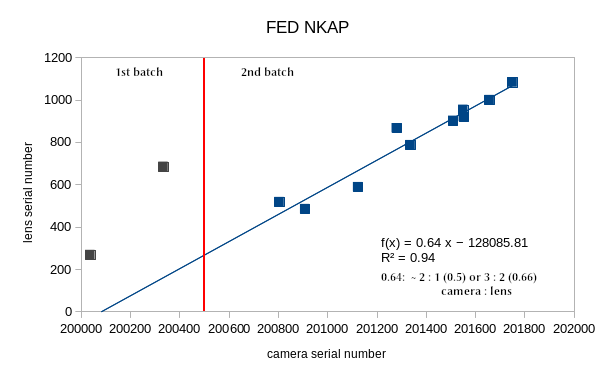
What we see here are 13 pairs of FED NKAP cameras with a 4-digit #0XXX lens. One from Jacques was omitted as he states the pairing is not original and a macro lens.

http://www.ussrphoto.com/UserContent2/462021_FED NKAP camera-lens 06_21.png

For the 2nd NKAP batch from about #200.500 onward these lenses apparently were paired with cameras in a specific way.

We would expect camera serials to start at 200.000 and lens serials at 1 and then roughly rise 1:1. For every camera serial the lens serial rises per one on average with more or less equal outliers grouping left and right as they poured together batches of cameras and lenses.
But obviously this cannot be true as quite some Red Flag cameras come with different lenses.

Now while the 13 cam-lens pairs with reasonable 3-4digit numbers group very well along a regression line pretty much like with the FED-S, things do not work as expected. Apparently it takes more than one camera serial numbers for the lens serial number to rise by one!

The blue line is the calculated regression for our samples - with a slope of 0.64 it lies between 2:1 and 3:2. Assuming 2:1, camera serial rises 200, lens serial rises only 100. Clearly these lenses were not paired randomly with cameras.
But this only works for the 2nd NKAP batch with sharp-edged top plates and shiny chrome from around #200.500 onward. There are only two samples for the first batch and they are unusually high lens serial numbers for these early cameras. Curiously the regression line pretty much hits zero on both axes, so if we moved back to camera #200.000 in this pairing scheme of batch2 we would theoretically arrive at lens #0001. But in the real world, the 'primitive' batch1 with the blunt edged top plate and dull chrome up to about #200.500 behaves differently.

So what happened here?
I have no idea. We see something like this in the FED-S where roughly every 10th camera was picked to get paired with a 50/2 lens - at a constant ratio from mid 'c' to late 'e'.

With at least the 2nd batch of Red Flags it seems only every 2nd camera was paired with this type of lens, or 2 out of 3, or a mixture which changed over time. But not every camera.

Remember we seem to have 2 Red Flag batches - up until about #200.500 the blunt edged rangefinder housing with coarse chrome and afterwards the normal sharp-edged one with better chrome. It is possible something regarding lens-pairing changed in between, we currently have a big hole there and early data is very poor.

Still I cannot explain what is going on in the 2nd batch from 200.800 onward. Obviously they produced all serials, we see odd and even last numbers. So the only explanation is - they produced cameras in very small batches and not every one but only every second or 2 out of 3 were paired with this type of lens. The others received either other lenses or none at all. Indeed we see a number of cameras with higher-number 4digit lenses and some early ones with NKVD lenses. No idea if these are original but it makes some sense that they could not keep up with lens production. Making glass and grinding/polishing lenses is a big deal, way more than machining camera parts.

But again I cannot explain how they managed to retain the lens-camera ratio other than 1:1 over considerable time (pairs group along a straight line), not in the Red Flag and absolutely not in the FED-S. But it seems they had a well working system involving small batches of a few dozen cameras/lenses. Also for both FED-S and Red Flag it seems the pairing got tighter in later version while being more random in the beginning.
We just don't know how this was achieved or above all - why?

Alternative hypothesis:
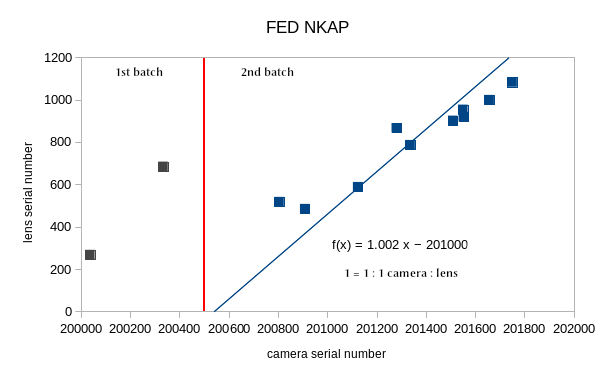
The lens:camera serial ratio for 2nd batch is indeed roughly 1:1 and we are just seeing a lot of outliers.
Things would look like this.

http://www.ussrphoto.com/UserContent2/462021_FED NKAP camera-lens 06_21 1-1.png

Impossible? Certainly not. Maybe the ratio was unstable an the beginning and flattened out towards the end. We saw something similar in FED-S'c'. Curiously this way the regression line reaches zero (or the hypothetical lens #0001) close to #200.500 where we expect the 2nd batch to start. This however excludes this lens type from the first batch meaning the two samples we see there are not original. Not improbable.

We only have 13 samples out of about 2000 produced Red Flag cameras, that's 0.65%
For the 2nd batch, omitting the beginning, 10 samples out of about 1000 which is 1% and not bad for such statistics. And these 10 form a pretty straight line to me.

Whatever happened, the take-home message is:
The 4-digit 0XXX lenses are most likely the original ones produced for the Red Flag. We cannot say if others were used in the factory. Probably at least in the 1st batch. The 2nd batch looks much more refined and behaves differently so frankly I would not be surprised if they only managed to produce these lenses for the 2nd batch and used other ones for the first, or none at all at time of production.

I remain sceptical about the entire 'reuse of pre-war parts' theory. It seems clear now that the parts for the 1st batch of Red Flag were built from scratch after the war. They did not reuse any significant FED1 parts - most likely because none of these made it to Berdsk.

My best guess is that they built the first batch of 500 cameras (mostly) without lenses as lens production lagged behind. Maybe they outfitted some cameras with old FED lenses they managed to acquire for display but organized production most likely only started with the refined 2nd batch. Which explains why the two 4-didig lens serials in the 1st batch cameras we know are unusually high. They were paired later - but maybe still at the factory during batch2 production when they managed to make lenses.


It's a shame we are still missing so many lens serial numbers. Should we at least add the ones we have to the wiki now, Jacques?

Reply with Quote Edit Reply Delete Reply

Delighted to see you back, Christian!Smile
For the changing of the lens # 01000/132 now on camera # 201657, previously on 201759, it's my own fault: I mixed numbers when recopying my listing. Hem...

Please, complete the wiki with the numbers we both have. It would be regrettable not to add them and they certainly can give some more light.

Now, I read cautiously your work. Thanks!!

Amitiés. Jacques.
Reply with Quote Edit Reply Delete Reply
Jacques,

I'll blow the dust off the thread :-)

I now also have a Red Flag, serial number 200214. The engravings on the top look original, the shutter housing is made of brass. The lens has the number 566 engraved on it and the rangefinder spot is yellow. But it has a normal housing with the normal vulcanite like later ones.

I will take pictures of the disassembly soon, when I have reassembled the Zorki 3.

Ulrich


http://fotos.cconin.de
Reply with Quote Edit Reply Delete Reply
Jacques,

some pictures of my Red Flag. The engraving on the top seems to be real from the proportions of the text. And as you can see on the inside of the top, nothing has been pressed out, so it appears to be genuine.
The shutter box is made of brass, with 30.XII 49 engraved on the side. Whether the date fits is the question...


http://www.ussrphoto.com/UserContent2/3132024_IMGL6911.jpg


http://www.ussrphoto.com/UserContent2/3132024_IMGL6919.jpg


http://www.ussrphoto.com/UserContent2/3132024_IMGL6912.jpg


http://www.ussrphoto.com/UserContent2/3132024_IMGL6915.jpg

Jacques, as you can see there is an irregularity in the chrome at the same place on my top, whether this is a sign of authenticity or a fake remains to be seen :-)
The lens has No. 566 engraved on it.
More pictures soon.


http://www.ussrphoto.com/UserContent2/3132024_IMGL6925.jpg


http://www.ussrphoto.com/UserContent2/3132024_IMGL6922.jpg

Ulrich

http://fotos.cconin.de
Reply with Quote Edit Reply Delete Reply
Very happy to know it's you who got it, Ulrich!Big smile And thanks for the photos.

I have no doubt too that the cover is original. The rest of your camera is a 1f, by your photos and those of the seller. Vulcanite, release button (not circled), speedbox in brass, nuts in white metal, etc, all seems borrowed to an early 1f.

The date inside (30/12/49) is very interesting. To complete it, I have found in my data:
- the 1f # 220722 with the lens # 750: 21/11/49 inside
- the 1f # 221187 with the lens # 530: 29/11/49 inside.
So, your body could have a number around 222000, with a corresponding lens (your number 566).

Once more time, we cannot be sure. But it seems that a number of Fed Red Flag were originally made in Berdsk with the "historical" parts. Others were mounted with available parts: 1d, 1e. And, for some reasons (probably lack of material), the remaining covers had to wait for the recovery of Kharkiv to be put on 1f bodies...

Thanks for this post, Ulrich! We are making progress!

Amitiés. Jacques.


Reply with Quote Edit Reply Delete Reply
Jacques,

thanks for the answer. When I disassembled the camera, I noticed that the repair (the replacement cloths) was done a long time ago. The new cloths were cut out with scissors and a lot of dirt had already accumulated in the camera.
So it could be a 1f that came from the factory like this. It makes little sense to put an RF cover on a repaired 1f, because if the RF had been broken, you could have repaired it instead of using a repaired 1f.
However, we'll never find out.
By the way, I left the cloths in, they are lightproof and still supple. And the red stitching looks cool ;-)
Now I've cleaned it, relubricated it and reassembled it, it's running really well again.

Ulrich

http://fotos.cconin.de
Reply with Quote Edit Reply Delete Reply
Jacques,

I habe inspected other FEDs and found this numbers on the shutter box:

FED Berdsk:
- 176810, lens 137814: 28.II (no year)
- 180496, lens 154822: 24.VII (no year)
- 182433, lens 105593: 5.VIII (no year)

Are any FED Berdsk known with a year?

FED 1f:
- 231581 (which was for CLA here): 10.VI.50
- 232172, lens 9638: 24.VI.50. Here it is interesting that the number is on the same place as on my RF and there is the same character (an A?)in front of the number.
- 242355 (no lens): 20.V.50
- 288327, lens 7483: 12.II.52

According to my list I also own the 292626 with lens 9946, but I havn't found it ;-)

Ulrich

http://fotos.cconin.de
Reply with Quote Edit Reply Delete Reply

Ulrich,

I have never seen a 1e with a year scratched on the speedbox. Anyway, there are only the day and the month on my 10 Fed 1e. Idem for my 5 RF (2 fakes): no year.

It's a bit more complex for the 1f.
- No year at the beginning (my 5 early 1f in the 210xxx range)
- 25-VI-48 or 49 (???) for the 215495,
- 14-VII-50 for the 232140. With an "A" before the date, like on your 232172.

I have not looked at my following 1f.

Amitiés. Jacques.
Reply with Quote Edit Reply Delete Reply
quote:
Originally posted by Jacques M.


- 25-VI-48 or 49 (???) for the 215495,


Jacques,

just for the records:

I now own a FED 1F with serial number 213429. There is T-27-IV-49 scratched onto the shutter box. So yours should also be made in 1949.

Seems that they have made about 2000 cameras in 2 months.

Ulrich


http://fotos.cconin.de
Reply with Quote Edit Reply Delete Reply

Thanks, Ulrich.
So, 2000 cameras in 2 months, and around 20000 in 15 months between your #213429 and my 232140. To compare with the 40000 cams already produced in 1951... Fed was clearly recovering.

Amitiés. Jacques.

Reply to Topic

Forum code enabled