USSRPhoto.com

Forums / Collectors and Users Open Forum

Unknown Zenit-1 prototype? Please help!

106 posts in this thread showing replies 81-100 of 105
Reply with Quote Edit Reply Delete Reply

Hello Iurii

Thank you for the new pictures. Very interesting pictures and the missing drill holes are for me an important evidence that's not a simple fake! I hope some experts will see other details because I don't understand absolutly nothing of the "things in the inside".

Best wishes - Guido
Reply with Quote Edit Reply Delete Reply
quote:
Originally posted by Nordmannen

Here are some pictures.


Thank you so much for your effort Lurii. It is impressive and unexpected.

Hope you could put everything back together again.
Reply with Quote Edit Reply Delete Reply

Dear members

I'm very surprised that no one but Lenny said anything about the pictures posted by Iurii. Really no opinion about this pictures? No more comments? Sorry, I'm wondering about ... Do you really have no opinion or there are other reasons to not talking about?

Okay, I have also some problems with the questions of Iurii because of his intentions to sell the camera and make as much money as possible. But this is only one aspect of this case, the other is the historical one. And maybe also the necessity to accept that other prototypes are existing and the history of the development of the Zenit 1 series must be changed. Maybe we should call this camera a "experimental" one, but for me it's not a big difference.

Please let me know your opinions, please share your opinions! And as an additional question, why you don't said anything about all this in the last time? Is there any reason not to talk about this camera? Sorry if I'm in trouble with this, but I don't understand.

Best wishes - Guido
Reply with Quote Edit Reply Delete Reply
I carefully examined the pictures, but I am not an expert on camera repair so I can't back any of my statements up by experience here.. sorry... I think one of few people here who actually has extensive repair experience here is Luiz.. I'm very curious on what he has to say. And thank you Iurii for posting the pictures, I am sure there will be people reading here that have qualifications to make conclusions.

Cheers,
Vlad
Reply with Quote Edit Reply Delete Reply
Dear Guido and All,

I have not said anything because I have been looking at the photos over and over. To me, everything looks okay for authenticity of a prototype (or more probably, an early pre-series because of the style of serial number, which includes a year). But, I am no expert on identifying all of the parts on the interior.

If all of the parts on the interior are either unique (hand made) or from cameras of 1950 or earlier, then that would point towards authenticity. To me, the way the prism housing and top plate are fabricated look authentic in technique as a KMZ workshop piece. I think that the diopter feature would be very hard to fake and also very hard to put into production on a large scale, so that looks like an authentic prototype feature as well. The engravings look to be authentic and it is more possible to get a close look at them in the new photos. I find that Iurii has been forthright and open and has responded to requests for information and photos without problem. As well, it would appear that Zoom thinks the camera is authentic in some regard (at least not a recent fake) and I value his opinions very highly.

If someone has a problem with the history of Zenit development and where this camera fits or doesn't fit, then I they would have to tell how the present line-up of known prototypes have been dated and why it would not be correct for this camera to fit in, either by dating or by the design of it. Since the other known prototypes have squared off prism housings and the production cameras have rounded housings, I'm not sure how anyone would expect that there would not be a prototype of the rounded housing design. To me it is a big change between a squared housing and a rounded housing and would have to be shown in person to the directors before proceeding with a rounded production model.

So, those are my thoughts as of now. But I am not an expert. Probably if I was still collecting I would want this camera. But what is the price? Thanks for the new photos Iurii.

Regards, Bill

Reply with Quote Edit Reply Delete Reply
quote:
Originally posted by nightphoto

... as a KMZ workshop piece. The engravings look to be authentic and it is more possible to get a close look at them in the new photos.


This is where it seems so wierd.

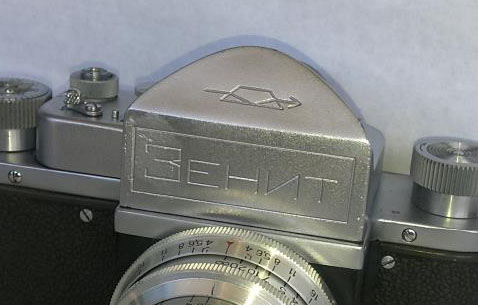
For example, someone made this photo with the serial-number to compare the font and it showed to be the same font used for another KMZ-camera. But the KMZ-logo itself is not in the right shape, how is this possible when it should be made inside KMZ with KMZ-tools.

Still many questions for me.
Maybe this should be normal for unique prototypes?
Reply with Quote Edit Reply Delete Reply
Hi Lenny,

Here is what I think could be a possibility regarding the difference in the KMZ 'tomb with arrow' logo that we see on later cameras by KMZ. It seems that up until 1949 there was just the 'tomb' - prism on the logo. It is right at 1950 when the arrow was added to the logo. So, possibly the logo was also in the early stages of design and the differences (mostly that the 'arrow shaft' is placed higher on the 'tomb') are due to the newness of this logo design change. Also, it looks a bit different because in the photos the flat plane, of the prism-housing front, that the logo is engraved on is tilted and not photographed from a higher angle. This causes some distortion to the shape. But if the camera is a prototype or pre-series of 1950, maybe there was no stencil made for the logo yet.

Regards, Bill

Reply with Quote Edit Reply Delete Reply
Accordig to pictures seen I feel as a one of a kind prototype made by some one fulfilling a request or for his own fun.
No more o less than that. Several variations were done.
changes in normal run were due needs of this particular production.
This reinforces the theory of factory built with fresh componentes.
Some time ago a 3m with turrete lens was shown, remember?
This could have been made by at factory at the developing department or in any of the repair rooms abroad the country.
When at former Vitronac and further Optotecnica Instrumental in Rio de Janeiro, once authorized Carl Zeiss Obercochen/ Zeiss Ikon Sttutgart repair shop I saw lots of one of a kind câmeras.
Repaired câmeras used original componens or modified with original componentes with diferente series and they had disponibility of original metals or componentes to be reshaped or really made, this fools the observer and arises lots of hypotesis or fantastic unbased dreams.
Wide angle câmeras with Plaubel Rada backs and Wirgin bodies were regularly built in Rio de janeiro always using Komura 47mm lenses.
Thia Zenit of course has his value although not far from regular câmeras from that era.
This is my particular point of view as Vlad requested
Regards You all!
LP
Reply with Quote Edit Reply Delete Reply
quote:
Originally posted by nightphoto

Here is what I think could be a possibility regarding the difference in the KMZ 'tomb with arrow' logo that we see on later cameras by KMZ. It seems that up until 1949 there was just the 'tomb' - prism on the logo. It is right at 1950 when the arrow was added to the logo. So, possibly the logo was also in the early stages of design and the differences (mostly that the 'arrow shaft' is placed higher on the 'tomb') are due to the newness of this logo design change. Also, it looks a bit different because in the photos the flat plane, of the prism-housing front, that the logo is engraved on is tilted and not photographed from a higher angle. This causes some distortion to the shape. But if the camera is a prototype or pre-series of 1950, maybe there was no stencil made for the logo yet.


If I remember correctly, the new KMZ-logo came with the Zorki-1a around April 1949. Could be KMZ did not have such a big template to engrave it, but that is the thing with a prototype, you have to make a new one. It does not seem to be so difficult to make a new template.

If this Zenit is from 1950 according to the first two digits in the serial-number the new KMZ-logo was already standard in production.

Could also be that KMZ did not allow to use the official KMZ-logo because this was not an official KMZ-made product.
Reply with Quote Edit Reply Delete Reply
quote:
Originally posted by nightphoto

Can you say what you think the differences between these logos are? First is this camera we are talking about. Second is a 1949 Zorki.


Thank you very much Bill,
so I checked many Zorki-1 logos of the non-export version, because there is enough room for the logo and I found many different ones.
- trapezoids with short base but high with steep sides
- trapezoids with long base not so high and not so steep sides
- trapezoids where each side has a different angle
- much later stamped trapezoids with a very short top

KMZ was not capable to produce the same logo in the same period of time. I think impossible for a Leica. Maybe KMZ did this all to please us collectors. I will keep an eye on the trapezoids.
Reply with Quote Edit Reply Delete Reply
Hello again! Here is a mail from my father to sort some things out with the case. Sorry, it’s rather a bit long.

“After analyzing the opinions expressed by the experts, I want to share my thoughts about the history of this camera.
They will be, as far as possible, justified by the documents that are available to us.
On the observations and analogies that the camera is made at a workshop abroad or in the USSR, I note that it would be possible, if it would be made from standard parts, slightly modified, redesigned.
Now, regarding the opinion that the camera was made at the KMZ by someone for himself or for some official person. I would like to recall that the KMZ was and it was a factory primarily oriented to military production, and a release of cameras was a minor task. On such factories there was a rigid system of secrecy. Passes were required to get into the manufactory room and not many workers could move throughout the factory. In such a situation (by an anonymous denunciation one could easily receive 10 years imprisonment without the right to correspondence) to make for themselves a camera manually, spending a lot of time working on their needs, was impossible.
It is possible that the camera could have been produced later in 70-80th when USSR became slightly more liberal. In such cases they used a serial sample and upgraded it for the better, both mechanically and in appearance. Typically, these cameras are superior to serial samples by all parameters.
The fact that the camera is not made in our time, I'm 100% sure. I bought this camera from an elderly woman, she told me about the former owner of the camera, a family name which is not very widespread in the USSR. And it matched to the records in the archives of the KMZ.
Also, if to forge a camera, people prefer to forge expensive samples, so you can easily and quickly sell. Otherwise, why to waste time, energy and finances?
Now about the official person. During the reign of Stalin in the USSR no officials of the highest rank could feel safe (remember the criminal case against Zhukov - Marshal of the Red Army after WWII). In such a situation, to order a personal KMZ camera is to give a reason for competitors to displace you from office. Even if it happened, is it possible to give such a camera to the official? I think not. The camera is not very well made. In such cases, the product is written off and destroyed, to avoid accusations of financial embezzlement.
In the USSR, they usually gave the serial camera with engraved commemorative plaque "Delegate 25th Congress of the KPSS… ".
Perhaps, there were cases of personal manufactured cameras, maybe experts can give examples.

So, in order to prove that it is a pre-production sample which is unique and is made of different parts, because it had to be done so, I will use the information from www.zenitcamera.com/archive/zenit-1/index.htm. I hope the owner will not mind.
Google on the pre (experimental) samples says:
Production of pre-production samples is a worldwide manufacturing practice for any technically complex products.
"Prototype - a full-scale, fully functioning model, designed to determine the needs and requirements of the production to the manufacture of this product. It is also used to obtain the latest before (fine-) serial production data on the functioning and reliability. The prototype is usually made by hand, as accurately as possible should meet the standards of the final design of the product or batch process. "

Here you dive into the real world of expensive services such as tool and die manufacturing, construction, assistance in moving some cases, planning equipment and accessories, as well as the services of the most expensive from the experts - the technology engineer. You will need all of these professionals, and even more to create a real pre-production prototype. Products created as a "working model" and "technical prototype," is impossible to put in the real market because of their cost price is too high, their design does not take into account all the necessary safety factors, and most importantly, they are not able to maintain that performance on during an acceptable lifetime. The set of inventors failed, trying to prove the opposite. On efficiency, reliability and safety of commercially manufactured products depends your reputation. It can break down by prematurely launching unfinished samples.

The prototype is created in order to show that the performance requirements are met, production problems solved, quality management is implemented, etc. Experienced pre-production sample is created so as to best resemble the product of mass production - the only difference in the volume of output.
© Rosnauka

My camera more than all fits to this definition: manual production, the most similar to the serial product of all the cameras.
By the way, in the process of studying this question, I came to the conclusion that most of the so-called prototypes made through fantasies by Komsomol activists and have nothing to do with the real "Zenit". Too large differences in design, a lot of different parts, which are then not used at all. Enthusiasm was encouraged at that time. Numbering is affixed to all products for the report for the materials used.
I quote from the article "Our Mission" of 31 December 1950 from the original factory newspaper.

"In recent years, we mastered three modern cameras that enjoy great popularity among customers. In the past year developed new models of cameras "Zorki-3" and "Smena 1". Now we are producing samples of the camera "Rodina".

These samples are now laboratory tested at the factory, and then be sent to the state tests in the All-Union Chamber of Commerce. Preliminary reviews by specialists are quite satisfactory. "

Zorki -3 we know. Who can indicate Smena-Zenit, which was on factory testing in the end of 1950 and then in 1951 was supposed be sent to the state tests? This is my camera. Made in 1950, it is very close in design to the production samples. Notice of release of the camera is a consequence of the fact that it belongs to the production factory.
Most likely it was released in a couple of samples. In it 1951 may have been taken to the factory and state tests, design improvement, after the test and so on.
When testing camera it is likely to test its endurance. I know that these tests are conducted in the construction theodolites and dumpy levels, although it is more fragile optical equipment than cameras. Through these tests, the first sample was likely to be crushed. Most likely, after these tests they took away corrector diopter, as it is located outside and it is very vulnerable, and replaced two side cover screws to the frontal plane of the mine to improve shock performance of the design. To the same goal they put deeper the logo of the plant, since it gives additional rigidity lid construction of the mine. By the way, Zorki-3 diopter corrector was designed at that time. He placed it more successfully and therefore was saved.
Quote from the article "For high-volume edition camera Zorki-3 newspaper Soviet patriot 1954":
"This question was at the meeting of the party committee on January 12. During the production camera " Zorki -3" chief engineer comrade Soloviev delivered a message. He noted that in the past year, considerable work on the development of this camera - newly created section of the assembly in the workshop held redevelopment equipment in automaton increased the number of machines in the shop Lens doubled the mechanical area, etc. But all this was not enough.
The speaker pointed out that the pre-production on the camera," Zorki -3 'in a number of issues carried out satisfactorily.
The design of the camera " Zorki -3" had a number of significant shortcomings and was not fit for the organization of large-scale production. An aim to “redesigne and prepare drawings for 1954" was given in June, with the term of meeting by October 1. With this work the design office is not right, and the first drawings were made only at the end of October, and a full set of drawings commissioned only 4 December.

Being late with the release of drawings made impossible a technological preparation of production by 1 January. As a result, in January and February will have to work with old drawings, with an unproven technology without sufficient equipment. "
Although it is said about the camera Zorki -3, manufacturing processes at the factory is the same everywhere. Consequently, all I described above, the test of camera Zenit
could drag on indefinitely, and therefore the release of a prototype in 1950, the end of an experimental batch of 1952, mass production 1953 - is quite real time interval.
Now for the design of the valve body, which Louis was talking about at the beginning of the discussion.
The body of a new design appeared in 1951, therefore, it was started to develop, at least in 1950.
Since the body is made on the basis of Zorki, if we put ourselves in the place of the constructor of my camera, and decide what kind of body we should use. The camera will definitely be launched in the series and we put the body on the old model, which will be out of use later or already out of production.
The question is a rhetorical one. I even can imagine that at the beginning the camera body was old-fashioned, but in the process of construction was replaced as obsolete, and it is not supposed to produce. On other cameras it was left because they hava little in common with the production of camera Zenit. Same story with the velocities at the head extracts. FED moved to the new standard Extracts in 1952. The decision to move was made before, and this decision was made not only on the factory FED, but also throughout the USSR and in this, because camera has been designed for the future, there was originally founded new standard exposures. Constructors in USSR gladly work for the future, however, the technique strongly resisted.

A quote from the same article of the same newspaper:
"Factory Director Comrade Egorov, in his speech said that the design office, engineering, equipment is not considered assembly plants, and in general plant workshops. "
This quote is like nothing better explains why the design pattern is slightly different from the experimental samples of the series.
Based on the foregoing, it is very likely to argue that the camera is a preproduction, prototype and all the details in her right place and it exists in one sample.”

I hope it makes things clearer. Thank you for your time.

Cheers,
Iurii
Reply with Quote Edit Reply Delete Reply

Dear friends

Back to this topic and the latest development: The camera in question may be found at the WestLicht Photographica Auction in Vienna.

http://www.westlicht-auction.com/index.php?id=4

(look at lot 362)


"Zenit Preseries *
well preserved Zenit pre series or test camera engraved No. 5000002 from the property of an employee of KMZ. Most of its characteristics are those of an early Zenit, e.g. the “Square Logo”, while it still has a few minor details in common with the first prototypes of the Zenit as well. It mainly differs from the series model by the execution of the prism housing and the eyepiece, which both seem to be one of a kind. Dr. Milos Mladek, well-known expert in Russian cameras writes in his expertise: 'After a thorough examination of the camera and after having compared it extensively with both a Zenit prototype and a “Square Logo” model Zenit, we consider this camera a KMZ factory research model that was very probably made just before the series production of the regular Zenit to test the new rounded shape of the prism housing and moreover to test a special diopter-adjustable eyepiece (+/- 3 diopters, three lenses in a non-rotating mount, very well made - regrettably it later did not make it into series production). It always was highly unlikely that KMZ would have started series production of the regular Zenit body without having tested the new shape of the prism housing: here is the test sample. - It comes with a later lens, cap and case'

Catalogue Number: 362
Sale No: 32126
Condition: B+
Year: 1950
Serial No.: 5000002
Estimate: € 5000-7000
Start price: € 3.000
Buyer's Premium: 20%"


Best wishes - Guido
Reply with Quote Edit Reply Delete Reply
Thanks Guido for the link! It is very interesting to hear Dr. Mladek's opinion about the camera as well! In case I miss it, if someone sees the final price, please update this thread. Thanks!

Vlad.

Reply to Topic

Forum code enabled