USSRPhoto.com

Forums / Collectors and Users Open Forum

Prewar Fed Optics (once more)

55 posts in this thread showing replies 21-40 of 54
Reply with Quote Edit Reply Delete Reply
Let's consider too that macro and reproduction work is probably not that suitable for a Jupiter 8. Its strenghts lay elsewhere. But the results of the Fed where indeed impressive.

According the Tessar and Elmar:

The place of the aperture is not simply changed in the three element design (Industar, Tessar, Elmar because pin-cushion distorsion depends on it.

quote:
There is another difference between the Fed and the Summar: the diaphragm. Round hole for Fed, beautiful hexagonal one for the Summar which is said to have a slight different rendering (swirling bokeh) for that reason in some conditions. For me, the difference is very tiny...

About the exact part of Fed factory, the GOI calculated all the lenses, and checked them. The JLP is affirmative on this point. But where were these lenses produced? By whom? In Kharkov? I should be glad to know more...


The Summar even has a dome shaped aperture, made to move between the sferical forms. That's why it only goes up to f12.5

The Fed swirls too when shot wide open:


Great to read the info about GOI. Fed used to have its own lens polishing workshop. But it is yet not known if they made and prepared the glass for the special optics. I would like to know more about it too.


Reply with Quote Edit Reply Delete Reply

It's not a swirl, but a maelstrom...

I have never tried one of my uncoated lenses in such conditions! In the thirties, they were considered as aberrations which had to be corrected...
The movement seems different with Sonnar formula lenses. With a Sonnar 1,5/5cm or a Jup 3 wide open (or a 8,5cm or 13,5cm Sonnar or Jup), there are as many swirls as things (leaves for example) in the background, at a correct distance, of course...

PS: your Fed 2/50 is really perfectly regulated...

Reply with Quote Edit Reply Delete Reply
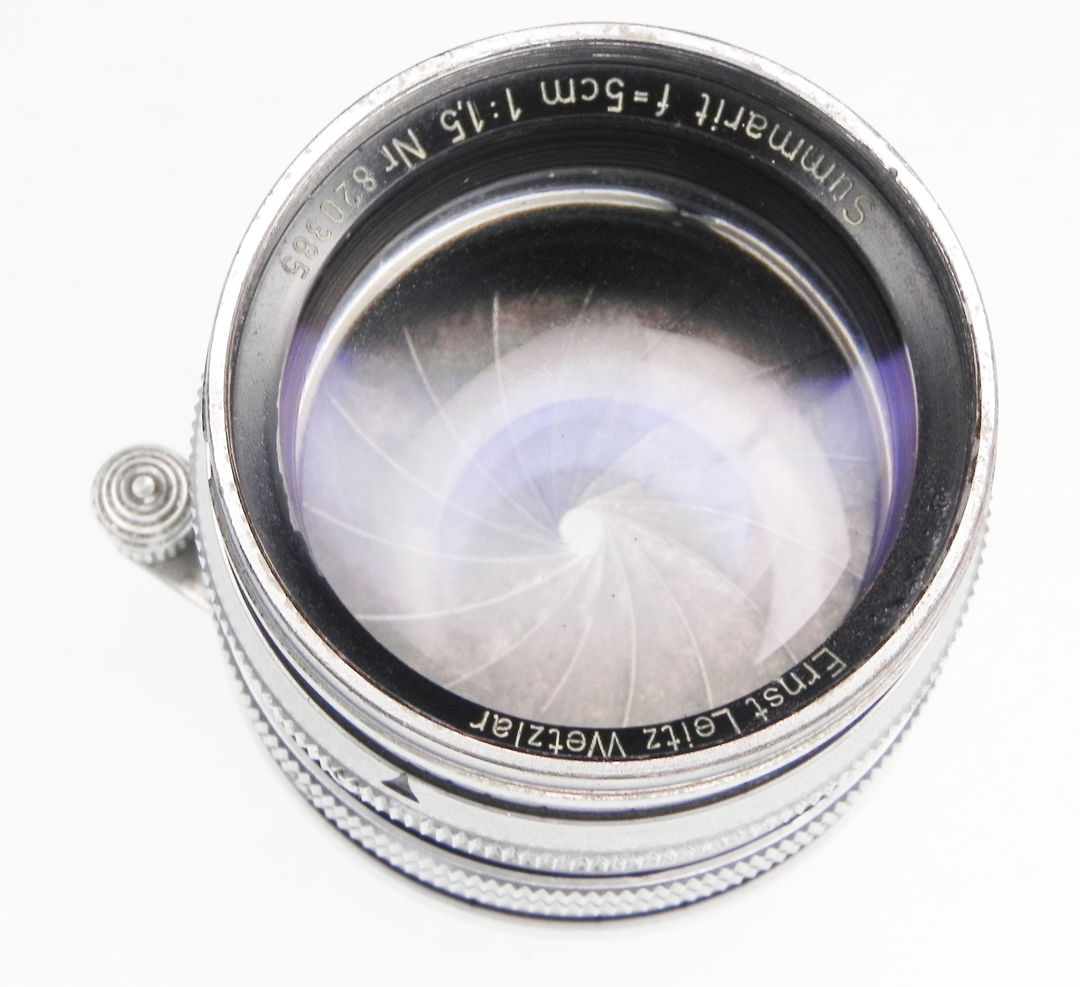
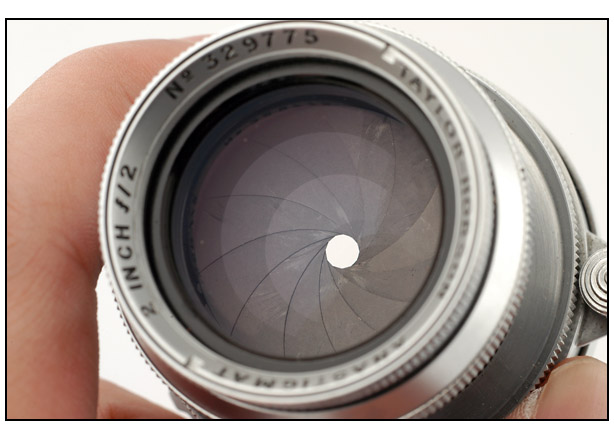
Just to complete this interesting thread, a short comparison of the diaphragms.
The Summar first (not mine, screw too tight):

http://www.ussrphoto.com/UserContent/642016_leica-summar-5cm-1937-l39-blades.jpg

The Fed 2/50mm one:

http://www.ussrphoto.com/UserContent/642016_DSCF2351.JPG

And the Taylor-Hobson's:

http://www.ussrphoto.com/UserContent/642016_taylor hobson f2.jpg

10 blades on the Fed, 12 on the Taylor-Hobson. The Summar is out of race!
All that makes me think that Fed lenses are not copies as servile as we could think...
Reply with Quote Edit Reply Delete Reply
Of course, if you want to copy something you don't copy everything. If you have aperature blades on the shelves, you use them. They just took the design of the Taylor-Hobson formula, needed to calculate it again for the kind of glass they had available.

Thanks for the pictures Jacques, seems this Taylor-Hobson is quite expensive. And the Summar hahaha I don't want one.
Reply with Quote Edit Reply Delete Reply
I read in the Wikipedia that Leitz and Taylor-Hobson worked close together before the war. Leitz even built a factory in Britain. When the war started the factory was expropriated from the british government and given to Taylor-Hobson and Taylor-Hobson continued production.

I found this Summarit, the seller describes it as a Taylor-Hobson version. Could be, that even Leitz copied the Taylor-Hobson and if it does match the timeline, Fed could have copied a Leitz which was a Taylor-Hobson copy. The blades look exactly like on the Taylor-Hobson.


http://www.ussrphoto.com/UserContent/642016_Leitz Taylor-Hobson.JPG

It seems it was later in the timeline, 1950. But still, Leicaforum descibes a Summarit as Taylor-Hobson version. Maybe there was already another version earlier in the timeline.
http://www.l-camera-forum.com/leica-wiki.en/index.php/Summarit_f%3D_5_cm_1:1.5

Reply with Quote Edit Reply Delete Reply

Just an addition about the Fed 4,5/28mm. This beautiful lens was probably very difficult to mount, with these six very tiny glasses in four groups... And what about the air/glass surfaces, with all these possible internal reflections...

The two main contemporaneous wide angle lenses were the Hektor 6,3/28mm (Leica) and the Tessar 8/2,8cm (mainly for Contax). The difference of aperture compared to the Fed is very impressive... We have diagrams of a Tessar and of the Fed above. The Hektor's is there:


http://www.ussrphoto.com/UserContent/742016_hektor_28_63.jpg

Jacques.

Reply with Quote Edit Reply Delete Reply
Thank you all for the great response.

quote:
And what about the air/glass surfaces


Not all of them are air spaced, the two outer lenses are cemented together. (but there are a lot of remaining reflecting surfaces. I know this because my 28mm lens has a separating front element. Disassembled it once, but it takes a very skilled person in optics to repair the kit layer of such a tiny lens.

But as far as I know. The Fed 28mm is the only wide angle 35mm lens that uses this formula. Unique of its kind and construction.

Reply with Quote Edit Reply Delete Reply

The cemented glasses have their bright sides: the lenses are easier to mount and have a reduced number of reflective surfaces. Six nevertheless for these two Fed lenses, plus the diaphragm which can play its part.

They have their weak points too: with age, balsam can yellow or produce haze. Summars often have that problem. My 4,5/28mm Fed too, but I won't try to disassemble it!Smile No separation, as it seems.

When I can, I will try some photos.
Thanks for your photos in the specific forum: they are an incentive to use our old Russian lenses.

Amitiés. Jacques.
Reply with Quote Edit Reply Delete Reply
quote:
Originally posted by Vlad

I have never heard of such cooperation, mostly western designs were "borrowed" without any licensing.

Vlad, I'm very sorry. But this is a very primitive understanding of patent law. The lens was patented in the USSR? No? Do svidaniya!
Reply with Quote Edit Reply Delete Reply
quote:
MC coating


A technique which appeared in the 60'ies. This could have been done afterwards. But what puzzles me is the larger barrel that touches the rangefinder cam.
Reply with Quote Edit Reply Delete Reply
quote:
Originally posted by Zoom

quote:
Originally posted by Vlad

I have never heard of such cooperation, mostly western designs were "borrowed" without any licensing.

Vlad, I'm very sorry. But this is a very primitive understanding of patent law. The lens was patented in the USSR? No? Do svidaniya!


Big smileBig smileBig smile That's awesome! Big smileBig smile
Reply with Quote Edit Reply Delete Reply


Optical designs where easy to get in the West. Patents where very well respected and each 'house' had its own specialties. In the preface of Dekking's book he writes about the companies which where very helpfull sending him schematics and details about lens construction.

But even if you decide to 'copy' a design to a certain example, you still have to recalculate it in order to make it work with the 35mm format and camera of choice. A mount has to be designed and constructed as well. Great work for the Fed has been done on this.

The Summar of Leitz was the first succesfull double Gauss design lens with an aperture up to f2 in the Leica family. Improving the triplet led to designs like the Elmax, Elmar and Hektor. They really forgot (even Zeiss) that the Gauss design was in fact the winning concept for a standard 35mm format lens of large aperture.

Reply to Topic

Forum code enabled