USSRPhoto.com

Forums / Collectors and Users Open Forum

Prewar Fed Optics (once more)

55 posts in this thread showing replies 41-54 of 54
Reply with Quote Edit Reply Delete Reply
quote:
Originally posted by Lenny

...what if the lens was patented in the USSR, would it had made any difference?


Of course. The state guarantee the exclusive rights of the patentee. The state was tough...

quote:
Originally posted by Valkir1987

But even if you decide to 'copy' a design to a certain example, you still have to recalculate it in order to make it work.

That is quite true.
Reply with Quote Edit Reply Delete Reply
quote:
Originally posted by Valkir1987


They really forgot (even Zeiss) that the Gauss design was in fact the winning concept for a standard 35mm format lens of large aperture.

I think they didn't forget. They had problems because they could not coat their lenses yet.
I have read interesting article in magazin "Fotografia" from 1953.
Every 1 cm of glass absorbs 2.4% of light.
From light absorbing piont of view 2 cemented lenses can be treaten like 1 lens. The most "dangerous" are surfaces between air and glass.
Two surfaces of a lens (air/glass/air) absorbs 10% of light.
This is the reason why they could not use Planar which was calculated in 1896, but Tessar from 1902 had less surfaces where air and glass met.
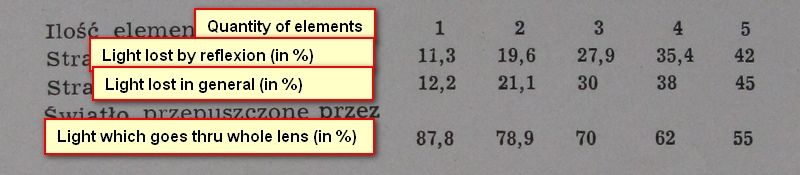
There are 2 intersting tables regarding light absobring. If somebody is interested in it I will place them here.


Reply with Quote Edit Reply Delete Reply
quote:
Originally posted by Alfa2


There are 2 intersting tables regarding light absobring. If somebody is interested in it I will place them here.


Sure Alfa, please post them, it's interesting.
Reply with Quote Edit Reply Delete Reply
First table. I think it is clear for all. Of course it refers to not coated lenses only.


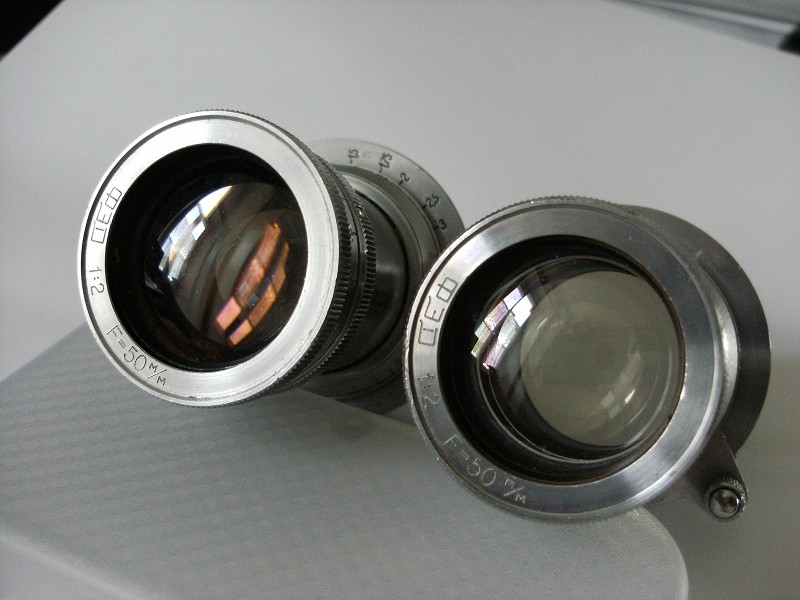
Jacques, very interesting coated FED 2/50 but there is too less photo. We cannot see e.g if rear lens is coalted too.

Reply with Quote Edit Reply Delete Reply

Thanks to this first table, Alfa.
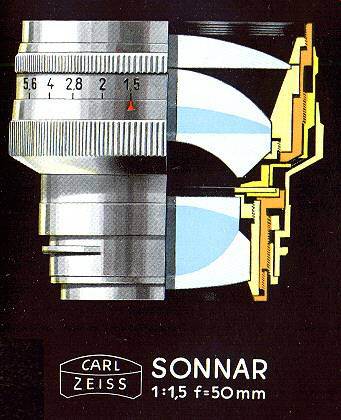
Generally speaking, I think that Sonnars were easier to cement. For example:


http://www.ussrphoto.com/UserContent/1642016_Sonnar 1,5-5cm formula.jpg

Seven lenses in three groups, 4 surfaces air/glass only. In the thirties/fifties, these Sonnars were better than Leica lenses. The Leitz Summicron (2/50mm, double gauss evolution) made up lost time, which was partially due to the poor resistance of the front glass of Summars and Summitars...
Zeiss produces now Planars (evolution of the "double-gauss")as well as Sonnars, for Leica M and others. Of course, things are different now...

Concerning my "coated" Fed 2/50mm, it's only the first lens which is coated.


Reply with Quote Edit Reply Delete Reply
quote:
I think they didn't forget. They had problems because they could not coat their lenses yet.
I have read interesting article in magazin "Fotografia" from 1953.
Every 1 cm of glass absorbs 2.4% of light.
From light absorbing piont of view 2 cemented lenses can be treaten like 1 lens. The most "dangerous" are surfaces between air and glass.
Two surfaces of a lens (air/glass/air) absorbs 10% of light.
This is the reason why they could not use Planar which was calculated in 1896, but Tessar from 1902 had less surfaces where air and glass met.
There are 2 intersting tables regarding light absobring. If somebody is interested in it I will place them here.


Coatings reduce the reflection and increase the contrast and sharpness. It is certainly true that designs with many air glass surfaces finally got their succes after lens coating was possible.

Zeiss even tried to develop glass with a refraction and dispersion close to that of air. This led to the 'Herar'. Only a few of them where produced.

But the focus for 35mm photography remained improving the triplet base. I doubt the main reason for this is the need of coating the surfaces.

Gauss designs where used in 35mm format mirror reflex camera's (Exakta) and motion picture camera's with beam splitters. A Gauss leaves more room behind the lens for mirrors and prisms in 35mm format. Retro focus lenses where yet to be developed.

Improving the triplet led to the Zeiss Sonnar, but such lens can only be used on a rangefinder. (it has only one reflective surface less than the Biotar) More than 1000 pages of optical calculations where needed to design the Sonnar. It really took more time in the computerless age.

Paradoxes and misconceptions have delayed the development of optics for ages. Isaak Newton for example was convinced of the fact that it was optically impossible to correct the shifting of colors with lenses. As a result telescopes where only built with mirrors. Film used to be sensitive only for blue and violet. It was not needed to correct colors for photography. But in field optics and microscopes, color correction was needed.

Only one Sonnar type lens appeared for the SLR, known as the Takumar 58mm.

Reply with Quote Edit Reply Delete Reply
quote:
Originally posted by xalmaz


Seems, Jupiter11/Jupiter21/Jupiter6 are not Sonnars now?


Jupiter-11 is a Tessar type, 4 elements in 3 groups. Don't understand why it got the Jupiter name because this formula is so easy and aperature 4.0 is definitely not like the sun (Sonnar). Other Jupiters are much more complicated. But a 135mm lens in the same type like the Jupiter-9 might have been so expensive that nobody could afford it.
Reply with Quote Edit Reply Delete Reply

I just think that Milo talked of the "normal" 50mm lenses.
It's right, for example, that Zeiss could not use their Sonnars on the Contax S, because a question of register. Hence the solution of the Biotar.

Some lenses had to be "cut" to adapt to a new register. For example, the Sonnar 13,5cm (Jup 11), but not the 8,5cm (Jup 9). And the Industar 22, "cut" to be put on the first Zenit...

I was surprised when I discovered that Canon had abandoned their Sonnars (the 1,5/5cm for example) to put double Gauss type lenses (the 1,4/50mm). Probably a question of normalization with their rangefinder and SLR cameras.

Some lenses were difficultly mounted on rangefinders: the 2,8/3,5cm (Jup 12) is the extreme type, with its protruding back. Some Bessas don't accept it...

Jacques.
Reply with Quote Edit Reply Delete Reply
quote:

I just think that Milo talked of the "normal" 50mm lenses.


True! Forgot to tell about that. The Jupiter 11, 9 and 6 are all true Sonnars. (which derived from the Triplet) The Zeiss Triotar is a 135mm f4 Triplet, and even a Tessar exists.


The Jupiter 12 is the only non Sonnar in this row. The Jupiter 12 is a Biogon making things complicated. It should have been named Helios instead.

Sonnar, Triplet and Tessar: Three group design.

Helios: Double Gauss, 4 group design with 6 element.


Reply with Quote Edit Reply Delete Reply
I also forgot to tell, that the resolving power of a lens doest not increase when a coating is applied. It will improve contrast and therefore also countour sharpness.

When optical glass ages, a natural coating will form as a result of contact with air. If you are lucky and the balsam layers remain intact, the lens will improve in performance.
Reply with Quote Edit Reply Delete Reply
Milo, thank you for your explanation. It is very interesting. I did not know some facts you have written.
But why performances on not coated Xenon/Summarit 1.5/50 were so week (only 5 groups of elements) while performances of coated lenses with more groups of elements were/are OK ?

Reply with Quote Edit Reply Delete Reply
Coating strongly reduces reflections and stray light.

And pls read what is written e.g. here
http://www.klassik-cameras.de/Biotar_en.html

"Ib) SONNAR family
Ernemann was merged 1926 into ZEISS-IKON and Bertele founds himself a lens designer in Jena. Already in 1924 he succeed in scaling down the Ernostar f/2 integrating a cemented group consisting of three elements (triplet). At Zeiss he managed to connect the third and fourth element, and therefore reduced the total of optical groups to three and effetively reduced objectionable reflections and stray light. Within a year he afford to enhance the aperture of that lens about virtually one f/stop to f/1.5 by means of replacing the last element with a cemented group of two.
......................................................................
With the advancement in coating technique it is possible today to arrange glass elements isolated rather than to combine them into a group without getting objectionable reflections and stray light. Secondly fabrication of cemented triplets were, and are, more expensive than with isolated elements. At least the short back-focus length makes the Sonnar compact in build but not usable for most SLR cameras because the moving mirror requires more space. These facts - not performance considerations - caused the extinction of "true" Sonnars since 1960."

Reply to Topic

Forum code enabled