USSRPhoto.com

Forums / Collectors and Users Open Forum

Fed-Arsenal

185 posts in this thread showing replies 41-60 of 184
Reply with Quote Edit Reply Delete Reply
Dear Bill,

I did not get the point why FED Arsenal was a secret military camera. I personally said that it was most probably issued for Arsenal workers. No wonder that the finish was of low quality. Prior to 1946 Arsenal was by no means connected with optical or camera production. The chrome plating is involved technology that was completely new for Arsenal workers immediately after the war.

FED logo has little to do with FED factory it only refers to well known brand. Everybody heard in Soviet Union about the Soviet Leica - FED. FED Arsenal is like "Fritz Cola" that has little to do with "Coca-Cola" or "Pepsi-Cola". Similar story is with the early FED-Zorki.

I think the following discussion makes no sense since again it is the matter of belief. You don't believe that FED Arsenal is genuine. Fine. I accept your skepticism. At the same time I do not see any reasonable disproof of my statement that it is genuine. I don't think that I need to search for some mean forgers that managed to create the very complicated scheme how to fool us and who put the FED Arsenal camera in the factory museum. Probably these mean forgers pay me now the salary and I try to pose the camera as genuine. I think the world is not so complicated.

with best regards
altix

Reply with Quote Edit Reply Delete Reply
Dear Alix,

You are wrong. I don't believe that FED-Arsenal is fake. And I don't believe it is authentic. At this time I can see that it could be a fake or it could be authentic. I am not trying to convince anyone either way and I like the FED-Arsenal either way. This is why I have written all of the information I have. I only think that it is better to withhold judgement and look at the facts as they become available. No doubt more information will become available over time. You are the one who has the belief that it is authentic, as you have said, "At the same time I do not see any reasonable disproof of my statement that it is genuine."

I didn't say that mean forgers put the camera in the museum. It is what you call, in the art world, provenance. If in a museum then there would be some records of when it was added to the museum collection and it also should be in mint condition if acquired by the museum directly from the factory when made. If it was not acquired by the museum when made and was acquired at a later time, then who donated or sold it to the museum. And, did the museum curator of the collection keep records? If it was stolen from the museum in the 1990's then there is no history that came with it. If it was not taken from the musem, how did it come into private hands. I am just saying that if these questions are answered, then there is meaningful provenance. That is all. If the questions can't be answered then the story does not mean so much as far as authenticating the camera and where it originated.

I have never talked about 'mean forgers' and no doubt many forgers are very nice people just trying to make a living. I have no problem with fakes or the people who make them.You are the one with all of these complicated thoughts about forgers and paying you, etc.

Would, in your opinion, the Arsenal factory be allowed to put the military logo of hammer and sickle on a camera made for workers?


Regards, Bill

Reply with Quote Edit Reply Delete Reply
Dear Bill,

I don't believe that military Arsenal logo is a certain proof that the cameras that bears it was initially assembled for military. It is a tendency that every military device from late forties- early fifties has military logo but is not true that every civil product from that time should have the logo without hammer and sickle. For me the proof of military camera or military device is the presence of the inventory number. There are a lot of Arsenal civil products from early fifties that bear the military logo. Just one example


http://www.ussrphoto.com/UserContent/1572015_1.jpg


http://www.ussrphoto.com/UserContent/1572015_2.jpg

But of course I cannot exclude that the first batch was produced by request of military.


regards
altix
Reply with Quote Edit Reply Delete Reply
Alix,

What kind of item is that in the photos? Do you think that one (with hammer and sickle) is for military and the other (without hammer and sickle) is civilian model? On the items I have seen, from all factories, the hammer and sickle always denotes made for the military.

And in any case, unless I find or hear new information, I don't have much more to add about FED-Arsenal. My opinion is, that I am open to authenticity, but I am not convinced at this time from what I have heard and seen. Thanks for the photos and info.

Regards, Bill

Reply with Quote Edit Reply Delete Reply
I showed the containers for film cassettes that were produced for civil market. The earlier one has logo with hammer and sickle. Just to show that this logotype does not mean that the item was produced for military purposes. I think that time nobody paid much attention which logo to put on the product.
Reply with Quote Edit Reply Delete Reply
Hi Alix,

Thank you for the photos. Maybe Arsenal was very used to having the hammer and sickle in their logo as they were primarily a military factory before and during WWII.

To All,

I have made changes to the FED-Arsenal entry, that was originally made by myself, to reflect the current information available and the discussion as to it's authenticity. Please feel free to edit, add photos and details about individual examples of FED-Arsenal cameras to the entry.

Also, although I am not personally convinced of it's authenticity at this time, I no longer think the entry for FED-Arsenal belongs in the category "Modified & Fantasy Cameras" and would be better classified in our WIKI as either "Unidentified / Contested Authenticity" or possibly a new category of "Arsenal"
if the consensus of our members is that the FED-Arsenal is for sure authentic and made at the factory. Maybe a discussion of the appropriate category would be helpful.

.

Regards, Bill

Reply with Quote Edit Reply Delete Reply

Hello my friends

Thank you very much for this very interesting discussion about this rare cameras. I have no final opinion on the question of authenticity.

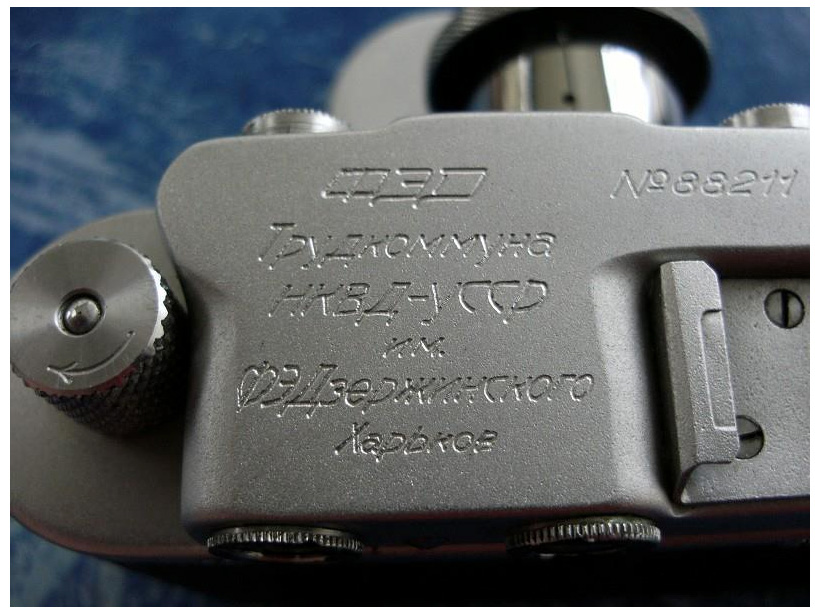
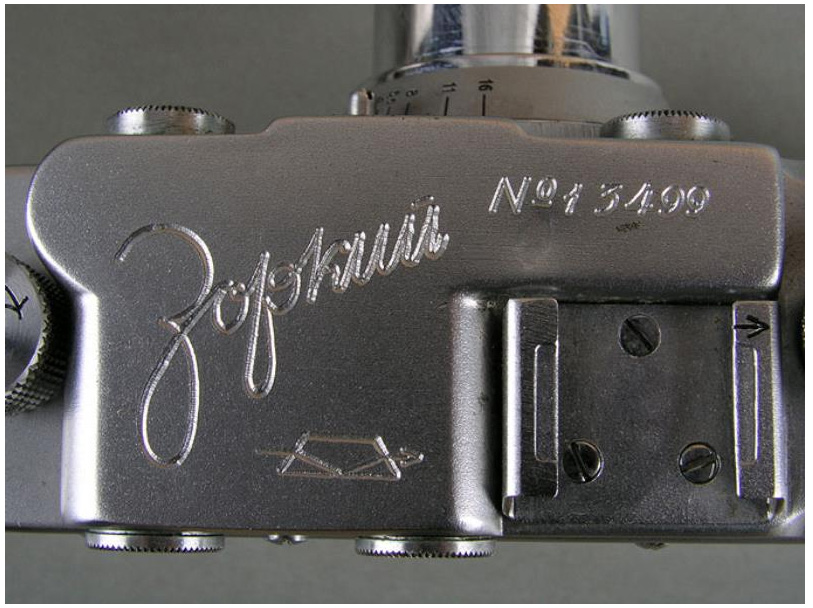
The FED-Arsenal remember me much to the FED-KMZ, only the FED engravings are not exectly the same (regular vs. italic). On the other hand the FED-Zorki with a more rounded FED logo.

Could it be that Arsenal was selected to produce a FED like camera in the years after the war and then the desicion was changed because the Contax production moved to them and KMZ was selected to continue the program? Only a guess ...

I think poor engravings and chroming says much about the authenticity of the camera, a fake would be much more perfect at my opinion.

For the category ... "Kiev / Arsenal - ..." looks wrong for me, "Arsenal - Kiev ..." and "Arsenal - other" would be better and the FED-Arsenal could be sorted in the last category.

By the way about categories ... I just saw a so called "FED-Zorki Jura" as a "fantasy camera" ... "*FED-Zorki* Jura"! I think we will be d'accord about the fact this was a Zorki (1d or 1e), so "Zorki Jura" should be the better choice. No, I don't want to change it, but if someone agrees with me he will do the change.

Best wishes - Guido

Reply with Quote Edit Reply Delete Reply

Hello!

For the moment, I have no idea about the place where this camera must be put... Perhaps we could wait a bit before changing something.

I am gathering some different detailed informations about the 00067 and the 00216, so that we have an idea when the important parts were made, if there are differences or if they are homogeneous. I will let you know, of course!

Amitiés. Jacques.
Reply with Quote Edit Reply Delete Reply
quote:
Originally posted by Guido


I think poor engravings and chroming says much about the authenticity of the camera, a fake would be much more perfect at my opinion.


Interesting remark! I wouldn't have thought of that. Thanks, Guido.

The magnetic parts of the Feds can help to date them. To be as precise as I can:

- the shutter boxes were made in brass up to the s/n c. 12xxxx. So, non magnetic. Magnetic after until the end of the 1e series (c. 184xxxx). Then, NKAPs and the first 1f have shutter boxes made in brass again, before it turns to magnetic metal up to the end of Fed 1.

- the two plates are first made of chrome brass, then of chrome magnetic metal from the s/n c. 15xxxx up to the end of the 1e (184xxx). In fact, during WW2. Certainly Fed had other uses for brass at that time. After, the plates of NKAP, 1f and 1e are always made of non magnetic metal.
But I am not 100% sure of my NKAP, so, if Alexander could check on his camera?

Of course, I don't speak of the cover which is never made of magnetic metal (as far as I know).

Concerning the hole in the press film, it disappears at c. 15xxxx. It allowed to regulate the camera/lens with the corresponding hole in the back of the camera. This hole in the camera had disappeared years before!

That question of magnetic properties was initiated by Niko80 on this site. Of course, there can be exceptions (repairs, remountings, etc).

On the cameras s/n 00067 and 00216,
- there is no hole in the press film,
- the shutter box and the plates are made of magnetic metal.

So, I am sure that they were made between s/n c. 15xxxx and 184xxx, corresponding to the years 1940/41 or 1940/46, depending on where we put the 1e Berdsks: that's another question!

I try to find something about the original parts now: view counter, winding button and speed dial.

Amitiés. Jacques.

Reply with Quote Edit Reply Delete Reply
Hello everyone,

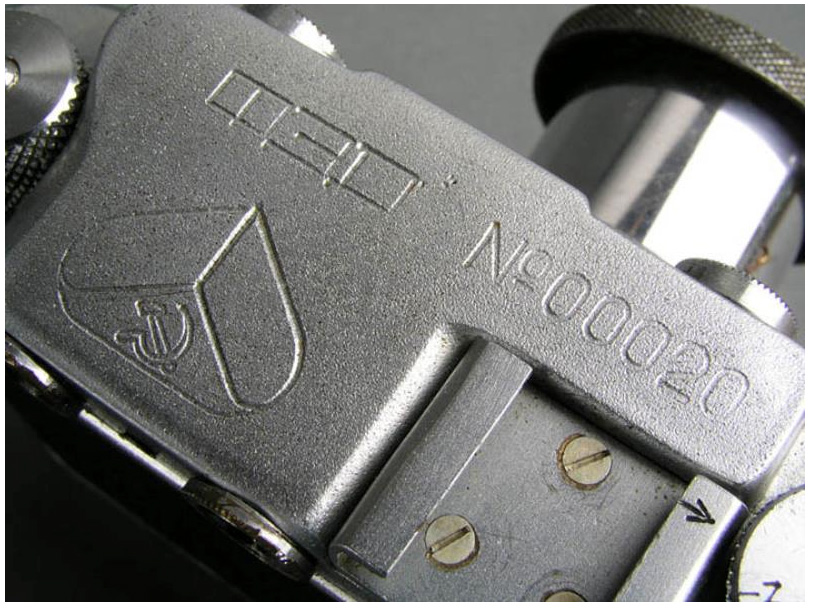
Concerning FED-Arsenal No. 00020.

It is possible to tell the difference between the rangefinder housing of a Zorki and the rangefinder housing of a FED by looking at photos. Specifically, if you look, from the top, at the shape outline of each, it can be seen that FED rangefinder housings look to have been hand-filed and are less square towards the rear section (where most of the engraving is). They look hand-shaped or hand-finished. The Zorki rangefinder housing, when looked at from the top seems more squared off, possibly more finished by machine than by hand. The Zorki has an almost strict right angle around the accessory shoe, where the FED has a slightly 'wavey' or bent look to the line, somewhat uneven as though hand finished - filed. Probably this is due to a slightly different and more advanced manufacturing process and technique at KMZ or more advanced machinery used at KMZ since they were a more modern plant. I have always noticed this and have used it to determine if cameras that had mismatched parts (rangefinder housing to body).

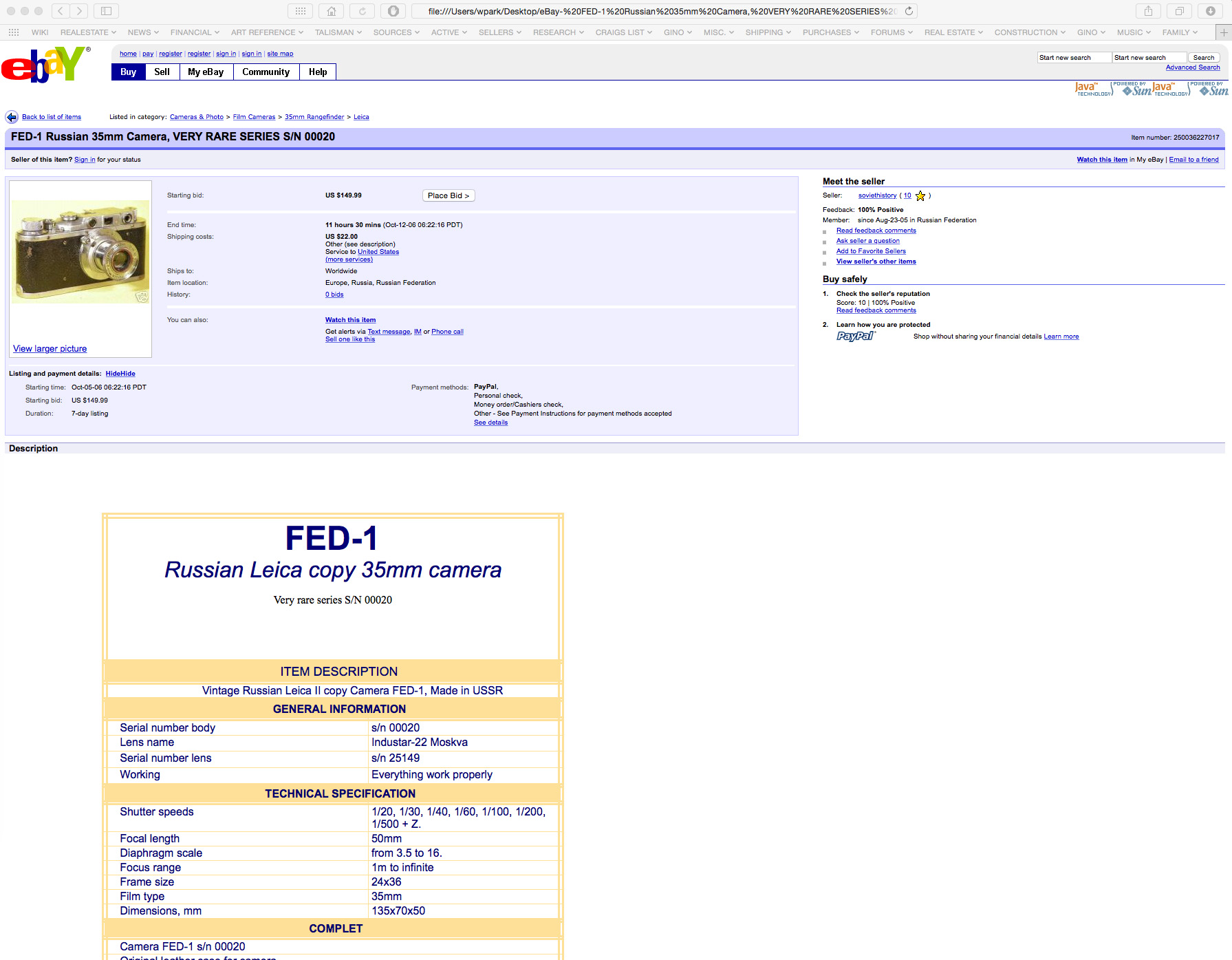
From looking and comparing photos, it seems that FED-Arsenal No. 00020 has a Zorki rangefinder housing (more squared in the outlines, seen from the top) that matches it's Zorki body. In other words, the camera is totally a Zorki, not a Zorki with an older FED rangefinder housing. If that is the case, then it would mean the camera was a Zorki when engraved with the FED-Arsenal logo and number. I have no doubts that the No. 00020 camera is the same as the other FED-Arsenal cameras as far the engraved logo and number details, in every way. I can not imagine that No. 00020 is a fake of an authentic FED-Arsenal camera as I bought it nine years ago (in October of 2006) when the others had not yet come to light and there was little or no discussion of this camera. If correct, this would point towards at least one FED-Arsenal "first series" being made from a later Zorki, not matching the time line of the FED-Arsenal story and not something a factory would be likely to do

Below are some comparison photos showing the rangefinder housings.

FED-1c

http://www.ussrphoto.com/UserContent/1672015_FED 1.jpg

Zorki-1b

http://www.ussrphoto.com/UserContent/1672015_Zorki 1.jpg


FED-Arsenal No. 00020 (Zorki body)

http://www.ussrphoto.com/UserContent/1672015_FED-Arsenal 1.jpg

Auction of FED-Arsenal No. 00020

http://www.ussrphoto.com/UserContent/1672015_No.20 Auction.jpg


Regards, Bill

Reply with Quote Edit Reply Delete Reply
Hello,

There is another detail which is interesting to consider: the hollow which let the rewind lever move freely, on the cover.
That feature, on my s/n 164433:


http://www.ussrphoto.com/UserContent/1772015_DSCF2215.JPG

On Feds, this hollow is more or less square. And it exists on the prewar and wartime series (1c to 1e) without interruption. We find it again on the first postwar 1f, up to c. s/n 220000, then it disappears (my 1f s/n 232140):


http://www.ussrphoto.com/UserContent/1772015_DSCF2218.JPG

On Zorkis, it is there on the first series. For example, on my Fed-Zorki s/n 03278:


http://www.ussrphoto.com/UserContent/1772015_DSCF2217.JPG

On Zorkis, this hollow exists too on the 1a and a part of the 1b, then it disappears. Note that on Zorkis, it is more rectangular than on Feds.

This hollow is present on the covers of the Fed-Arsenals 00004 and 00067. It is absent on the 00020 and 00216. I don't know for the others. As the engravings have exactly the same characteristics, they were for sure made at the same time, when covers without hollow existed, probably in the very early 1950 years.

So, I share Bill's opinion: certainly these cameras were not made in 1946/47.

Amitiés. Jacques.


Reply with Quote Edit Reply Delete Reply
Dear all,

I consider your argumentation about the hollow is insufficient for proving that the camera is fake. This hollow was made after the main shape of top plate was stamped. Otherwise you would be unable to take away the stamped detail from the stamping form. The absence of the hollow on the top plate can only tell about the simplification of the manufacturing procedure. It cannot serve as a proof that the top plate was used from the late Zorkis where the manufacture procedure was also simplified. As I see the top plates of FED, FED Arsenal and FED-Zorki have different geometry that says only that the stamping forms in three cases were different.

For final resolution of the puzzle we will need the documents from Arsenal plant or to perform, say, the spectral analysis of alloys that were used in production of top plates for FED Berdsk, FED Arsenal and FED-Zorki. I consider these both verification approaches are much better than any attempts to discuss the camera originality based on recollections of former Arsenal workers or on the shape and geometry of the top plate.

with best regards
Reply with Quote Edit Reply Delete Reply
Hi Alzo,

If I understand well, you consider that there were some non-stamped covers left, and that these covers could have been used to make some Fed-Arsenals? Why not... That would explain why some cameras have this hollow, while others don't.

I must say too that there were several different "forms" to make the covers, at Fed's, sometimes used at the same time. So, a specific shape is not a proof in itself: it should be crossed with other specifications. Too long and hazardous.

So, yes, a spectral analysis would certainly be interesting...

Amitiés. Jacques.
Reply with Quote Edit Reply Delete Reply
To all,

At present there is lack of documents from Arsenal and no passports or other official documentary evidence has been found, such as mention of this production at Arsenal in one of the magazines like Sovetskoe Foto. If the camera is fake there will never be authentic documents found and so lack of known documents can not be seen as proof that the camera may be authentic. It has been 65 years since the hypothetical production of FED-Arsenal, a long time for some documentary evidence to surface, as it has with many production details of different cameras, including the very secret KGB cameras and documentation of their manufacture. It is not enough, in my opinion, just to say that Arsenal was a secret factory.

Of course the small indentation near the rewind lever, that Jacques has mentioned and shown with close-up photos, can and was in the original stamping of the rangefinder housing, and not hand-stamped later. It will easily lift up from the stamping form by just lifting the piece out from the other side. The hollow is quite shallow and anyone with knowledge of metal stamping and die work will see this instantly.

In any case, it is almost beyond belief that rangefinder housings would be found without this detail as it would have been done at the same time as the initial stamping, even if for some reason they were hand-stamped. I think this theory is over the top and just being offered so as not to give up hope of origin at Arsenal.

All of the photographs of the different known FED-Arsenals appear to have the rangefinder housing of a Zorki, with the squared off-shape, rather than the somewhat uneven shape of the FED housing. This is very clear from photos of all examples that I have listed in the revised WIKI article of this site, with the exception of No. 00070 of which there are no known photos.

If all the examples of FED-Arsenal have Zorki rangefinder housings on either older FED bodies, or in the case of No. 00020, a Zorki body, then it is clear that the rangefinder housings were engraved at a later time and affixed to old cameras to deceive. It is pretty clear.

A comparison of spectral analysis of the metallic alloy content of various housings would be fine, but would have to be done by a well-known accredited - certified laboratory. Not just sent off to a participant of this discussion. But the subject parts be sent directly to the lab and the official results sent back from the lab. In this way the results would not be contested. I think it would be proof that the FED-Arsenal parts are of KMZ origin, but the tests would tell for sure.

And, lastly, concerning documents from Arsenal. Any documents that would suddenly become available in the near future, just after this highly public controversy, would need to be tested for authenticity, compared to other documents from Arsenal, and probably be tested for age.

I have followed and participated in the arguments concerning this camera quite closely, as you all know. I no longer own a FED-Arsenal and have not written a book or made a film that declares it to be authentic or a fake. I have written the initial entry for FED-Arsenal in the USSRPhoto.com WIKI and have recently edited it to reflect the uncertain status discussed by members of this forum. I have no monetary interest in whether it would be authentic or not and I am no longer a collector of Soviet or Russian cameras but I studied all aspects of Soviet, post Soviet, and pre-Soviet cameras for almost 20 years.

Considering the evidence and details that have been talked about and shown in photos, and the lack of any proof to the contrary, I now believe the FED-Arsenal camera is an older fake using re-engraved Zorki rangefinder housings added to old FED bodies and that the FED-Arsenal was never in production at the Arsenal Zavod. The cameras themselves tell the story, as always. Information from non-verified sources and unproven theories with no documentation do not take the place of the evidence and details visible and obvious on the cameras themselves.

Regards, Bill

Reply with Quote Edit Reply Delete Reply
Dear Bill,

Since you have studied all the aspects of Soviet cameras can you please describe the process of metall stamping of the top plate with a hollow?. I have the problem to understand how it is possible to stamp the top plate with the hollow in one stamping run. I can only imagine how to do this using two runs with two different stamping forms. Sorry to ask this probably trivial question. Thank you in advance for detailed explanation.

faithfully yours
Reply with Quote Edit Reply Delete Reply
Hi Alzo!

On thinking of the possibility of a spectrographic analysis, I wonder if it would really give us the solution of the problem, contrarily to what I have said above. Sorry...

I try to explain.
I suppose that the analysis will be made by comparison with another part, which will be the model. For example, the cover of a Fed 1e "Berdsk" and the one of your 00216. It's perfect if the result is positive. But what do we know exactly about this 1e cover? Is it different by its composition from a 1d or a 1f? Or even from an early Zorki's? I fear that we don't really solve the problem: we only change the question.

And even if it is proved that the 00216 cover is absolutely like a Fed Berdsk's (by it composition or whatever else) and that the series of these cameras is coherent, we won't know where, when and by whom this cover was engraved.

Here is the "hollow" on my Fed-Arsenal's cover. As you can see, it's a Fed type one. The camera is coherent and can be made of Fed Berdsk parts only. But that doesn't tell me if there is a series of Fed-Arsenals...


http://www.ussrphoto.com/UserContent/1872015_DSCF2220.JPG
(sorry for the paint -not removed- of a precedent owner!)

Perhaps things would be better on analysing the odd spare parts, specially this very interesting counter frame I had never seen before. But in that case, what will be the model for the comparison?

I fear that you will find much more questions than solutions. To protocol should be hard. But I'm not a scientist!Wink

For me, it would be better to look for original papers of the factory, if it is possible. If not, probably this question will join the non-solved cases...

Amitiés. Jacques.

Reply with Quote Edit Reply Delete Reply
Dear Alzo,

Although I am quite familiar with the details of the die and stamping process (from a former job at a manufacturing company), I am afraid it is beyond the scope of this forum and my own time constraints to explain them in detail. With some time and research, you can learn them on your own. You will see that it is not difficult or unusual to stamp a shape such as this (including the small hollow) in one stamping, and would be easy to remove from the form by just lifting out. In fact, it would be done this way. Even in the case of a more complicated shape that could not be done in one stamping, the second stamping would be done at the consecutively, at the same time as part of the process and it would not happen that the parts would be left unfinished for another time. It would be very unlikely that a group of parts would be left unfinished, shipped to another location, and then finished before assembly. This is a very weak argument and scenario to hinge the authenticity of this camera on. You will find this out if you research the process and examine the interior of this particular part.

Regards, Bill
Reply with Quote Edit Reply Delete Reply
Thank you very much for your detailed and comprehencive answer of stamping with hollow. I meant that time is most precious resource - it comes and never comes back. Sorry for my bad English.
Reply with Quote Edit Reply Delete Reply
concerning the stamp form: there are forms that consist of multiple parts for complicated shapes. same for the upper press that can consist 2 or 4 parts that join in pressing. after the stamping you take out a more regular part of the form in the middle, this liberates the other parts.

Reply to Topic

Forum code enabled