USSRPhoto.com

Forums / Collectors and Users Open Forum

Fed-Arsenal

185 posts in this thread showing replies 61-80 of 184
Reply with Quote Edit Reply Delete Reply
In the following I plan to show you several documents that show that FED was produced in Kiev after WWII. I am very appreciated my friend Alzo who did a great job while searching in libraries and archives and who was very kind to share his findings with me and you.

The first document is from Ukrainian State Kinofotofonoarchiv http://tsdkffa.archives.gov.ua/.
It is dated by 13. February 1945. NKW is people's commissariat of armament.

To narkom of armament
of USSR
comrade Ustinov D. F.


Until September 1941 cameras FED were produced in Kharkov by factory 296 NKAP, which in November 1942 transferred all its equipment, devices, incomplete production and documentation on cameras FED and it accessories to factory No 237 NKW.

Taking into account that the factory No 237 does not work on the reconstruction of FED cameras production, I ask you to assign to the factory No 237 to transfer all equipment, devices, incomplete production and documents on cameras FED and it accessories, according to acceptance certificate betwen the factory No 296 NKAP and the factory No 237 NKW - Ukropromsovet, which according our order organizes the cameras production in Kiev city.

I ask you also assist in starting of production of photographic cameras by optical equipment and control-measuring tools from factories of NKW:

a) Equipment 23 items (appendix 1)
b) Control-measuring equipment 26 items (appendix 2)

Chairmen of Union of People's Commissariat of Ukrainian Soviet Socialistic Republic
N. Khrushchev


http://www.ussrphoto.com/UserContent/1292015_p1.jpg


http://www.ussrphoto.com/UserContent/1292015_p2.jpg
Reply with Quote Edit Reply Delete Reply
The second document is the article in Ukrainian newspaper "Radians'ka Ukraina" (Soviet Ukraine) dated by 12 Oktober 1945. The original one can find in Vernadsky National Library of Ukraine (department of newspapers) http://www.nbuv.gov.ua/.


http://www.ussrphoto.com/UserContent/1292015_p3.jpg

Here is the article "Peaceful Arsenal"


http://www.ussrphoto.com/UserContent/1292015_p5.jpg

I rewrite here the full version in Ukrainian. If you would like to read it whole use Google Translator. The most interesting place is here "... But there are some first tries. There is something that makes the words of factory director K. Smirnov real. He says that soon here would appear the camera on which people would search usual trademark FED but would find another - a Kiev one. "

Мирний Арсенал


Палає вогонь у горні. Від полум'я червоніє сталь, міцно затиснута довгими кліщами. Скільки років дивиться в полум'я горна своїми вже натрудженими очима коваль Михайло Піорко! Йому вже 69 років, 44 з них він на цьому заводі. Історія заводу - біографія старика.

Доля заводу стала долею його людей. Та ось спіткало велике нещастя коваля Михайла Піорка і, здається, як би не мінявся завод, ніяк не вплине ця зміна на його долю - синів вже не піднімеш. Один в 1941 році вів літак над Прибалтикою, літак зробив своє діло, але льотчик, - похмуро говорить батько, - приземлився навічно. А другий... Скільки ще разів зазеленіють дерева на широкому бульварі Шевченка, тягтимуться до сонця, наллються соками нові віти. Загубиться серед них і та, навколо якої обвилася мотузка, туго зав'язана німцем, щоб другим кінцем намертво задавити горло двадцятирічному хлопцеві. І під тінь тих вітів ніколи не прийде вже з дівчиною Василь Піорко.

З трьох синів залишився єдиний. Сумно було в напіврозваленому будинку коваля. Він та стара - ще на Уралі. Старого надіслали сюди, а син ще точив деталі для гармат, таких гармат, що їх - скільки пам'ятає старий - так багато випускав його рідний Арсенал.

Війна невблаганно втрутилася в історію заводу і біографію коваля. Війна інесла поправки в земний профіль України. Зорана снарядами, здиблена динамітом, вдавлена бомбами наша земля. Гори руїн піднялися над рівнинами міст і селищ. Багато треба вирівнювати. Треба заново нанести на карту профіль землі, вирваної з німецького пекла, щоб потім по цій карті креслити нову.

І ковалеві Піорку, що все життя кував деталі для цехів, які робили гармати, після повернення на рідний Арсенал довелося сильніше роздути горно, взяти в руки кліщі і міцніше затиснути в них нову деталь для нового заводу, що створюється на рештках старого. Цей новий завод дасть і вже подекуди дає те, що в воєнний час озброює око наводчика, мінера, флотоводця, а в час мирний - око геодезиста, дослідника, будівельника. Людина, що робила гармати, разом з своїми товарищами здобуває нову професію, і в ній багато такого, що виходить за рамки звичайного збагачення виробничого досвіду.

Колись німці вихвалялися: "Люди всього світу дивляться крізь оптику Цейса". Німецька оптика вважалася неперевершаною. До неї зверталися, як до найдосконалішого еталона. Проте і найдосконаліші скла, через які солдати Гітлера вже навіть виразно бачили Москву і Ленінград, не врятували німців.

І ось у стінах колишнього заводу, зруйнованого, скаліченого, ми знаходимо перші ознаки нового. Він тільки створюється. Коваль Михайло Піорко кує для нього деталі машин. Прибувають ешелони з устаткуванням. Його монтують, встановлюють у нашвидку пристосованих цехах. І вже гудуть мотори. Серед хаосу руїн вже обертаються розумні, зовсім нові для Києва верстати, і варто побути тут дві - три години, щоб стати свідком чудесного перетворення.

Reply with Quote Edit Reply Delete Reply
It is worth to note here that the author of the article mentioned Carl Zeiss and new "smart" equipment and tools, brought by trains, that were continuously mounted and some of which were already in use. Probably here is mentioned equipment from Dresden plants of Zeiss Ikon.
Reply with Quote Edit Reply Delete Reply
Грубий, непрозорий шматок скла. Його бере у майстра дівчина, що прийшла на завод з колгоспу. Вона обліплює таким склом чавунний грибок і встановлює на обдиральному верстаті. Потім інша дівчина, теж ще новачок, переставляє грибок на шліфувальний верстат. Він майже беззвучно обертається, і ще через деякий час вже зовсім прозоре, відшліфоване скло переходить у руки полірувальниці. Від неї ще до однієї жінки, яка повинна зробити це скло шедевром точності - вивірити його оптичний фокус. Але й ця жінка тут новачок. Потім невидимий шар бальзаму міцно з'єднує обидва скельця лінзи, і вона переходить в руки тих, хто повинен зробити лінзу деталлю складних геодизичних приладів - нівелірів, кіпрегелів та приладів інших, що ними користуються люди військові.

Не можна вразити радянських людей, сказавши, що тут роблять речі з точністю до десятих часток мікрона. Але, коли талановитий радянський оптик, киянин Віктор Йосипович Іванов запрошує подивитися, як від наближення його пальця до трубки камерного високочастотного рівня рівень приходить у рух, бо на його вплинуло тепло, що вилучається пальцем, то як було не здивуватися, що всі ці понадточні вироби народжуються у цехах, де ще не прибрано пил руїн, де лютують протяги, де крейда ще не всюди вкрила на стінах сліди диму від пожеж? Як було не здивуватися, коли головна лінія потоку в цеху понадточних рівнів розмістилася в... тісній конторці начальника цеху, а вивірку рівнів робили просто на підвіконні?
Reply with Quote Edit Reply Delete Reply
Here it is very interesting information that high-precision instruments like theodolites were produced in dusty draughty workshops with traces of fires left on the walls. The calibration and tests of devices were performed on window-sill in small office of workshop head. These optical devices were assembled by ex-dairymaids. No wonder that chrome plating on FED Arsenal is very poor.


http://www.ussrphoto.com/UserContent/1292015_p7.jpg

Here is the picture from this newspaper that shows these ex-dairymaids. "Senior controller of assembling workshop of Kiev plant, where the director is com. Smirnov, N. M Koronina and controller O.A. Kozlova accept the new levels".
Reply with Quote Edit Reply Delete Reply
Скажімо відверто - нема ще заводу в повному розумінні цього слова. Але є наслідки першої проби сил. Є те, що робить реальними розповіді директора заводу К. Смірнова про те, що мине декілька місяців, і звідси вийде у світ фотоаппарат, на якому шукатимуть звичну марку "ФЕД", а знайдуть іншу - київську. А потім вийде ще один апарат, що буде останнім словом сучасної фототехніки і успішно змагатиметься щодо якості з "Лейцем" і "Контаксом". Віриш, що слідом за першими оптичними верстатами, що їх власними силами зібрав завод, почнеться серійний випуск цих верстатів. Віриш також в те, що селище заводу, про проект якого так захоплено розповідає нам депутат арсенальців у Верховній Раді УРСР Андрій Васильович Душко, дійсно виросте і дасть притулок тим, хто покищо тулиться в тісноті, а іноді ночує і в заводському клубі, і в конторі, бо надто вже багато арсенальських жител зруйнував вогонь.

Віриш, бо бачиш, як працюють люди і що це за люди. Відмовляється від відпустки і заклопотано бігає по цеху білобородий Іванов, людина дивної творчої вигадки, віртуоз своєї справи. Залишає Ленінград уже літня жінка Віра Іванівна Большакова і їде в Київ вчити жінок новій складній справі, і вже тут вона дістає звання майстра. Днює і ночує на заводі начальник одного з цехів Рогожін, і коли в нього запитують про відпочинок, він розповідає: "Ви знаєте, коли відпочиває людина? Коли вона знаходить те, чого шукає".

Це сказано чудесно. Бо все, кого ми бачили на Арсеналі, знаходять заслужений відпочинок після важких, дуже важких років війни у тому, що на руїнах вони швидко будують зовсім нове виробництво вищого класу точності.

У директора на столі лежить рознорядка Наркомату. Уже вироблену продукцію треба розіслати в 49 місць, в Донбас, в карелію, в Естонію, в Молдавію, в такі й такі польові пошти, - хіба це не радість людям, які знайшли після німця в себе в домі тільки руїни? І коли вони згадають, що робить мирний Арсенал таку зброю, яка допомагає змінювати лице нашої землі, шукати нові багатства надр, прокладати нові магістралі і вчитися про який випадок влучно націлювати гармати й танки, - їм стає ще більш радісно.

От тому, коли все це приходить на думку старому ковалеві Михайлові Піорку, він ще сильніше роздмухує вогонь у горні. В творенні нового заводу зарубцьовується його душевна рана...

- А Арсенал справжній, грізний, гарматний! Його хіба немає? - запитає киянин, для якого не більш, ніж звичайне підприємство.

І той Арсенал є. Перебазований киянами, він виріс на іншому місці і жерла його гармат посилали не одну сотню снарядів по німцях. І дуже часто пише звідти син Піорка, благаючи негайно повідомити, що нового в Києві, що робиться в стінах прославленого революцією Київського Арсеналу.


БОРИС ЯМПОЛЬСЬКИЙ
Reply with Quote Edit Reply Delete Reply
Here is interesting to note the following information. We find the indirect information about the future production of cameras Kiev. "Later another camera would appear that would be the latest word of modern photo cameras and which would successfully compete in quality with "Leitz" and "Contax"".

Here is also mentioned that the war destroyed almost all houses of Arsenal workers and a new Arsenal village is planned for workers. Some workers sleep directly on the territory of Arsenal - in offices and in factory club.
Reply with Quote Edit Reply Delete Reply
The last document that we want to show here is the article "The new Arsenal" from the newsletter "Pravda Ukrainy" (29 July 1945). This newspaper you can also find in archives of http://www.nbuv.gov.ua/.


http://www.ussrphoto.com/UserContent/1292015_p8.jpg

Here is the full text in Russian (that I will reproduce below)


http://www.ussrphoto.com/UserContent/1292015_p4.jpg

Here is the part of the article saying about FED Arsenal cameras


http://www.ussrphoto.com/UserContent/1292015_p6.jpg

Namely here is written "And soon from this factory the country would obtain - in quantities of many dozens of thousands- the first-rate cameras "FED". Up to 120 thousands per year!"
Reply with Quote Edit Reply Delete Reply
НОВЫЙ АРСЕНАЛ

Когда в тревожное лето сорок первого года немецкая угроза нависла над Киевом, приготовившимся к осаде, и на дворы Арсенала подали эшелоны для эвакуации - казалось, не огромный завод покидает свое обжитое гнездо, а старый, бывалый солдат меняет позицию, чтобы удобнее было выбирать цели, вести огонь...

Старые боевики-арсенальцы отнесли в вагон обтянутое чехлом, знаменитое заводское знамя. И на Урале они не осрамили его.

Уехавший завод не вернулся на свое место. Прочно, обеими ногами, врос он в свое новое гнездо. А просторные и высокие киевские цехи Арсенала вновьзаполняют люди. Отныне новая, замечательная продукция мирного времени будет рождаться под этими крышами.

Наша страна из огромного военного лагеря стала лагерем строителей. И всюду, впереди плотников и каменщиков, идет человек с нивелиром и металлической лентой, - без него никто не проложит трассу дороги, не спланирует территорию завода, не выберет места для цехов.

Этот нивелир - простых и сложных систем - всей стране уже дает молодой оптико-механический завод, вырастающий в старых арсенальских стенах, выщербленных пулями. И скоро от этого же завода будут получать - многими десятками тысяч - первоклассные фотоаппараты "ФЭД". До 120 тысяч в год!

Еще недавно в захламленных цехах уныло посвистывал ветер, а уже в апреле первая партия в полсотни нивелиров в изящно отделаных ящиках была сдана заказчикам. Здесь никогда не давали литья под давлением и не обрабатывали стекла с точностью до половины микрона, не штамповали пластмассу и не серебрили оптические призмы. Но все это уже делается на новом Арсенале.

Их пока несколько десятков на заводе - инженеров и мастеров, влюбленных в свою редкую профессию оптиков, они живут в мире предельных точностей, они придирчево проверяют свою ювелирную работу, пока неподкупный солнечный луч, преломившись через стеклянный калибр, не признает шлифовку совершенной.

Они - душа завода. Его директор Константин Смирнов, главный инженер Дмитрий Соболев, главный конструктор Иван Монченко, руководитель производственного отдела Григорий Третьяков, начальники цехов и мастера, - все они как-то сразу сумели привязаться к этим, на первый взгляд слишком просторным, для оптики цехам и всей душой почувствовать, что отныне это их дом - большой дом- киевский гигант оптической механики.

Когда появляется на свет нивелир, двенадцать цехов стоят над его колыбелью, 500 станков вытачивают, шлифуют и полируют его малейшие частицы, две тысячи рук дают ему жизнь и следят, чтобы он был точен до сотой миллиметра. Его части гальванизируют, хромируют, никелируют, окрашивают, - они должны долго и честно служить своим будущим хозяевам.

Оптическим цехом руководит ленинградский оптик Ефим Мозес. Это - святая святых завода, цех волшебных превращений стекла. Оно приходит сюда в виде литых или штампованых кусков с матовой, шершавой поверхностью. и на ваших глазах этот мертвый, тусклый кусок стекла начинает как бы оживать.

Вот он прошел грубую обдирку на маленьком станке шлифовальщицы и уже определились четкие грани призмы или линзы. Из рук в руки передается стекло для будущей призмы, уровня, окуляра, об"ектива, еще точнее становится шлифовка, все чаще прикладывает девушка стеклянный угольник к полуготовой детали, все осторожнее ее движения. И вот уже ловкие и нежные руки Татьяны Мясниковой бережно прижимают хрупкую призмочку к вертящемуся кругу, а нога привычно вращает его. Татьяна выпускает линзу в мир, она полирует ее тончайшие фаски, едва заметными движениями придает ей окончательную точность.
Reply with Quote Edit Reply Delete Reply
The text of this article contradicts in one place to the text of "Peaceful Arsenal" in Radianska Ukraina. It is very interesting text for people who study history of Zeiss factory in Jena.

This text was written in July 1945. Already one month Zeiss factory was under control of Soviet occupation forces. As we know Soviets ordered to increase the production numbers of military and civil optics. The staff of CZJ has grown from 4500 (July 1945) to 6000 (beginning of August 1945) [taken from F. Schomerus "Geschichte des Jenaer Zeisswerkes 1846-1946, Stuttgart 1952, p.302"] The production line in Jena consisted of 12 workshops.

Now we read in the article "The new Arsenal" that Arsenal has finished the first batch of levels and shipped in July 1945 and that the levels are produced in 12 workshops by almost 2000 workers. This information is written in such a way that reader starts to believe that all levels were produced in Arsenal and that this factory has already 2000 workers. But in reality in 1945 there were only few workers on the Arsenal plant (mainly ex-dairymaids) and it seems that they just used to relabel Zeiss products and learned hard how to produce optical elements and cameras. Probably the production of FED Arsenal was thought as a camera for practicing of camera assembly and production before Kiev project started.

But you can see how the propaganda worked that time. The levels from Jena "in beautiful wooden boxes" were officially "produced" in Arsenal by 2000 workers in 12 workshops with piles of dust and fire traces on the walls Big smile.

It is worth to mention that the author describes Arsenal workshops as very spacious ("too spacious for optics workshops"). It indicates that initially the production started in old Arsenal building near Kiev-Pechersk Lavra as I've mentioned already in the beginning of this thread.
Reply with Quote Edit Reply Delete Reply
Попробуйте представить себе угол наклона в 15 секунд! Это нормальная величина, которой оперируют в этом цехе, в цехе почти фантастической точности.

- Я больше на гектары привыкла считать, - улыбается бригадир молодежной бригады Галина Деггар, - а вот теперь научилась новому счету.

И она, и все ее подружки пришли на завод из села. Пытливый ум простых девушек и честные работящие руки помогают им выполнить три нормы на той работе, где одно неловкое движение - и линза идет в брак.

В этом цехе мы познакомились с интересным человеком, старейшим русским изобретателем Виктором Иосифовичем Ивановым. Этот старик с умными, проницательными глазами, налаживал когда-то выпуск первых уровней в России и производство первых точных делений на оптическом стекле. Он приехал сюда из Москвы и вместе со своим учеником инженером Мозесом кропотливо добивается идеального основания уровня.

Он ведет нас к станочку, изобретенному им, - простая и хитроумная машина автоматически шлифует стеклянные трубочки уровней. А еще недавно эта деликатная работа доверялась только человеческим рукам.

Эта влюбленность мастеров оптики в свою профессию, в свое дело помогает им обратить в "свою веру" тех, кто только издали видел нивелир в руках геодезиста и "ФЭД" в руках фотолюбителя. Инженеры-технологи, делавшие пушки, становятся энтузиастами оптики, домашние хозяйки учатся собирать уровни, токари, обдиравшие стволы минометов, вытачивают двумиллиметровые винтики, доярки шлифуют линзы шестикратного увеличения.

Щедрой рукой страна дает киевским оптикам оборудование. Механический цех уже выпускает 300 глухих нивелиров в месяц, а его искуснейшие механики Глуховцев, Арефьев, Иванов, в сотый раз начиная все сначала, в неутомимых поисках совершенства, ставят на производство сложный нивелир - "Кипрегель Большой".

- Сами становитесь на ноги и сами учитесь ходить и постарайтесь это сделать хотя бы втрое скорее, чем ребенок, - так сказали инженерам, посылая их на завод. И возле слесаря-виртуоза Ольховского уже подросло несколько молодых слесарят из колхозных пареньков, и первый из столяров завода Голсанин имеет плеяду своих учеников, и инженер Боган в механическом научил домашнюю хозяйку Ямкову искусству тончайшей сборки нивелиров, и начальник механического Луконин переходит от станка к станку, направляя резец вчерашнего ремесленника...

Новый завод получил в наследство от старого не только пустые коробки цехов, дворы, под"ездные пути и не только немые стены - свидетелей героического восстания. Нет, он получил гораздо большее: в этих стенах незримо витает неукротимый дух арсенальцев, их умение вносить страсть во все - и в жаркий бой, и в досрочное выполнение важного заказа, и в шефство над машинно-тракторной станцией.

......

Ю. АЛЕКСАНДРОВИЧ

I omitted some non-interesting pathetic passages at the end of the article.
Reply with Quote Edit Reply Delete Reply
Hello Altix,

A huge Thank you to you and Alzo for uncovering these documents and posting them here, it took me a while to read through all these at least once, I still need to reread it a few more time, it is a treasure trove of documentation!

From my "inattentive reading" of past 24 hours I do get the impression that this establishes that the cameras FED-Arsenal truly existed, I understood that the production was started there and quickly abandoned in favor of Volga (Kiev)... great material, nothing I can say, except for the fact that it now opens a new chapter - which FED-Arsenal cameras are genuine and which are fakes that were built based on "Rumors" that they existed. Smile.

Thank you again, it's unbelievable that this kind of information can still be found after the fall of USSR...

Best regards,
Vlad.
Reply with Quote Edit Reply Delete Reply
Dear Vlad,

thank you for this wonderful resource where we could discuss such thrilling topics. For me the uncovered material supported some my guess about the origin of early optical devices in Arsenal. If you don't mind I would like to share some my thoughts about the early Arsenal theodolites, levels and kippregels. It has nothing to do with FED Arsenal but I believe it deserve to be presented here in the view of uncovered information from the newspapers. These observations can also help you to understand how difficult to determine what is the original Soviet design of the post-war precision optical instruments.

The Arsenal levels are quite rare items and not many of them I was able to spot and investigate. I can distinguish three main types of Arsenal levels.

The first type that I consider the most rare one was probably completely produced and assembled in Arsenal based on German documentation. This is almost one-to-one design of Zeiss Jena Ni IV (1920-1922). In 1945 -48 this design was already obsolete. Why Arsenal produced them? Most probably they were able to assemble it quickly and since levels in post-war country were of immense importance the obsolete design played no role.


http://www.ussrphoto.com/UserContent/1492015_Type1.jpg

I cannot be sure but I think that these levels have similar optical parameters like 20x zoom. One can note that some details in construction of Arsenal level are different from the German one. Note also the presence of plastic elements on arsenal level - a new technology that became familiar to Arsenal workers after the war (according to newspapers).


Reply with Quote Edit Reply Delete Reply
The second type was state-of-the-art level in 1945. This level we see on the picture of the newspaper


http://www.ussrphoto.com/UserContent/1492015_p10.jpg

It was called in Arsenal "Nivelir Gluhoy -NG" ("deaf level"). The first article (July 1945) writes that it is planned to produce "NG" while the second (October 1945) already shows a photo. But I doubt that these levels were assembled in Arsenal in 1945. Actually it is almost one-to-one Carl Zeiss Ni B (1945-1946). There are some cosmetic differences but I believe the optical properties are the same for Arsenal and Zeiss levels (improved 31x zoom ). I believe that Arsenal level was actually produced by Zeiss (at least in 1945-46). In 1946 the equipment was brought from Jena to Kiev and probably Arsenal levels 1947 -1953 (?) one can consider as truly Soviet ones produced on Zeiss equipment.


http://www.ussrphoto.com/UserContent/1492015_type2.jpg

After 1946 Zeiss was unable to produce levels for German market due to regulations of occupation forces. It started with a new model only in early fifties.

The difference in design of Zeiss Ni B from Arsenal one can be explained by the fact that Zeiss labeled levels were produced for export to US, England and France occupation zones. That demanded much higher standards of quality. I think Arsenal level is simplified version of Ni B.

Here is the comparison of Soviet and German packaging:


http://www.ussrphoto.com/UserContent/1492015_type2_1.jpg

Later Arsenal NG levels have plastic parts and were produced probably up to 1957. Some further developments can be traced even in 1962 (NB-3 model).
Reply with Quote Edit Reply Delete Reply
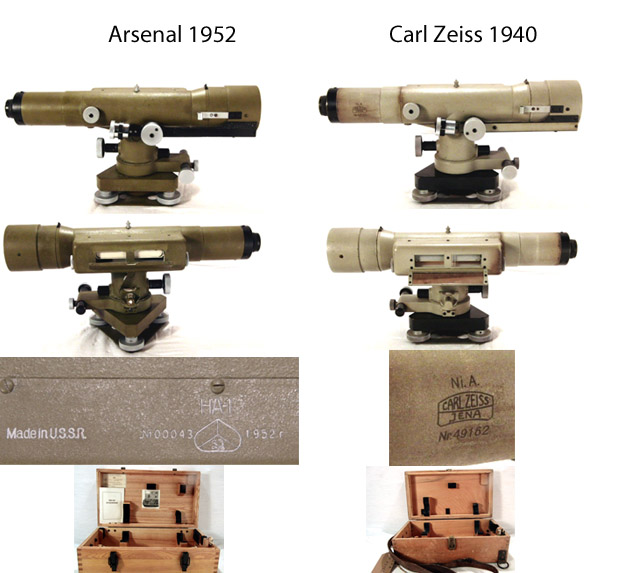
The third model is very rare. It has 44x zoom. Arsenal level is actually Zeiss Ni A from early forties. These both designs are completely identical. Definitely it was produced on the same equipment.


http://www.ussrphoto.com/UserContent/1492015_type 3.jpg

I acknowledge the site http://www.bau-popp.de/ for pictures and information on Zeiss levels.

Another interesting creature of Arsenal factory is the Arsenal kippregel. In the newspaper from 1945 was mentioned that Arsenal planed to start its production. This device is also extremely hard to spot and it looks fantastic. Actually its design was very obsolete for 1945 -1948 and comes most probably from the end of XIX century! I have found many similarities of Arsenal kippregel with Kern kippregel.


http://www.ussrphoto.com/UserContent/1492015_kippregel.jpg

Reply with Quote Edit Reply Delete Reply
quote:
Originally posted by Vlad

From my "inattentive reading" of past 24 hours I do get the impression that this establishes that the cameras FED-Arsenal truly existed....


Strangely enough, but it seemed to me that everyone (of course: everyone, who are interested in this theme ;) knows this fact...
It was a complicated story, there are a lot of interesting details, some things remains a mystery, but this history is not a secret in generally. (Or may be I am wrong: if I have a knowledge, it is not means that everyone has this knowledge too? :(
Reply with Quote Edit Reply Delete Reply

Wow!
I just come back after a two weeks' absence, and I find this incredible work by altix and alzo. Sure, congratulations are not enough...

No doubt that Fed-Arsenal have existed. And the details which are given lead towards the same conclusion: the remaining parts, tools and plans have been transfered to Kiev, and the Fed-Arsenal cameras can be considered as a training work for Arsenal, just before the "Wega-Kiev".

Two questions, at least (!) remain open.

The variety of these cameras is great. So, very probably, some parts of the original work were not immediately used, and mounted after with Zorki parts. If 150000 cameras a year were planned and we only have half a dozen of them, sure there can be extra parts...

The other question is about the Fed history. By what Krushchev says, I understand that N° 237 (Berdsk?) was unable to reconstruct a production line. But they could have done a mounting work, from the Kharkov parts.

So, we could have a more complex history, where there are three places where Feds can have been made in those years: Kharkov, Berdsk and Kiev. There is too a fourth one which is possible: Krasnogorsk. The Fed 1e are too fine to have been made at Berdsk's. They have the same quality as the Fed-Zorkis. And the Zeiss screw lenses, officially recorded "for Fed", were delivered at KMZ's and mounted on Fed-Zorkis... But it's another story!

Zoom, you say that the existence of Fed-Arsenals is well known? Could you explain, please?

Merci, altix et alzo!
Amitiés. Jacques.


Reply with Quote Edit Reply Delete Reply
quote:
Originally posted by Jacques M.


The other question is about the Fed history. By what Krushchev says, I understand that N° 237 (Berdsk?) was unable to reconstruct a production line. But they could have done a mounting work, from the Kharkov parts.


The plant number 237 is "Kazansky optiko-mekhanichesky zavod" -- KOMZ.
Some additional information (but in Russian) you may find there:
http://www.zenitcamera.com/archive/history/davidov-from-lupe.html (a brief plants' history and an information about numbers)
http://www.zenitcamera.com/archive/misc/gko-docs.html (decrees of the State Defense Committee -- GKO)
http://www.zenitcamera.com/archive/misc/letter-snk-ukssr-13021945-552.html (Khruschev's letter with comments)

quote:
Originally posted by Jacques M.


Zoom, you say that the existence of Fed-Arsenals is well known?


Yes... These cameras have long been known. As I understand, they were considered as fakes. This is not surprising: the market was swamped with forgeries made in Ukraine (plus Poland). However, it is possible that some "made in Arsenal" FEDs are fakes. Unfortunately, this story is interesting to me only as a part of the KMZ's history. The rest I'm not interested... In particular -- this cameras themselves. From the word "absolutely". ;)
Reply with Quote Edit Reply Delete Reply

Thanks for your confirmation about the genuineness of the Fed-Arsenals, Zoom, even if I am a bit surprised by its delay. Since the time we have discussed of these cameras!

About the n° 237, you confirm it was KOMZ plant? (sorry, I cannot read Russian and the translator is not operative).

Amitiés. Jacques.

Reply to Topic

Forum code enabled