USSRPhoto.com

Forums / Collectors and Users Open Forum

Fed Berdsk - Known Examples

231 posts in this thread showing replies 61-80 of 230
Reply with Quote Edit Reply Delete Reply
Hello Christopher,

I'm sorry I have to warn everyone it's just my subjective opinion, this topic of Berdsk cameras bothers me a lot and I've been doing a lot of thinking regarding these cameras and reading about the WWII period in Soviet Union. The more I read about how things were during the war the more I am beginning to think that this camera was manufactured in Kharkov either before and or after the move to Berdsk or both, since it doesn't seem likely during those hard times in extreme shortages of military equipment and ammunition when all the factories retooled to manufacture production for war, the Berdsk factory went through all the trouble to keep making civilian cameras that the war could easily do without... it's just not very probable, almost unrealistic when you have all women and children working 24/7 making tank parts, shells, bomb, grenades, bullets everywhere in USSR, you have all of the sudden FED cameras made..

Your opinions are welcome.

Cheers,
Vlad
Reply with Quote Edit Reply Delete Reply
Hi Vlad,

I agree with you 100%. There is really no indication anywhere that any parts were made at Berdsk, and in my opinion, there was probably the assembly of parts that already existed, brought along from the evacuation at Kharkov.

The mysteries behind undocumented or lost histories concerning the Soviet cameras are intriguing, but collectors do have a tendency not to always understand and put themselves in the place and time and imagine (or learn through reading, etc. as you are doing, Vlad) what was really going on. This was a very hard and tragic time for the Russian people in general.

Very well said, Vlad.

Regards, Bill

Reply with Quote Edit Reply Delete Reply
Thank you Bill for supporting my line of thought, and that's exactly what we can do is recreate the situation to the best of our knowledge but I know that I can't probably even imagine the harsh reality. One other thing I was thinking too that it was probably a very different factory also once it moved to Berdsk since most likely most of the boys (I'm sure girls too) working in the commune were called up to serve in the war, so production of FED was probably mostly taken over by local Berdsk population, losing the camera works expertise in the process.. once again just speculation for discussion's sake..

Also I found an article where one collector claims that BRZ (Berdsk Mechanical Factory) was the factory that accepted FED in Berdsk during evacuation and that 500-1000 FED Berdsk were made there as well as FED-B - a Leica III copy, but the journalist writing the article didn't find any examples of the Berdsk war-time made cameras in the local museum. Here's an auto-translated fragment of the article:

Publisher of the "Wedge" Vadim Komarov collects cameras. An online auction "Molotok" he bought the camera "FED-B", made in the walls of Berdsk radio factory during World War II. Until 1941, the production of cameras has been established at the Kharkov plant, which at the beginning of the war were evacuated to Berdsk. It was believed that the production of cameras stopped. However, Vadim Komarov says that in 1941-1942 the plant produced 800-1000 cameras. According to some reports, beginning in Berdsk produced model "B" - a copy of the camera «Leica III», which adds long-term exposure.

Abbreviation FED means Felix Dzerzhinsky. The first models were produced in 1934. At the end of the 30s produced the so-called second model, it "FED-C" or "commander FED", which was supplied with the lens "FED" 2/50, the shutter speed range has been increased - added shutter speed 1/1000 sec. C 1938 to 1941 produced a modification "FED-B" or "the general's FED", with extended excerpts from 1 sec to 1/1000 sec.

In Berdsk Historical Museum of Art no models were found made in Berdsk during the war. Chief curator of funds Tatiana Ovchinnikov stressed that the special value of the fund collection are "FED" and "press photographer" pre-war years. One of the exhibits found in the garage, took out one berdchaninu inherited. He was there collecting dust forgotten by all. The most surprising is that the camera is a mechanism that allows you to stretch, like a concertina mechanism. Thus conducted focus is activated. "Fotokor-1" was produced from 1930 to 1941. These cameras have become the primary means of shooting by courtesy of the Great Patriotic War.

http://www.kurer-sreda.ru/2012/04/11/64256

Reply with Quote Edit Reply Delete Reply
Another fragment from a different article:

С началом Великой Отечественной войны, летом 1941 года в город Бердск было эвакуировано два завода из Бердянска и Харькова выпускавшие до этого знаменитые фотоаппараты ''ФЭД'' (завод им. Дзержинского) и комплектующие. В Бердске, на базе этих заводов было организовано производство топливных агрегатов для двигателей истребителей
ИЛ-2 и оптических прицелов для танков Т-34 и военных самолетов. В 1946 году завод имени Дзержинского был реэвакуирован, а на базе оставшегося завода, на освободивших-
ся площадях, решением правительством СССР от 10 октября 1946 года был организован радиозавод.

Since the beginning of the Great Patriotic War, in the summer of 1941 in the city Berdsk two factories were evacuated from Berdyansk and Kharkov produced before the famous'' cameras FED'' (Plant. Dzerzhinsky), and accessories. In Berdsk and on the basis of these plants was organized by the production of fuel assemblies for engine fighter
IL-2 and optical sights for T-34 tanks and military aircraft. In 1946, the plant was named after Dzerzhinsky unevacuated, and on the basis of the remaining plant, freed-up areas, the decision by the Government of the USSR on October 10, 1946 was organized into Radio Works.

http://www.proza.ru/2011/01/28/162
Reply with Quote Edit Reply Delete Reply
The way I see it we have absolutely no proof that even a single camera was produced in Berdsk.
This is why I have renamed the corresponding wiki entry to "FED 1e"

I have to agree with Vlad, I am sure there were other priorities than producing cameras back then.

However, as the factory in Berdsk never suffered from war-time damage, the probability that some documents survived should be much higher than in the case of the Kharkov factory. If we could establish a contact to someone from the Berdsk Museum maybe they could have a look at the city archives to see if some documents have survived.

By the way - has anyone ever tried to contact someone from the modern FED-Factory? I don't know how much interest the company has in their own history but it wouldn't be surprising if they do know a lot more than we do.

Chris, I have added the lens numbers of your cameras to the wiki, I hope you don't mind.

Regards,
Christian

Reply with Quote Edit Reply Delete Reply
Hello all

Pages 379 and 380 in the 1200 Cameras book refer to this topic, with some specific time frames and numbers quoted, so I assume that the authors should be able to provide some references.

I cannot trust my google-translated pages to be correct, so would be interested to hear others' thoughts on this data.

Cheers
Geoff
Reply with Quote Edit Reply Delete Reply
Thanks Geoff for the reference, I looked up those paragraphs and here's that Suglob/Kochergin/Shaternik say on this topic (summarizing): From February to October 1942 the assembly of cameras continues in Berdsk. Supposedly Berdsk cameras started somewhere after No. 165xxx until 173xxx in quantities of 8000 units. In 1943 the kombinat moved under NKAP-SSSP (People's Commissariat of Aviation Manufacture) umbrella raher than NKVD-SSSR and was renamed into "Zavod"(factory), and cameras made from 1946 in Berdsk had engraving "...Zavod of F.E.Dzerzhinsky".

Cheers,
Vlad
Reply with Quote Edit Reply Delete Reply
Also an interesting classification extract from 1200 Cameras book - FED NKAP (Red Flag) is technically FED-1f and not the encircled FED logo one, because it's the next one in the line that was released after the "Berdsk" when factory returned to Kharkov and made 1800 red flags..

Cheers,
Vlad
Reply with Quote Edit Reply Delete Reply
Nice!
Too bad we can't see what type of FED1 is shown in the photo.

As for the comments in the "1200 Cameras" book, this would mean that the cameras produced at Berdsk would actually have been late FED"d" CCCP-NKVD and all FED 1 "e" were produced after the war.
I am confused...
Are there any references cited?

Also I'd like to point out that I am now the owner of the FED"e" #180024 with the corresponding documents. If there is any information I can provide just let me know.

Regards,
Christian
Reply with Quote Edit Reply Delete Reply
Nice photo David. I think it may read "Assembly of the first postwar cameras, FED" and so not exactly meaning that it is a photo of the 'assembling' of the cameras, but that it is a photo of the first group of postwar cameras. But, no doubt at Berdsk, if the caption is correct. These guys don't look like the people who do the assembly work, but more like the bosses or executives at the factory who are showing a group of their first post-war production. I suspect that Vlad is correct and that although the manufactured parts were evacuated from Kharkov to Berdsk early in the war, they probably sat around through most of the war, and then camera production (from the Kharkov-made parts) was started again after the war, and the first cameras made were at Berdsk where the parts were located. so, they had the pre-war FED-1e logo on them since that is how the rangefinder housings were engraved while still in Kharkov in the early 1940's.

They look quite pleased to have FED cameras being produced again, no doubt a difficult task as many of the skilled assemblers before the war, had been killed or otherwise not able to work for FED from the results of the war.

Regards, Bill

Reply with Quote Edit Reply Delete Reply
quote:
Originally posted by Niko80

There is currently a late FED1-e camera #182948 on ebay which also has 5 screws.
http://www.ebay.at/itm/FED-NKVD-Type-1e-BERDSK-Rare-Russian-35mm-Rangefinder-Camera-182948-/360706589152?pt=US_Vintage_Cameras&hash=item53fbc9c1e0

Another one, #176596 seems to have only 3 screws but it's a little hard to see.
http://www.ebay.at/itm/USSR-Soviet-Collectible-FED-1-Berdsk-35mm-RF-camera-with-FED-3-5-50-lens-EXC-/390554007760?pt=Film_Cameras&hash=item5aeed538d0


Unbelievable, it seems that both cams got the vulcanite fresh painted and both are still on ebay. Nothing to wonder about, no collector wants those painted ones.

Then you have to think about how they paint them. Some old paint might not tolerate new paint. Even the old vulcanite might not tolerate some new paint. They are simply different chemicals and will react by time.
Destroying those wonderful cams.
Reply with Quote Edit Reply Delete Reply
I have not opened the forum since some days, and all is running away!

So, just some "technical" ideas: it really seems to me that the separation due to the war passes between 1e-s and NKAP.

There is no distinction between the second series of 1d-s and 1e-s: all is the same, including the quality of construction.

NKAP-s show some differences, for what we know: generally poor quality of chrome, stretched vulcanite, 1a or 1b buttons, yellow pale/yellow rangefinder, 1d belt and 1c/1d brass shutter box... As if Fed had been obliged to make a series whereas it had not the convenient parts. It makes me think of remaining parts in boards which are assembled in urgency...

The metallurgy of the cover is not always the same. Some have neat angles (like on the 1d or 1e), others are blunt. And many have traces of a vice (probably to hold it when engraving). So, a variability which does not help to know the genuineness... Mine looks genuine, but two letters are not engraved on the cover...

The first 1f are in the continuity of these NKAP-s concerning the general poor quality and the special vulcanite, for example. And as they are very rare, one can wonder if all the series was really made... As for the brass shutter box, we find it up to the s/n around 225000(the aluminium ones were the rule between c. 115000/183000: no shortage of aluminium before the war).

I don't know Soviet history enough to go farther. The logic would be that all the 1e were made before the war, and NKAP after. Or the last part of 1e mounted at KMZ's as training before the official production: surely impossible, even if the comparison between a 1948 Fed-Zorki and a 1e is astonishing: they look like twins...

Anyway, happy of the new turn for this topic!

Amitiés. Jacques.


Reply with Quote Edit Reply Delete Reply
quote:
Originally posted by James McGee

As far as I can gather some Berdsk's have only three visible screws in the baseplate, and other Fed Berdsk's have five visible screws. The three visible screws applies only to the Fed Berdsk, and no other Fed-1, so if only three screws are visible, and other parameters are correct then I believe that the camera is without doubt a Berdsk.


The bottom plate is the easiest thing to change on a camera.
Fotoua.com has the Zorki-1 with simplified bottom plate (plate with 3 screws) listed around s/n #51000, but there are many many other Zorkis far behind #51000 with 5 instead 3 screws.
If you call a Fed with 3 screws "Berdsk", I call them "Zorki".
Reply with Quote Edit Reply Delete Reply

In the JLP, it is said that the NKAP s/n 201280 was delivered with a passport printed at Berdsk, signed the 19 of august 1946...
Would it be impossible that the NKAP were in fact the real Berdsk? It's only an idea, probably crazy...

Jacques.
Reply with Quote Edit Reply Delete Reply
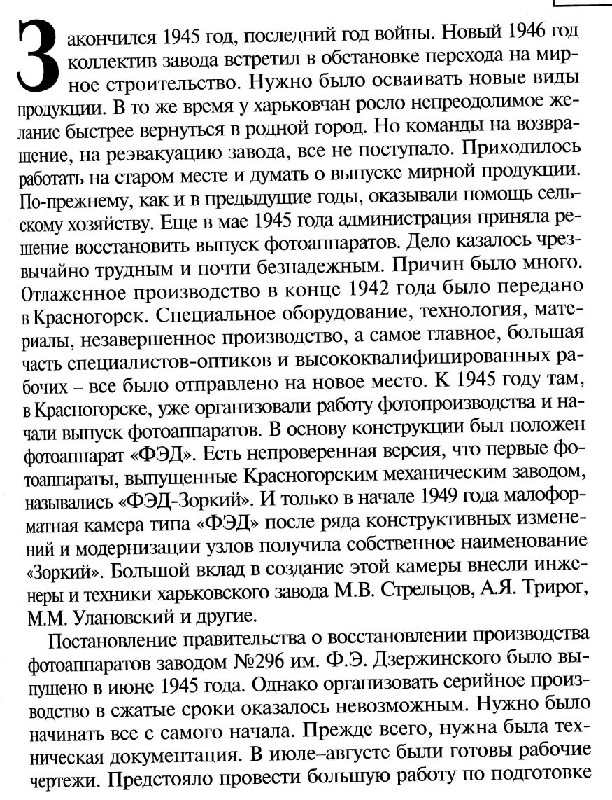
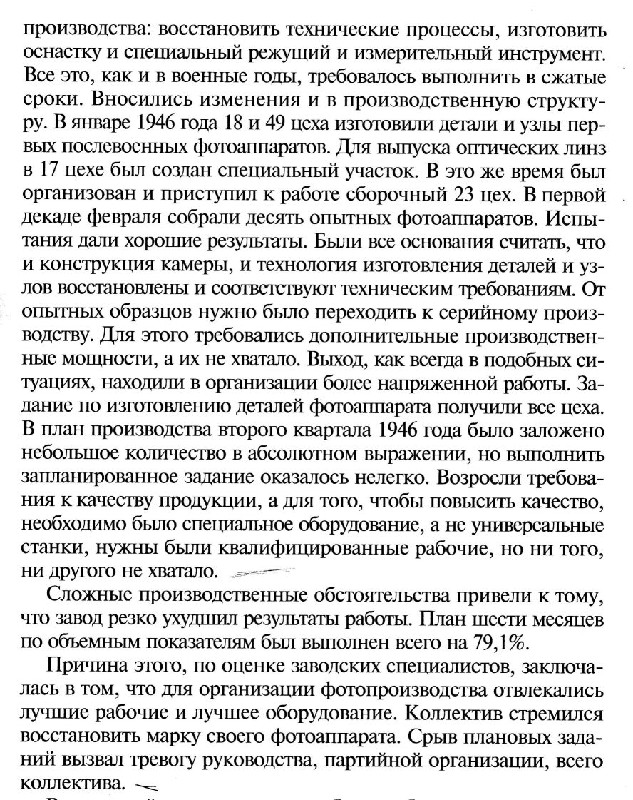
Having found the photograph above, I thought it might be a good idea to try and translate the accompanying pages. It is taking quite some time, using Google translate, but here is the first part:

'Back in May 1945 the administration decided to restore the production of cameras. The case seemed extremely difficult and almost hopeless. There were many reasons. 'Debugged' production was transferred to Krasnogorsk in late 1942. Special equipment, technology, materials, work in progress and most importantly, most of the optical experts and highly skilled workers were sent to the new location. By 1945, in Krasnogorsk, they had already organised work and started production of cameras. The design of the cameras was as the FED. The anecdotal version of the fist KMZ camera was called FED-Zorki. It was only in 1949, after a number of design changes and modernisation that the small format camera, FED, got its own name, Zorki. A large contribution of the creation of the camera came from the engineers and technicians of the Kharkov plant, M V Strelitsov, A R Trirog, M W Ulanovski and others. Government decision on restoring camera production at plant No. 296 FED was issued in June 1945. However, to organise production in a short time was not possible. We had to start from scratch. Firstly, we needed technical documentation. In July and August drawings were ready. We had to spend a lot of work on pre-production: restore the technical processes to produce tooling and special cutting and measuring instruments. All this, as well as being in the war years was required in a short time. Changes were made in the production structure. In January 1946 workshops 18 and 49 fabricated parts and assemblies of the first post-war camera. For the production of optical lenses there was a special section in workshop 17. At the same time, workshop 23 started to work as an assembly plant. In the fist ten days of February they completed ten cameras. Tests showed good results. We had every reason to believe that the design and fabrication of parts and components met our technical requirements. From the prototypes we went on to serial production. This required additional production capacity and there was not enough. Output as always I such situations required more hard work. The task of making the camera parts got under way. In the production plan of the second quarter of 1946 a small quantity was scheduled, but the task was not easy. To increase quality requirements special equipment, not standard machines, were needed and also skilled workers were required.'


Maybe this poses rather more questions than it answers. When I get the time, I will translate a little more.

David.
Reply with Quote Edit Reply Delete Reply
Many thanks, David, for the photo and for the translation!

If I understand well, Fed equipment and technology were transferred to Krasnogorsk in 1942. Till now, that fact had not been said clearly. Or I did not know... Anyway, to find identical shutter boxes on Fed 1d/e and 1948 Fed-Zorki is not a hazard...

Really interested too by what is said to resume the production (at Fed-Kharkov, I suppose?) and by the dates. They did not say which cameras were made first, alas... Do we have a way to find that?

Jacques.
Reply with Quote Edit Reply Delete Reply
David, thank you for the translation, if you don't mind please post the original Russian text as well, very often Google translates different language nuances differently which can mean something opposite. Thanks again,

Vlad.

Reply to Topic

Forum code enabled