04/27/2010 21:50
Vlad,
Thank you for relaying the letter from Milos Mladek. We know each other well and I always respect his ideas and opinions to the very highest degree! And, also the letter from Larry Gubas who is very knowedgable about the history of Zeiss. The TSVVS is a fascinating subject and although in some ways the mystery of its unknown origin is appealing to me, I would also be so happy to know the answer for sure!
I don't have any definitive answers to the origin of the TSVVS and my own speculations are only created by observations of the two examples I have in my collection, the photos I have seen on the internet of other examples, and my general knowledge of Soviet cameras and German cameras. Any ideas that I have are really questions since there has been no actual documents about the camera that I have seen or heard of and I don't believe anyone so far has proven where the origin actually was.
I agree with Milos that the story of Yuri Davidenko, with the origin placed at the Almaz factory, sounds good and is possible. But we have also just heard another story from a source that Alexey Nitikin that also sounds true and has some rather convincing details:
"The owner had told him that when he was still a boy, his family lived in Germany and his father was an army man in Soviet army in the division that was stationed in Germany. His father had made a deal with some other ensign about buying an illegal camera TSVVS from warehouse there. And the camera No756 was bought in Germany for 15 soviet rubles in some military base. From the conversation Alexey understood that from that warehouse you could buy more than one TSVVS camera. The owner said the camera didn't take really good pictures, later his Zenit was better. "
Of course 60 years has gone by and recollections, whether from a former worker at the Almaz factory or from the son of a Soviet soldier stationed in Germany, can be wrong in the details and actual facts, however the story from the Soviet soldiers son is direct and a TSVVS was on hand during the relaying of the story. When I reviewed the Alamz story (many times over the past few years, since published) I actually found little to back up any of the story and remember feeling that maybe either the whole story was not told by Yuriy, who I believe is telling it to his son to translate, or the story is mixed up in some way by the person who worked at Almaz and told it to them.
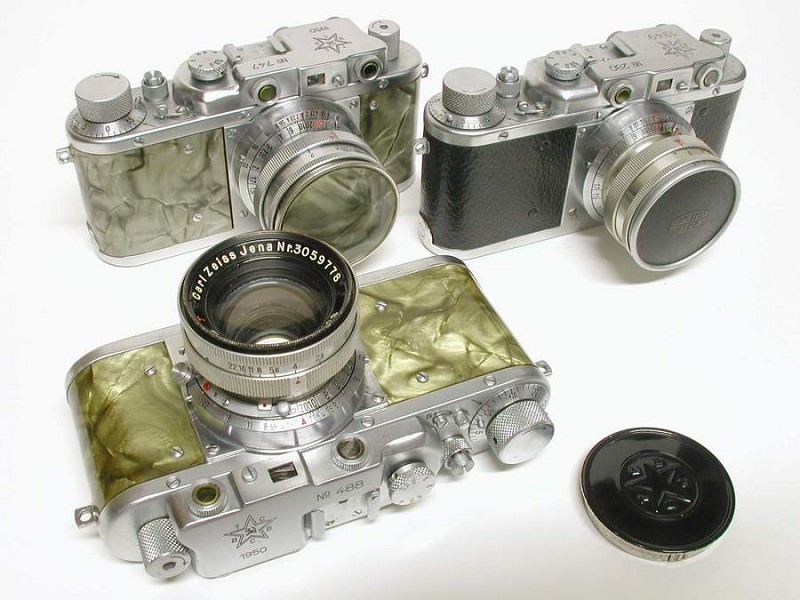
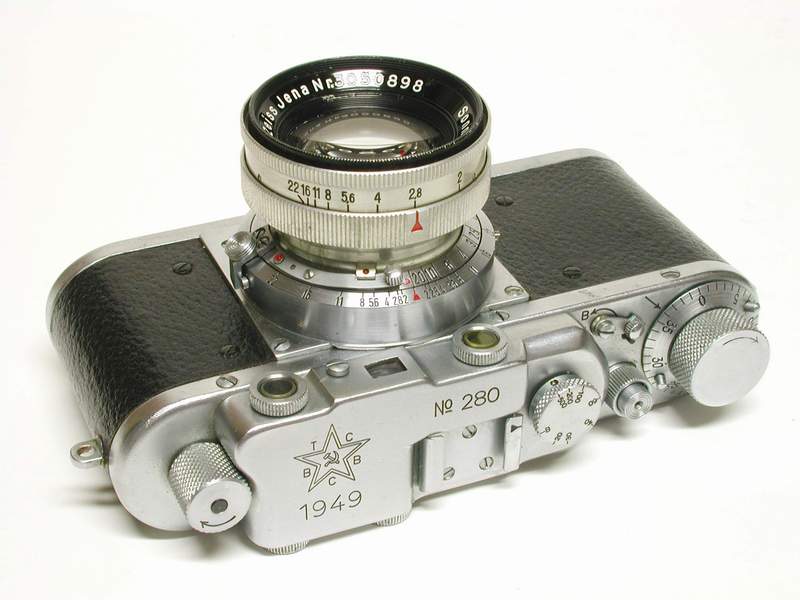
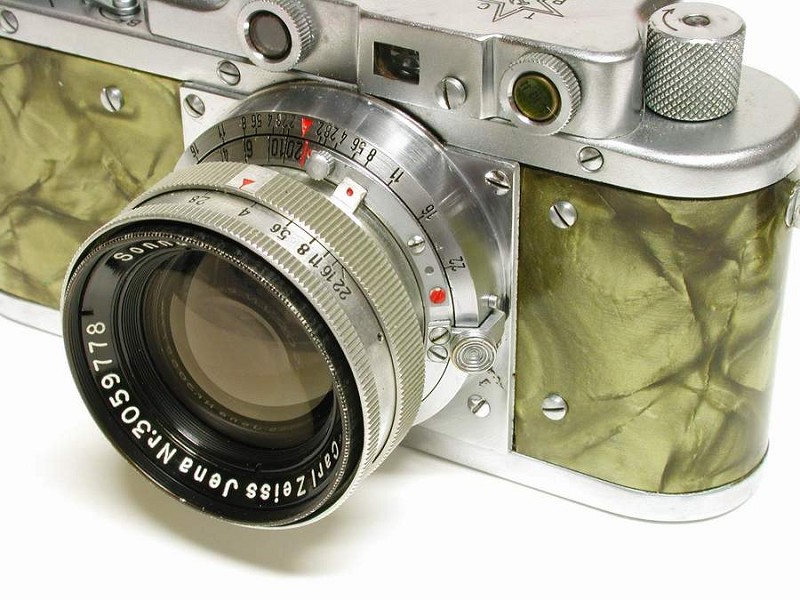
As well, I have often felt that the materials used were not so Soviet. For example we can see the unusual gray and green vinyl or plastic covering that some of these cameras had with the beautiful abstract designs in the photos of Milos' cameras. To me, I don't believe it is a Soviet or Russian material. Also, the type of leather used seems different than Soviet leathers that I have seen. To me, both of these coverings are more European and their identification and origin may be a key fact in identifying the origin of the camera itself.
I also agree with Milos that the camera was probably not made at Zeiss Jena, pretty much for all the reason he stated ... the Zeiss history experts and collectors have not found anything about it and also why would they change the mount so much when they already had Contax mounts or at least were prepared to make them (possibly).
As unlikely that it might be that a distantly related German (to Zeiss) factory would redesign the Contax mount which would no doubt be available to them to replicate, it seems that also it is unlikely that a Soviet factory would not have the same Contax mount to copy since they were making KIEV II cameras at Arsenal since 1947 and also must have had many captured examples of the Contax since 1945. Whoever made the camera, German, Soviet, or elsewhere knew that they would be using Zeiss lenses with Contax mount. So why is the mount different ... because the front of the camera is different, especially the top plate.
Also, if made in the Soviet Union, why is the body of the TSVVS different in length than FED body? The TSVVS is several millimeters longer than a FED and the Fed bottom plate will not fit a TSVVS. Seems like the Soviets would have used the measurements of a FED ... but maybe in Germany it was not thought of to find a FED to copy exactly.
One question that I have, and which would probably be helpful to know the answer, is: Do the serial numbers (on the whole) of the Zeiss lenses match up to the serial numbers on the early KIEV cameras. In other words, is it possible to make a correlation between the lenses on the TSVVS cameras and prove by these numbers that they come from the groups of lenses which are known to have been transported to the Soviet Union from Germany? To me that would be some very convincing proof that TSVVS was made in the USSR and also give more weight to the Almaz theory.
But I'm quite sure that there were places in East Germany (or the Russian Zone) during the late 1940s until 1950 that didn't have access to the manufactured screws. Remember, much German industry was destroyed by bombing and war, and no doubt things like miniature screws were hard to get and in demand for other things as well. Maybe some small workshop or factory would not have those perfect screws if a commission from
the Soviet Military was made.
So, do the lenses match the groups that were brought into the USSR after the war? And where is the origin country of that really cool vinyl green and gray covering that Milos' cameras have? Those are my questions before I make a bet too!
Regards, Bill